Digits Adds Multi-Entity Support to AI-Native Accounting Platform
Digits now lets firms and founders run every legal entity under one login and one bill, with extra entities at $35 a month after 250 free transactions.
Digits, the AI-native accounting platform, launched Digits Multi-Entity on October 27, 2026, letting businesses and accounting firms run every legal entity under one organisation with one login, one subscription and one bill.
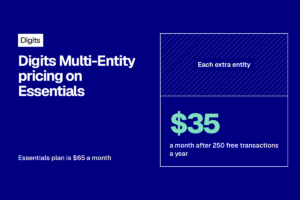
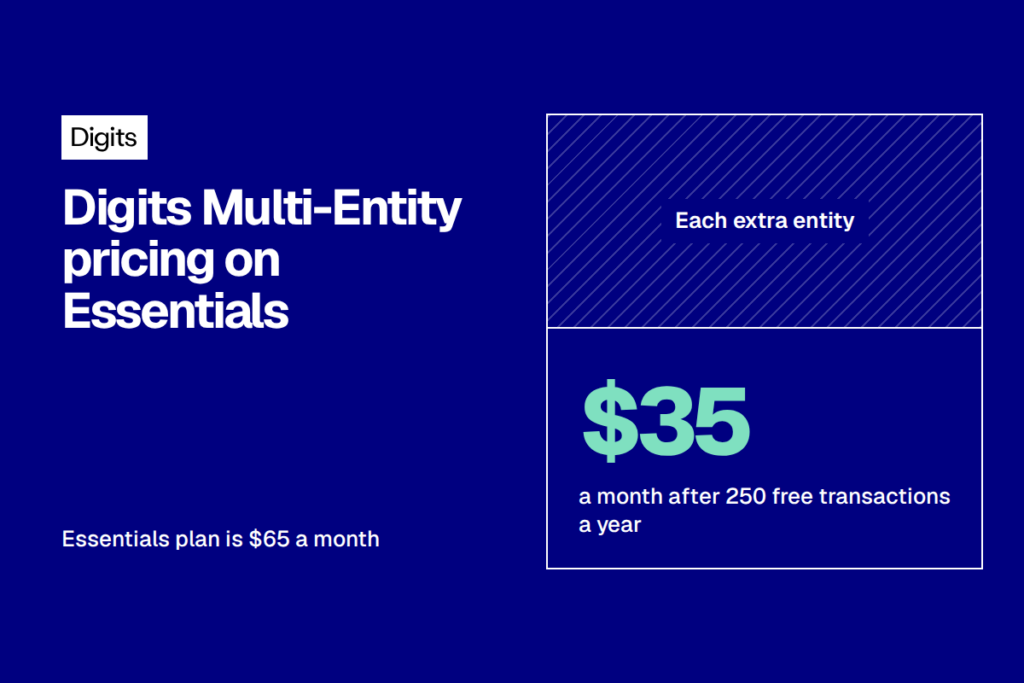
The release is Digits’ answer to a limit that has pushed growing clients off entry-level ledgers: the point where a second or third company arrives. Each additional entity on the Essentials plan is free for its first 250 transactions a year, then costs $35 a month, according to Digits. For firms pricing multi-entity accounting software, that is a flat per-entity charge rather than a separate subscription for each company.
Digits lists Essentials at $65 a month, Core at $100 and Pro at $250, with Pro marked as coming soon. Its pricing page says multi-entity is included on all plans. Digits is currently available only to US-based entities, which limits the launch for UK and EU readers.
ERP and General Ledger in the Accountio directory
92 ERP and General Ledger toolsEvery company in the category, with features, pricing and marketsCompare all →Article Sponsor · your logo, one line and a link inside every article
What the multi-entity accounting software does
Every entity keeps its own ledger, transactions, close and tax identity. Users switch between entities without switching accounts.
A client that operates through several entities appears as one grouped client on the firm dashboard, and firms can add entities to a client directly. Each transaction in each entity is categorised and reconciled continuously through Digits’ Automated General Ledger.
“A legal entity is a structure a founder chooses. It isn’t the business itself,” said Jeff Seibert, founder and chief executive of Digits. “Adding entities is one of the most common reasons businesses outgrow small business accounting software, because those tools only understand the structure.”
Digits names the structures it targets: real estate operators with a limited liability company for each property, holdco and opco setups, special purpose vehicles, family offices, and finance teams that want per-entity reconciliation.
Consolidation runs through Reach Reporting
Digits does not consolidate inside its own ledger. Users connect their entities to Reach Reporting for consolidated financial statements, dashboards, budgets and forecasts, with drill-down from group results to any single entity.
Digits said it is working with Reach to make it simpler to connect a whole multi-entity organisation at once. The announcement does not say whether intercompany eliminations are handled in Reach or left to the preparer, and it does not describe entity-level permissions or separate charts of accounts. Firms with complex groups should test those points in the 30-day free trial before moving a client.
That gap matters for the buyer. Multi-entity accounting software built for group reporting normally posts and eliminates intercompany balances automatically, and a stack that splits ledger from consolidation moves that work to a second tool and a second bill.
How it compares with established tools
Digits is entering a field where the incumbents sell depth. Sage Intacct and NetSuite are built around multi-entity structures, with consolidation in the product. Accountio’s comparison of NetSuite and Sage Intacct sets out how the two differ for groups, and its list of Sage Intacct alternatives covers the wider field.
At the other end, QuickBooks and Xero serve the small-business tier Digits is targeting. Accountio’s Digits and QuickBooks and Digits and Xero comparisons cover the single-entity case. Pricing for multi-entity features at QuickBooks Online Advanced, Xero, Sage Intacct and NetSuite varies by plan and is not part of Digits’ announcement.
Digits is positioning itself between those tiers. It offers separate books per entity and a flat $35 add-on, but not the native consolidation that a controller at a larger group would expect from an ERP.
Write MCP and the wider product push
The release follows Digits’ announcement of Write MCP, an update to its free MCP server that lets customers’ own AI agents make changes in the general ledger, not just read from it. Write MCP is built on Locked Periods, so agents can do accounting work while books a firm has already closed stay protected.
Together the two releases point at the model behind an AI-native accounting firm: continuous categorisation in every entity, agents working on the ledger, and a single client record for the partner. Digits has not named customers using Multi-Entity, and it has not published usage figures for the product.
What multi-entity accounting software needs to prove
The announcement does not include comment from a firm partner or multi-entity controller on whether the product solves real problems, so the claim that it fixes the outgrowing problem rests on Digits’ own account.
Firms should check three things before they move clients. First, whether a per-entity charge beyond 250 transactions a year stays below what they pay now for separate subscriptions. Second, whether staff can be limited to named entities. Third, whether each entity can hold its own chart of accounts when a group needs different structures.
The close is the other test. Digits says each entity keeps its own close, which suits compliance, but group reporting still depends on the Reach connection being current at month end. Firms weighing the wider field can start with Accountio’s guide to financial consolidation software.
The next thing to watch is Digits’ work with Reach to connect whole organisations in one step. Until it ships, firms adding entities will connect them to the consolidation tool one at a time.
Accountio.
The go-to weekly newsletter for accounting professionals. Trusted by 10,000+ industry leaders to deliver the tech trends and insights that matter most. Join them today.
Companies in this article
DigitsERP and General LedgerView listing →Reach ReportingFP&A and ForecastingView listing →Sage IntacctERP and General LedgerView listing →NetSuiteERP and General LedgerView listing →XeroBookkeepingView listing →Compare ERP and General Ledger software
NetSuite vs RilletSide by side: features, pricing and who each suitsCompare →NetSuite vs Sage IntacctSide by side: features, pricing and who each suitsCompare →Odoo vs XeroSide by side: features, pricing and who each suitsCompare →Microsoft Dynamics 365 Business Central alternativesOther ERP and General Ledger tools to shortlistSee list →NetSuiteCompany profile: what it does, funding and customersProfile →OdooCompany profile: what it does, funding and customersProfile →All ERP and General Ledger softwareEvery company in the directory categoryDirectory →