Vertex Unveils AI-Powered Vertex Sōl Across the Tax Lifecycle
Vertex Inc. launched Vertex Sōl on October 26, linking tax determination, e-invoicing, filing and audit defence in one record per transaction.
Vertex Inc. (NASDAQ: VERX) launched Vertex Sōl on October 26, a tax compliance system that keeps one governed record of each transaction from tax determination through e-invoicing to audit defence.
The company said Vertex Sōl brings intelligence, workflows, decisions and evidence together for tax compliance across the lifecycle. Its customer base includes more than 60% of the Fortune 500, so the way Vertex packages AI and record-keeping affects a large share of the world’s biggest indirect tax functions.
For tax directors the question is practical. Vertex Sōl tax compliance is built to show what an AI recommendation was based on, who approved it and what evidence sits behind it, which is the test an auditor applies. Vertex did not publish pricing or a general availability date with the announcement.
Tax and Compliance in the Accountio directory
122 Tax and Compliance toolsEvery company in the category, with features, pricing and marketsCompare all →Article Sponsor · your logo, one line and a link inside every article
What Vertex Sōl tax compliance covers
Vertex describes the transaction as the atomic unit of commerce. Vertex Sōl ties tax and compliance to each one, creating a single continuous record rather than separate files for calculation, filing and audit.
The system covers six areas: tax determination, certificate management, e-invoicing, indirect tax close, reporting and filing, and audit and notice management. Vertex Intelligence, the company’s AI layer, supplies tax expertise, global regulatory intelligence, explanations and recommendations inside the workflow.
The name comes from the Latin for sun. Vertex positions the product as the point where tax teams govern their work through one system of control, from decision to defence.
Vertex said the product is meant to help tax teams see potential issues sooner and understand their impact, while people stay in charge of what happens next. Bala Chandran, chief product and technology officer at Vertex, said tax professionals can “command the outcome instead of the manual work around it.”
Three moments Vertex Sōl tax compliance is built for
Vertex framed the launch around three situations. The first is a rule change, where Vertex Sōl assesses which tax compliance policies, configurations and transactions are affected so a professional can review the impact.
The second is before filing, when it surfaces issues that would otherwise appear only after a return is submitted. The third is an auditor’s call, when Vertex Sōl gathers a notice, the relevant records and the supporting evidence, and shows where gaps remain.
These map to the points where indirect tax teams lose the most time. A VAT or sales tax rate change, a rejected e-invoice and a notice from a state revenue department each send staff back through transactions by hand.
How AI trust levels work in Vertex Sōl tax compliance
Vertex built the AI around what it calls graduated trust. A team chooses whether the AI recommends an action, assists with the work or acts within controls the team sets.
At each level, users can review, override or reverse actions and see how a decision was made. That design answers a worry that has slowed AI adoption in finance. A Datarails survey found 75% of finance leaders cite auditability as the top obstacle to trust in AI.
Vertex commissioned its own research on the point. Emerald Research Group surveyed 402 tax and compliance software decision makers in the US and Germany, and 81% said they would adopt AI in compliance only with full visibility into automated decisions and the ability to override or reverse any action.
Christopher Young, chief executive of Vertex, put the commercial case in one line.
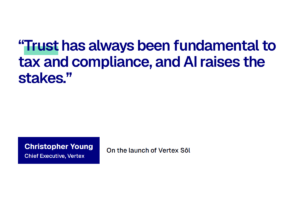
“Trust has always been fundamental to tax and compliance, and AI raises the stakes.” Christopher Young, Chief Executive, Vertex
Vertex Sōl tax compliance rests on that principle: the AI proposes, the tax team holds the authority over consequential decisions.
Testing the evidence and audit trail claims
The record is the part of the launch that matters most to a controller or tax director. An audit trail is only useful if it is complete, time-stamped and tied to the transaction it supports.
Vertex says Vertex Sōl carries tax compliance context, actions, approvals and available evidence forward from determination to defence. Its product page says capabilities, availability and scope may vary, and describes product direction as illustrative and subject to change. The same page says Vertex is building toward the connected record, so buyers should expect the full chain to arrive in stages.
Kevin Permenter, senior director of enterprise applications research at IDC, said enterprises will judge vendors on “whether each action can be governed, explained, and traced back to the original decision.” That is a standard for the buyer to write into an evaluation, not a feature the launch alone proves.
Finance teams assessing the product should ask four things. Which evidence is captured automatically, and which must be uploaded? How long is it retained? Can an auditor export it without Vertex staff? And does the record cover transactions that pass through third-party systems?
Where the Vertex Sōl launch fits in the market
Vertex describes Vertex Sōl as a tax compliance system built on a customer’s existing Vertex foundation. The company sells ERP-connected products including Vertex for SAP and Vertex for Oracle, and lists partner ecosystems around SAP, Oracle and Microsoft. It has not tied specific Sōl connectors to those ERPs in its launch material.
Vertex expanded its e-invoicing business in August 2024 with the acquisition of ecosio, an Austrian EDI and e-invoicing provider. Vertex Sōl is the first launch to place that capability in the same tax compliance record as determination and filing.
The competition is crowded. Avalara, Sovos and Thomson Reuters all sell indirect tax engines and e-invoicing, and Thomson Reuters has released a new CoCounsel for tax and accounting. Each is adding AI assistance to its own products.
Vertex is competing on governance rather than on the calculation. Rate accuracy and jurisdiction coverage are close to table stakes among the large vendors, so the argument is shifting to who can show a defensible record. Buyers comparing options can start with Accountio’s guide to the best indirect tax software.
What tax teams should do next
Teams already on Vertex should ask their account manager which Vertex Sōl tax compliance capabilities are live for their ERP and which are on the roadmap. Teams on other platforms have no need to move yet, but should ask their own vendors the same questions about evidence and override rights.
The regulatory backdrop raises the stakes. E-invoicing mandates across the EU and the pending VAT in the Digital Age rules mean transaction data is increasingly reported to tax authorities in near real time, a shift covered in Tax Technology: What MTD, ViDA and Wayfair Mean for Finance Teams. A record that links the invoice, the tax decision and the filing becomes more valuable as that reporting speeds up.
Readiness inside the team matters as much as the software. Accountio has reported that AI indirect tax compliance tools are accelerating, but most tax teams are not ready to use them.
The next test is how many Vertex customers have Vertex Sōl running in production, and how the tax compliance record holds up the first time an auditor asks for it.
Accountio.
The go-to weekly newsletter for accounting professionals. Trusted by 10,000+ industry leaders to deliver the tech trends and insights that matter most. Join them today.
Companies in this article
VertexTax and ComplianceView listing →DatarailsFP&A and ForecastingView listing →SAPERP and General LedgerView listing →AvalaraTax and ComplianceView listing →SovosTax and ComplianceView listing →Compare Tax and Compliance software
Kintsugi vs NumeralSide by side: features, pricing and who each suitsCompare →Numeral vs ZampSide by side: features, pricing and who each suitsCompare →Anrok vs AvalaraSide by side: features, pricing and who each suitsCompare →Avalara alternativesOther Tax and Compliance tools to shortlistSee list →NumeralCompany profile: what it does, funding and customersProfile →SphereCompany profile: what it does, funding and customersProfile →All Tax and Compliance softwareEvery company in the directory categoryDirectory →