HMRC Issues Agent Toolkit as MTD Covers Incomes Over £50,000
HMRC’s updated toolkit gives agents a segmentation exercise, webinars and sign-up steps, but no templates, pricing guidance or software list.
HMRC updated its toolkit for MTD for income tax agents on November 12, 2026, seven months into the phase covering sole traders and landlords with qualifying income above £50,000.
The toolkit is a set of six GOV.UK pages, first published on January 28, 2026. It is the department’s main attempt to tell tax agents how to plan their client lists, set up their practices and sign clients up for MTD for Income Tax.
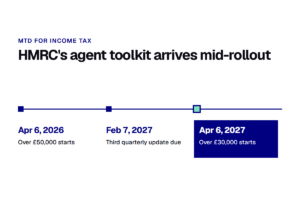
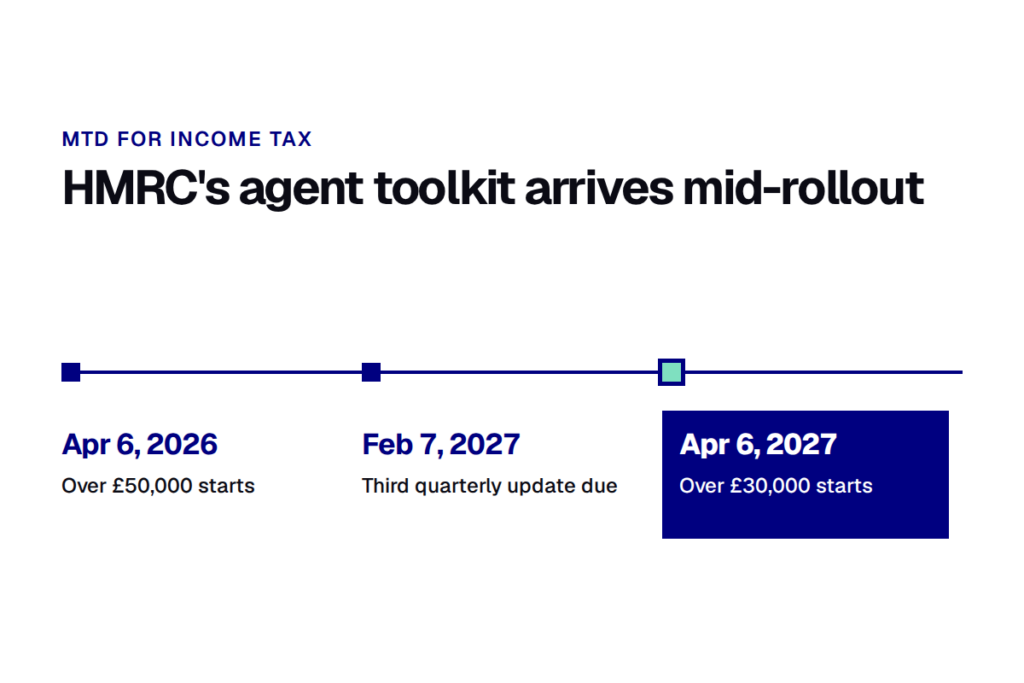
The timing matters. The second quarterly update deadline of the 2026 to 2027 tax year passed on November 7, the third falls on February 7, 2027, and the threshold drops to £30,000 on April 6, 2027. Every agent with clients in that second wave has about five months to sort them.
Accountio.The go-to weekly newsletter, straight to your inbox.Weekly newsletter, straight to your inbox.
What the MTD for income tax agents toolkit contains
The toolkit has five working sections and a resources page. HMRC’s landing page lists them as understanding the rules, planning, preparing the practice, preparing clients and “what agents are saying”.
The planning section is the most practical. It sets out a client segmentation exercise that asks agents to check four things for each client: whether they meet the income threshold, whether they are exempt, how many income sources they have and whether another agent acts for them.
It names the boxes to add up from the 2024 to 2025 return to find qualifying income, including SA103F boxes 15 and 16, SA105 boxes 5, 20, 22 and 23, and SA106 box 14. It also includes a process flow chart in SVG format, the only downloadable file in the toolkit.
A digital capability table sorts clients into five groups, from those already using MTD for VAT to those with no internet access, who may qualify for digital exclusion.
The practice section describes four service models: digital record keeping, preparing and sending updates, reviewing a client’s updates before handling the return, and handling only the return. It tells firms to appoint one or two MTD “champions” and covers the difference between main agents, who see everything, and supporting agents, who can only prepare quarterly updates for sole trader and property businesses.
On authorisation, firms need one agent services account, and clients already authorised through Online Services for Agents do not need fresh authorisations. Software connections must be renewed every 18 months. Agents wanting more detail on the account step can use Accountio’s guide to registering for MTD as an agent.
The client section lists topics to raise before sign-up: software, record frequency, business bank accounts and forwarding HMRC letters, which HMRC does not copy to agents. It says plainly that “HMRC will not be signing up clients”, so the agent or the taxpayer must do it.
Support HMRC offers agents on MTD for Income Tax
The resources page points to live and recorded webinars, a YouTube playlist on setting up an account, adding authorisations and signing up clients, and a monthly Agent Update newsletter. HMRC’s Agent Engagement team also runs interactive group sessions on Microsoft Teams, with registration through an online form.
The page links four customer letters for agents’ awareness: a preparation letter sent from November 2025, a September 2026 sign-up letter, an October 2026 reminder for clients who missed the first quarterly deadline, and a November 2026 letter on checking Self Assessment bills. Agents do not receive copies.
HMRC has also released campaign copy for newsletters and social media. Eight firms are quoted in the toolkit, among them Brighton Tax, COS Bookkeeping, and Tax and Financial Solutions Limited.
Where the toolkit leaves agents on their own
Measured against the problems agents face, the toolkit covers the process and leaves out the commercial questions.
It contains no fee guidance. Pricing appears only as an item for firms to consider. It names no software products and refers agents to HMRC’s compatible software finder. It carries no client letter templates, and says example engagement letters are available from professional bodies without linking to any.
Firms looking for ready-made documents have to go elsewhere. Accountio’s MTD for Income Tax pack includes an MTD client letter, and the HMRC agent authorisation template covers the permission step.
The quarterly workload is the other gap. The toolkit says updates are quick if records are current, and suggests clients may need to send records more often than quarterly. It does not say how much extra time a firm should budget per client.
HMRC has softened the penalty exposure for now. The department said there are no penalty points for missed quarterly updates in 2026 to 2027. From 2027 to 2028 each missed deadline earns a point, and four points bring a £200 penalty, according to HMRC’s penalties guidance.
What practitioner bodies say about MTD for income tax agents
None of the four bodies has published a formal response to the November update. Their earlier guidance does address the gaps.
The AAT’s Comment site tells practices to “consider offering fixed monthly fees that bundle quarterly submissions and software use”, with tiers by client complexity. It advises firms to reduce the range of software they support and warns that calendar quarters still leave deadlines “within five days of each other”.
ACCA tells agents to update engagement letters, confirm that their agent services account is linked correctly and encourage real-time record keeping. It flags February as the tightest point in the cycle, because the update falls soon after the January 31 Self Assessment deadline. It also says nil quarterly returns should not be filed where transactions exist.
ICAEW has focused on HMRC’s own services. Frank Haskew, tax director at ICAEW, said in July that the digital services available to advisers still lag behind those for taxpayers.
“HMRC’s work to address the key pain points is an important short-term solution, but it is disappointing that in the last year agents have seen little in the way of positive change,” said Frank Haskew, Tax Director, ICAEW.
Lindsey Wicks, senior tax technical manager at ICAEW, said before the first deadline that “it does feel like the calm before the storm at the moment”. She said agents worried about disruption to client service, including lockouts from agent accounts after changes to registration and multi-factor authentication.
What practising agents report on MTD for income tax
The agents quoted in HMRC’s toolkit are broadly positive, and all were chosen by HMRC. Karen Garrattley of COS Bookkeeping said she and her practice had been preparing “for over 12 months” and advised firms to “look into appropriate software choices for your clients. Not one solution fits all.”
Anita de Louvois of Tax and Financial Solutions Limited said “the most time-consuming aspect was designing my internal processes.” Fozia Muddassir of Reddy Siddiqui LLP told peers to identify affected clients “so you know what that number is and how you will be managing the workload”.
Those comments line up with the toolkit’s order of work: segment first, then choose software, then sign up clients. They are silent on fees, which is where AAT’s advice is most direct. A firm that cannot show clients a fixed monthly price for four updates and a final return has no easy answer when a sole trader asks what the change costs.
Firms already on MTD for Income Tax sign-up have found the sign-up itself takes minutes. The toolkit says the same, and urges agents not to wait. The harder part is the client with paper records and several income sources, each of which needs its own quarterly update.
For firms building a client-by-client plan, Accountio’s client onboarding and disengagement pack covers the engagement side.
What comes next for MTD for income tax agents
The next quarterly deadline is February 7, 2027, followed by May 7, 2027. On April 6, 2027, clients with qualifying income above £30,000 in 2025 to 2026 join, and the threshold falls to £20,000 on April 6, 2028.
HMRC said feasibility and delivery planning for the agent service improvements it set out in July, including withdrawing clients from Self Assessment online and tracking submissions, will continue through 2026 to 2027. Penalty points for late quarterly updates begin with the first 2027 to 2028 update, due on August 7, 2027.
Accountio.
The go-to weekly newsletter for accounting professionals. Trusted by 10,000+ industry leaders to deliver the tech trends and insights that matter most. Join them today.