IRS Sets November 19 Final Day for FIRE as IRIS Takes Over
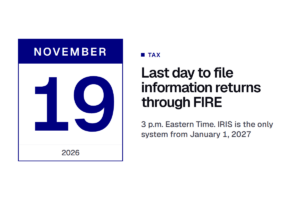
FIRE closes at 3 p.m. ET on November 19, and filers without an IRIS TCC cannot file tax year 2026 information returns in 2027.
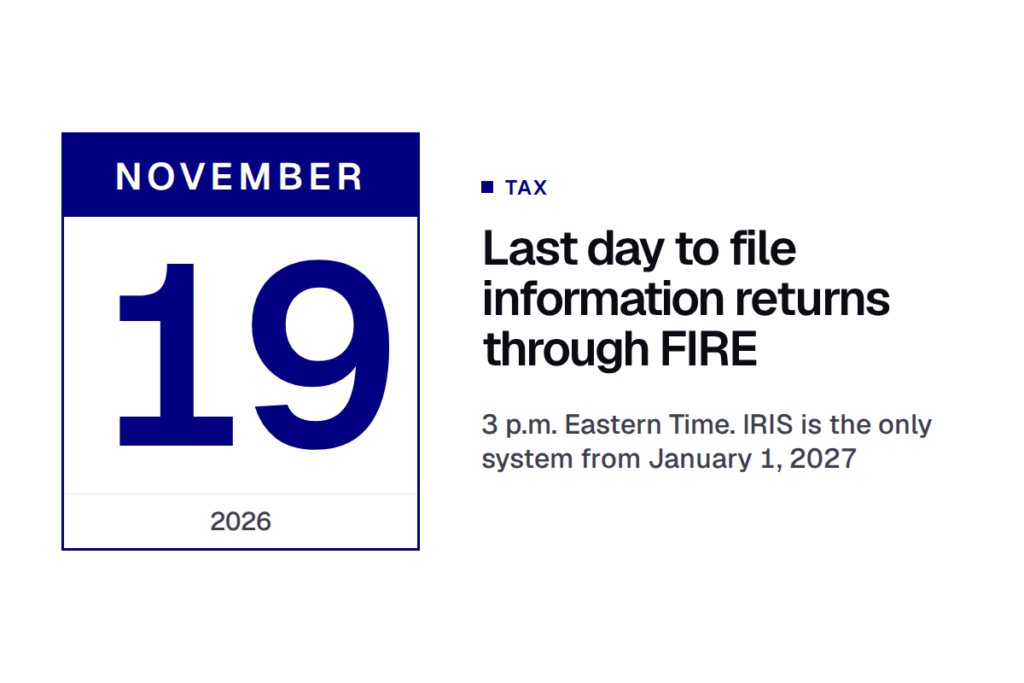
The Internal Revenue Service will close its Filing Information Returns Electronically (FIRE) system at 3 p.m. Eastern Time on November 19, 2026, leaving filers who have not completed an IRS IRIS application for TCC unable to file tax year 2026 returns in 2027.
The IRS said in an August 24 reminder that current FIRE users must move to the Information Returns Intake System (IRIS) for the 2027 filing season. From January 1, 2027, IRIS is the only electronic system for information returns, covering current-year filings, prior-year filings and corrections.
For accounting firms, payroll bureaus and finance teams that file Forms 1099, 1098 and W-2G for clients, the cutoff is a hard stop. A transmitter control code (TCC) issued for FIRE will not work in IRIS, according to IRS guidance, so each filer needs a new one.
Accountio.The go-to weekly newsletter, straight to your inbox.Weekly newsletter, straight to your inbox.
The penalties for missing the January and March filing dates are unchanged but steep. Under Section 6721 of the Internal Revenue Code, the charge is $60 a return up to 30 days late, $130 a return from day 31 through August 1, and $340 a return after that or if nothing is filed. Statutory maximums reach $4,098,500, and intentional disregard carries $680 a return with no cap, or 10% of the reportable amount if greater.
What the IRS IRIS application for TCC involves
The IRS says current FIRE users must complete an IRIS Application for TCC. The application is separate from the FIRE-era Information Returns (IR) Application for TCC, which the IRS FIRE page says is no longer accepting new applications.
Existing FIRE applicants could edit their applications until November 9. They are now read-only and kept for historical reference. The IRS stopped accepting test files through the FIRE Trading Partner Test System on November 1.
Lead times matter more than the November 19 date. The IRS has said a TCC is usually assigned within about 24 hours of a completed application, with 45 days as the outer limit. Its guidance also recommends applying by November 1 of the year before filing, a date that has already passed.
Firms that submit a complete IRS IRIS application for TCC now should still have time, but they should not assume it. A rejected or incomplete application can run into the January filing rush.
The IRS publishes Publication 5911 as the application tutorial. Tax professionals can use the IRS chat feature for general TCC questions, while account-specific questions require a Login.gov or ID.me account.
How IRIS differs from FIRE for 1099 filers
FIRE dates to the 1980s. Filers built ASCII-formatted files, batched them by employer identification number and uploaded them to the IRS portal.
IRIS is portal-based and built around an application programming interface. It needs no special software and supports a wider range of applications than FIRE.
The IRS offers two routes. The IRIS Taxpayer Portal is free and web-based, and filers can key data manually or upload a CSV file of up to 100 returns at a time. Payee copies can be downloaded from the portal.
IRIS Application to Application (A2A) is meant for larger volumes. It suits filers using third-party software or self-developed systems that connect directly to the IRS. The IRS Working Group Q&A says A2A intake requires testing, while the Taxpayer Portal does not.
The change reaches beyond the upload. Sovos, the indirect tax provider that is helping businesses with the move, said the transition affects data formats, API connectivity, TIN validation, correction workflows and state reporting. Its executives said the work looks different for every filer.
“The FIRE-to-IRIS transition is a once-in-a-generation infrastructure change for information reporting.”
John Kreger, vice president of product management, Sovos
Kreger said the financial stakes are real and that the change is receiving attention at the highest levels of the organisation. Sovos said migration has moved from tax and compliance teams to finance and technology leadership, and at many companies it is now a board-level priority.
Corrections and prior-year returns after the cutoff
Corrections are the area where firms should read the guidance most closely. After January 1, 2027, the IRS says IRIS handles corrections as well as original filings, and FIRE will not be available for any submission.
That includes tax year 2025 returns filed in 2026 that later need amending. The IRS Working Group Q&A says the prior-year correction process is still being developed, so firms with open corrections should clear what they can through FIRE before 3 p.m. on November 19.
The IRS has also said it is working on a process for foreign entities to transmit through IRIS. Non-US filers are directed to a separate Foreign Filer TCC Registration page in the meantime.
Payroll teams that run W-2G or 1099 filings for several client entities should list every TCC they use today. Each one needs a successor in IRIS, and an entity missing from the inventory is the likeliest source of a late filing.
Software vendors and what firms must do before November 19
Most accounting firms file through third-party providers and may notice little change. Those providers have spent the year rebuilding their connections to IRIS so that practitioners see no break.
Firms should still confirm three things with each vendor in writing. They need to know whether the vendor files under its own TCC or the firm’s, whether the IRS IRIS application for TCC has been completed, and whether A2A testing has passed. The IRS has not published a list of certified software providers on the pages reviewed, so confirmation has to come from the vendor.
Firms that use practice management software or a payroll platform to generate information returns should ask the same questions of those systems. The payroll software accountants use for client filings often carries the 1099 and W-2G workflow.
A short checklist covers the rest:
- Inventory every FIRE TCC and the client entities filed under each.
- Submit the IRIS Application for TCC for each filing entity now.
- Clear outstanding prior-year corrections through FIRE before 3 p.m. ET on November 19.
- Confirm vendor readiness for A2A, or decide to use the Taxpayer Portal CSV upload.
- Check TIN validation and state reporting set-up against the new format.
A tracker helps for the portal route. Accountio’s vendor 1099 tracker template lists each payee, form and status in one sheet, which is useful when a CSV upload caps at 100 returns.
If a filer misses the FIRE deadline
The IRS has not announced an extension or fallback. Its FIRE page, last updated November 10, says nothing about relief for filers who miss the date, and the August notice says IRIS is the only electronic route from January 1, 2027.
The IRS also noted that news items are not always updated after release and told filers to verify dates before relying on them. Filers with questions can call the IRS Technical Services Operation at 866-455-7438, Monday to Friday, 8:30 a.m. to 5:30 p.m. Eastern. The line does not answer individual account or tax law questions.
Staffing is a separate risk. The IRS told an AICPA conference that staffing cuts will strain the 2027 filing season, which suggests slower answers if a TCC application stalls in January.
The IRS has said it will share updates through IRIS QuickAlerts, IRIS Working Group meetings and IRS.gov. The working group meets on the second Wednesday of each month, which makes December 9 the next session for filers still waiting on a TCC.
Accountio.
The go-to weekly newsletter for accounting professionals. Trusted by 10,000+ industry leaders to deliver the tech trends and insights that matter most. Join them today.
Companies in this article
SovosTax and ComplianceView listing →