HMRC Replaces Most P11D Reporting With Mandatory Benefits Payrolling
Employers must payroll company cars, vans, fuel and medical benefits from April 2027, and most other benefits from April 2028, HMRC says.
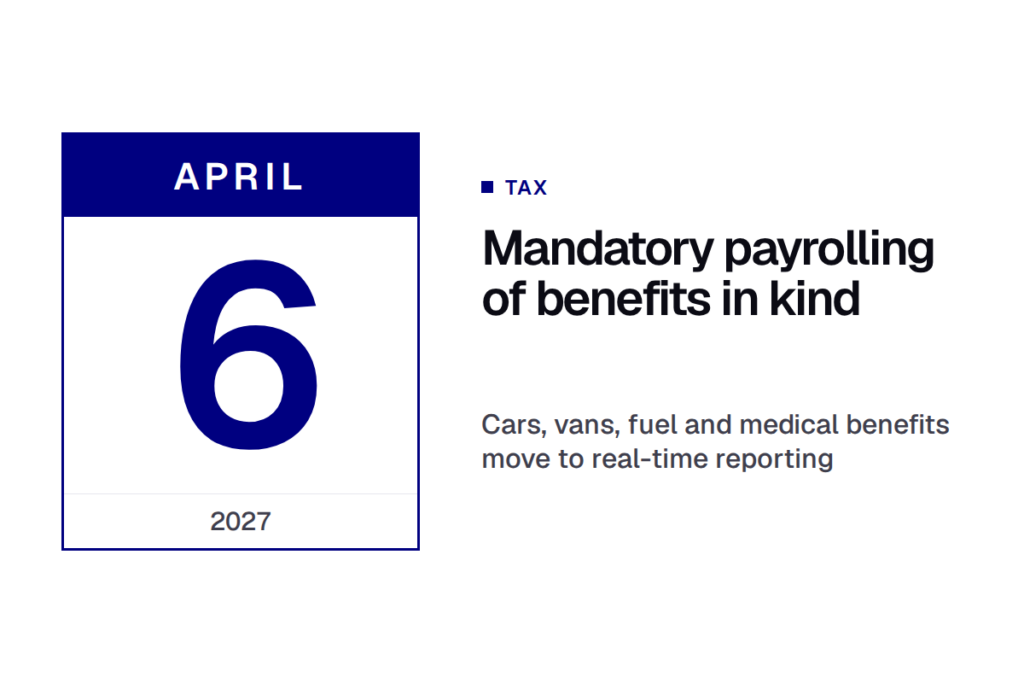
HMRC will require employers to report company cars, vans, fuel and medical benefits through payroll from April 2027, ending P11D and P11D(b) filing for those benefits, according to guidance the tax authority updated on November 9, 2026.
Most other benefits in kind follow in April 2028. For finance teams that buy VAT software for HMRC returns and separate software for payroll, the change moves a year-end reporting task into every pay run.
The update is Annex 5 of HMRC’s interim guidance on reporting benefits in kind in real time, first published on November 26, 2025. It is background material rather than new law, and it sets out the phasing, the Class 1A National Insurance treatment and the exceptions.
Accountio.The go-to weekly newsletter, straight to your inbox.Weekly newsletter, straight to your inbox.
Some secondary coverage still gives April 2026 as the start. That date is out of date. HMRC’s annex says mandatory payrolling starts in April 2027.
What HMRC requires from April 2027
From April 2027, employers must payroll four groups of benefits: company cars and car fuel, company vans and van fuel, and medical benefits. Income Tax and Class 1A National Insurance contributions on those benefits will be collected through the employee’s pay during the tax year.
Employers will no longer file P11D and P11D(b) forms after the year end for those benefits. HMRC says the forms will generally only be needed where benefits have not yet been mandated for payrolling, or where an exception applies.
Employers will be able to tell HMRC that specific employees or particular benefits need an exception and should be reported on P11D or P11D(b) instead. The annex says further details will appear in future guidance updates, so the exception route is not yet defined.
HMRC chose cars, vans and medical benefits first because employers commonly provide them and many already payroll them voluntarily. The annex describes them as the most practical starting point.
Which benefits stay outside mandatory payrolling
From April 2028, HMRC says most other benefits in kind will be mandated for payrolling. Employer-provided loans and accommodation are the stated exception: the annex says it will not be mandatory to payroll them.
Until then, employers can payroll all other benefits voluntarily if they choose. Where they do, the associated Class 1A contributions must also be reported and paid through payroll in real time.
For benefits that are not payrolled, the old pattern continues. Income Tax and Class 1A are reported after the end of the tax year, and tax is collected from employees in the following year, potentially through a change to the tax code.
HMRC also says the legislation updates the rules for calculating the taxable value of classic cars provided as a workplace benefit. It allows a temporary penalty easement during the first year, covering certain genuine mistakes.
Class 1A and the payroll software HMRC expects
The amount of Income Tax and National Insurance due is not changing, HMRC says. The reform changes when tax is collected and how the figure is calculated: through PAYE, using information from the employer, instead of an estimated benefit value in the tax code.
Class 1A is the larger shift for employers. From April 2027 to April 2028 it must be reported and collected alongside Income Tax for cars, vans, fuel and medical benefits, instead of being settled once a year.
HMRC acknowledges the cash flow effect. It says the phased start gives businesses more time to prepare for the new Class 1A payment schedule, and that it will work with industry on support from the start of the 2027 to 2028 tax year. Employers facing hardship are told to contact HMRC.
The reporting will run through the Full Payment Submission, so payroll software HMRC recognises will need new data fields. HMRC says the fields mainly mirror what P11D and P11D(b) collect today, and that company car fields are largely already in the FPS.
Employers will only complete fields for benefits they provide. A business with no medical benefit will add nothing to that section.
The annex gives software providers no release dates. HMRC says it increased engagement with employers, software providers and payroll professionals over the summer, ahead of finalising guidance and publishing revised technical specifications.
Voluntary payrolling and the registration deadline
Employers who want to go early on other benefits face a firm date. The annex says employers must register for voluntary payrolling by April 5, 2027 for the 2027 to 2028 tax year, and that it is now too late to register for 2026 to 2027.
Employers already registered for voluntary payrolling in 2026 to 2027 are not affected. Payrolling from April 6, 2026 to April 5, 2027 stays voluntary, but an employer that changes its mind must wait until the year end to stop. It still has to deduct tax on each payday and report the deduction.
The registration route sits in HMRC’s separate guidance on paying employees’ expenses and benefits through payroll. Practices running client payrolls should check that every client’s registration status matches its plans.
What accountants and payroll teams should do now
HMRC’s own advice is short. Employers should review which benefits they provide, consider what changes the payroll process needs, speak to their payroll software provider and read its guidance on preparing for mandatory payrolling.
For practices, the first task is an inventory. List which clients provide company cars, vans, fuel or medical cover, and which run voluntary payrolling already. Clients with none of the four benefits are largely untouched until April 2028.
The second is a software check. Bureaus and firms choosing among payroll software for accountants, much as they would when vetting VAT software for HMRC filings, should ask each vendor when it will support the new FPS fields, and how it will handle the exception cases HMRC has not yet defined. A software implementation checklist gives a structure for those questions and for testing.
The third is the employee conversation. HMRC says staff may see a different amount of tax each pay period, extra benefit information on payslips and a change in take-home pay.
In the first year, some employees will pay twice in one sense. One amount covers past benefits still being collected through the tax code, and the other covers benefits received in the current year and now taxed through payroll. HMRC says they are not taxed twice on the same benefit, and employees in hardship should contact HMRC.
Firms that keep P11D data in a spreadsheet can start with the P11D and payrolling benefits pack, which covers both reporting routes.
The VAT position is separate. The annex covers Income Tax and Class 1A, not VAT, so VAT software HMRC filings rely on needs no change under this reform. Finance directors who manage vehicle fleets will still want payroll software and VAT software records for the same cars to agree with what HMRC holds.
Teams that already maintain VAT software for HMRC submissions have a useful template. The same discipline of clean data, tested submissions and a named owner applies to payroll software HMRC will receive benefit data from.
Next steps for payroll software and HMRC guidance
HMRC says it will communicate the revised timing and phasing before it updates interim guidance and technical detail. It will use the Employer Bulletin, agent updates, webinars and regular stakeholder forums.
The deadline employers can plan against today is April 5, 2027, the last day to register for voluntary payrolling in 2027 to 2028, followed by April 6, 2027, when cars, vans, fuel and medical benefits go live in payroll.
Accountio.
The go-to weekly newsletter for accounting professionals. Trusted by 10,000+ industry leaders to deliver the tech trends and insights that matter most. Join them today.