Democrats Press IRS for Tax Gap Estimate During Midterm Elections
Forty-seven Democrats gave IRS chief Frank Bisignano until November 15 to release a tax gap estimate that underpins the IRS funding debate.
A group of Senate and House Democrats led by Senators Elizabeth Warren, Ben Ray Luján and Ron Wyden has given IRS chief executive Frank Bisignano until November 15 to release the overdue tax gap estimate, in a letter sent this week as the midterm elections took place.
The tax gap is the number lawmakers reach for when they argue over IRS funding, enforcement and audit staffing. Without a current figure, practitioners have no official measure of how much the Treasury believes it is losing, or of what a funded enforcement programme recovers.
The IRS has not committed to a release date. An IRS spokesperson said last month that the agency was updating its methodology, without saying what would change or when the data would appear.
Accountio.The go-to weekly newsletter, straight to your inbox.Weekly newsletter, straight to your inbox.
What the lawmakers demanded on IRS funding and the tax gap
Representative Mike Thompson of California, the ranking Democrat on the House Ways and Means Subcommittee on Tax Policy, signed alongside Warren and Luján, who sit on the Senate Finance Committee, and Wyden, the committee’s top Democrat. Another 43 Democrats also signed.
The letter makes three demands. The IRS should immediately release its latest tax gap estimates and explain any proposed changes to its methodology. It should also break out unpaid taxes attributable to offshore activity, corporations and individuals at the top of the income distribution.
The lawmakers asked Bisignano to answer a series of questions by November 15, 2026. The letter carries no legal force, and the IRS is under no statutory obligation to respond by that date.
The signatories were blunt about motive. “Your choice to hide the size of the tax gap from the American people is especially egregious,” they wrote, linking the delay to cuts in enforcement.
They concluded: “In sum, you appear to be hiding the size of the tax gap from the public while pursuing policies that will make it larger.”
Why the tax gap estimate sits at the centre of IRS funding
The IRS has calculated the tax gap since 1979 and began publishing estimates annually under the Biden administration, the lawmakers noted. The tax gap measures how much taxpayers owe but fail to pay on time.
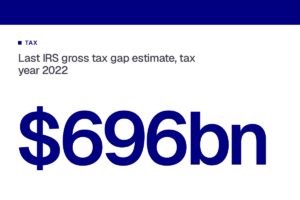
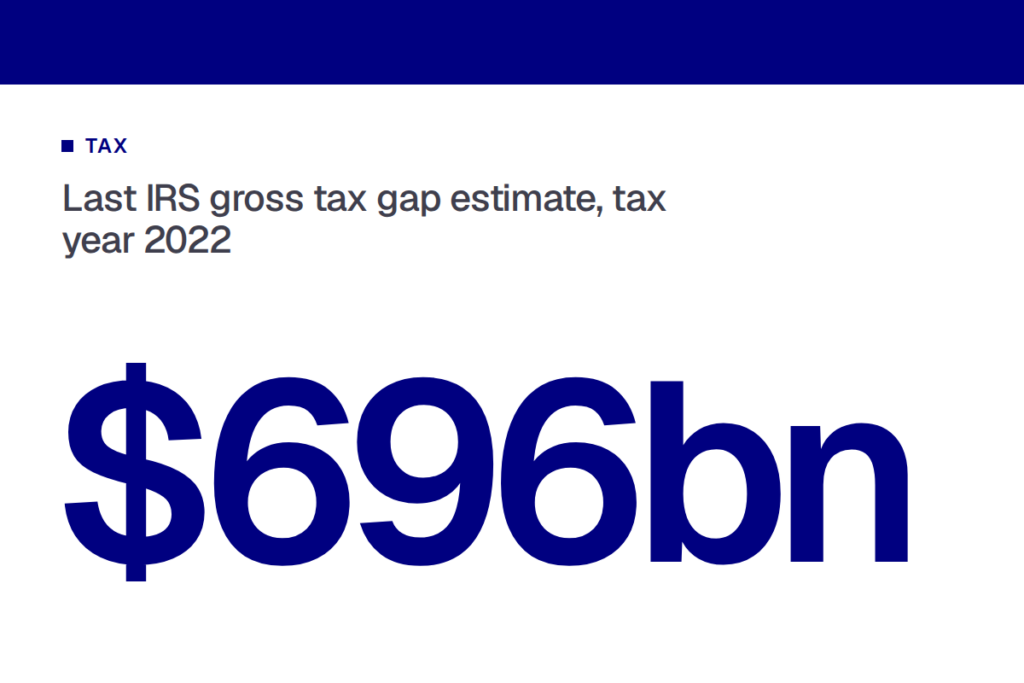
The agency’s last release came on October 10, 2024. The IRS projected a gross tax gap of $696 billion for tax year 2022, with a net gap of $606 billion after late payments and enforcement. About 85% of taxes were paid voluntarily and on time.
The IRS first reported a gross gap of $688 billion for tax year 2021 in October 2023. The 2024 release is the more recent official figure, and it is the one the Democrats cite.
The next estimate was due last autumn and has not appeared. Nothing in the public record sets a new date, so the November 15 deadline is the lawmakers’ own.
The number matters because it is the denominator in every argument about IRS funding. Supporters of larger appropriations point to hundreds of billions of dollars in uncollected tax. Critics of that funding argue the estimates are projections that rest on old audit data, and the IRS itself says figures for tax year 2017 and later may be revised.
A methodology change could therefore move the debate in either direction. A lower headline figure would weaken the case for IRS funding built on recovering uncollected tax, while a more granular breakdown could strengthen the case for targeting specific taxpayers.
The enforcement cuts behind the IRS funding dispute
The letter ties the delay to a loss of enforcement capacity. The lawmakers said the administration has cut nearly 40% of the staff in the IRS’s Global High Wealth Unit, dismantled the partnership audit group and weakened the Criminal Investigations division.
They also said IRS audit revenue fell by a third, or $3.5 billion, last year. The IRS has not published a response to those figures.
The letter says the wealthy account for a disproportionate share of the shortfall. The top 10% of taxpayers are responsible for 64% of unpaid individual income taxes, the lawmakers wrote.
The concentration of unpaid tax at the top is the reason the lawmakers want the offshore, corporate and high-income breakdown. It is also the segment where staffing cuts bite hardest, since partnership and high-wealth audits are the most labour-intensive.
The group’s earlier correspondence with the agency followed the same pattern. In an October 2 letter, Warren, Luján, Wyden and eight colleagues urged Bisignano to drop a proposed immigration status question and asked for the delayed tax gap report. That letter asked for the report by October 22, 2026. It concerned the citizenship question planned for the 2026 Form 1040, which the senators said could widen the gap.
What the IRS funding fight means for practitioners
For accounting firms, the gap in official data has practical consequences. Audit selection, notice volumes and the pace of examinations all follow enforcement resources, and those follow the budget.
Firms planning client advisory work for the 2027 filing season have no fresh benchmark for how aggressive enforcement will be. Last year’s drop in audit revenue suggests examinations have fallen, but it does not show where the IRS is concentrating what capacity it has.
The Treasury Inspector General for Tax Administration has separately flagged enforcement weaknesses, including $977 million in dubious car loan interest deductions the IRS allowed. That finding shows how much error can pass through when automated checks and staffing fall short.
Practitioners who file through IRS e-file should expect the agency’s attention to stay on automated matching, since that costs less than audits. The tax gap breakdown would show whether the IRS sees the biggest losses in categories that matching can catch.
The political context adds pressure. Several states are weighing millionaire’s surtaxes, with ballot measures in California and questions before voters in Massachusetts, Colorado and Washington, according to the Tax Foundation. A last week report from the Institute on Taxation and Economic Analysis found that, after the 2017 Tax Cuts and Jobs Act and the 2025 One Big Beautiful Bill Act, the largest profitable corporations pay the lowest tax rates in at least 40 years, with 114 of them paying nothing.
Those findings give lawmakers more reason to ask what the corporate share of the tax gap is. The IRS’s older estimates excluded corporate income tax, which is why the Democrats asked for it by name.
What comes next on IRS funding and the tax gap
The IRS has not said whether Bisignano will answer by November 15. The agency also has not said when the delayed estimate will appear or what its revised methodology will measure.
The first test is whether the agency replies to the lawmakers at all. The second is whether it publishes a tax year 2023 estimate before Congress turns to the next round of IRS funding negotiations.
Accountio.
The go-to weekly newsletter for accounting professionals. Trusted by 10,000+ industry leaders to deliver the tech trends and insights that matter most. Join them today.