Just 3% of FTSE 100 Companies Disclose Financial Returns From AI
Flexera’s review of 2025 annual reports finds 36% of FTSE 100 companies report meaningful AI use, but only 3% put a financial return on it.
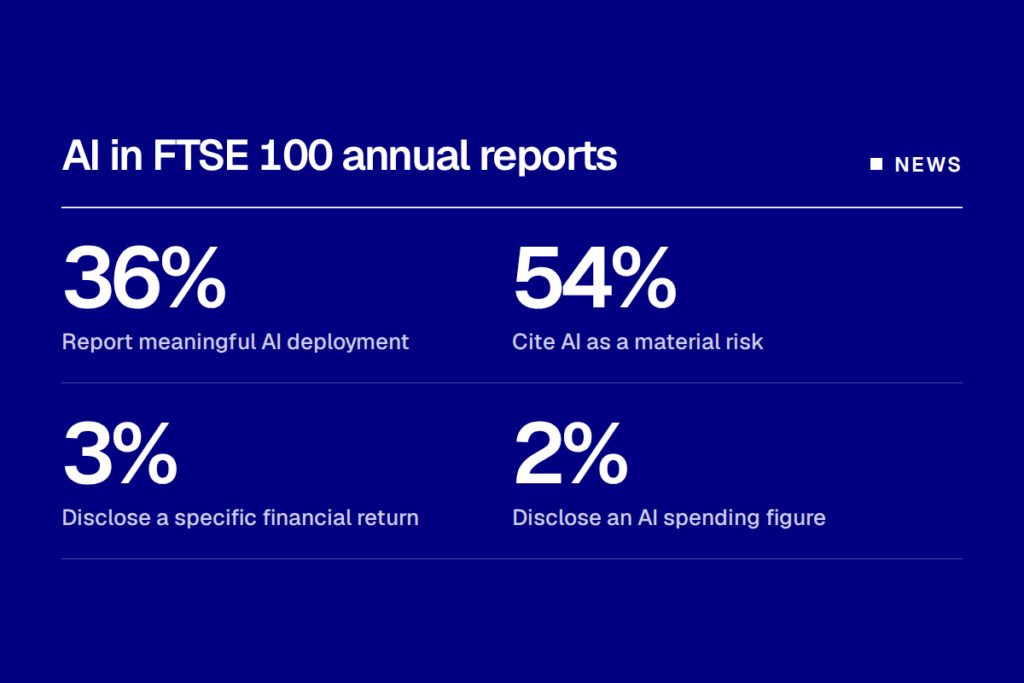
Just 3% of FTSE 100 companies disclose a specific financial return or outcome from artificial intelligence in their 2025 annual reports, technology intelligence company Flexera said on November 4, even though 36% report meaningful deployment of the technology.
For finance teams at FTSE 100 companies, the gap points to a reporting problem as much as a technology one. Boards are telling shareholders that AI is in use and carries risk, but almost none attach a pound figure to the benefit.
The same analysis found that 54% of the index cites AI as a material or company-specific risk. Risk disclosure is running at 18 times the rate of return disclosure.
Accountio.The go-to weekly newsletter, straight to your inbox.Weekly newsletter, straight to your inbox.
What FTSE 100 companies disclose about AI returns
Flexera examined the 2025 annual reports of FTSE 100 companies. It found that 36% reported meaningful AI deployment and 32% connected its use to identifiable business outcomes.
Financial detail thinned out quickly after that. Only 2% of the companies disclosed a specific AI expenditure figure, and none identified AI investment as a separate budget or cost line.
The 3% figure counts companies that state a specific financial return or outcome. Descriptions of productivity gains or operational improvements without a figure fall outside it, which explains the distance from the 32% that link AI to business outcomes in general terms.
Flexera sells software that tracks technology and AI spend, and published the analysis on the same day it released its findings. The count is of what appears in annual reports, not of what companies measure internally. A company may track AI returns closely and choose not to publish them.
Why FTSE 100 finance teams struggle to show AI value
AI spending rarely sits in one place. It is spread across software licences, cloud infrastructure, computing resources, data platforms and consumption-based services, often bought by different business units.
That makes the full cost of any one initiative hard for finance teams at FTSE 100 companies to assemble. It also makes the return hard to isolate, because a productivity gain does not automatically become a cost saving, higher profit or stronger cash flow.
Marlon Oliver, senior vice president for EMEA at Flexera, said budgets are under pressure and that visibility of spend is only the starting point.
“Companies are burning through annual AI budgets in months, and always-on agents will put those budgets under even more pressure. Having visibility of that spend and controlling it is essential, but it is only the starting point.”
Marlon Oliver, Senior Vice President, EMEA, Flexera
Oliver said measuring consumption does not show commercial success. “Token consumption, compute, and license numbers tell you what AI costs and how much it is being used. They do not tell you whether it is creating value,” he said.
Autonomous agents add to the difficulty. Steve Daheb, head of AI go-to-market strategy at Flexera, said agents can initiate their own workflows and consumption.
“Agents make those economics more complex because they can initiate their own workflows and consumption. A single instruction can set off repeated attempts to complete the work, each drawing on more computing power and adding to the bill.”
Steve Daheb, Head of AI GTM Strategy, Flexera
Finance functions that have not yet set rules for agents face a budgeting problem before they face a disclosure one. Accountio has set out where finance teams can start on AI agent governance, including cost ownership and approval limits.
What the FRC and the Code say about AI reporting
The Financial Reporting Council has concentrated on oversight rather than on returns. Its Annual Review of Corporate Reporting 2025/26, published on September 29, stressed effective oversight and control where AI is used in financial reporting processes.
The regulator’s news release on that review reported that reporting quality among FTSE 350 companies had been maintained. It named cash flow statements, financial instruments, impairment, fair value measurement and revenue as the most common areas of substantive questions. It did not address AI, and it set no requirement to quantify AI returns.
Separate research the FRC published on July 8 found that corporate reporting remains human-led. The research, conducted by Lancaster University with academics from Loughborough University, found AI use growing but cautious and uneven, concentrated in task-specific work rather than areas needing significant professional judgement.
Generative AI is seen as most valuable in narrative reporting, and its use in financial statements remains limited. Preparers cited trust, data quality, governance controls and legal and reputational risk as barriers.
The September review also pointed companies to coming changes, among them IFRS 18 and Provision 29 of the UK Corporate Governance Code on material internal controls. Provision 29 puts the board’s declaration on the effectiveness of those controls in the annual report, which gives audit committees a reason to ask where AI sits in the control environment.
None of that obliges a board to publish an AI return. Where a company chooses to state one, it joins the wider body of financial reporting that directors sign and auditors read, and the claim needs evidence behind it.
What FTSE 100 finance companies can do now
The practical steps fall to the finance function. Flexera’s recommendation is that companies connect AI investment to performance indicators such as operational efficiency, service delivery and revenue generation.
That starts with the cost base. Finance teams at FTSE 100 companies would need a total-cost view of each AI initiative, covering licences, cloud, compute and data, before any return can be calculated.
It continues with separating the kinds of benefit. Productivity gains, cost reductions and revenue improvements carry different weight in a forecast and different audit evidence, and a single blended claim hides which one is being reported.
Oliver put the shareholder’s position directly. “When shareholders are told AI is improving productivity, they should be able to see what that improvement is worth, what it cost and whether the economics are improving,” he said.
For auditors and reporting professionals, the analysis raises a narrower question. Where AI-driven efficiency feeds financial forecasts or management assumptions, the evidence for the efficiency becomes part of what is tested. Audit firms are also adopting the technology themselves, as with AI-suggested risks in Caseware’s Verity agent.
The disclosure gap and what to watch
The 2% that disclose an AI spending figure, and the none that show a separate AI budget, suggest that finance functions at FTSE 100 companies will need to mature cost reporting before return reporting can. A return cannot be stated credibly without a cost to set it against.
Audit-committee and investor views on whether quantified AI returns belong in the annual report are not yet on the public record in the FRC material reviewed here. The regulator’s stated direction is oversight, human review and monitoring of how AI use affects reporting quality.
The next test is the 2026 reporting round. Annual reports for the year ending December 2026 will show whether any more FTSE 100 companies move from describing AI deployment to putting a number on it.
Accountio.
The go-to weekly newsletter for accounting professionals. Trusted by 10,000+ industry leaders to deliver the tech trends and insights that matter most. Join them today.
Companies in this article
CasewareAuditView listing →