Expensify Signs Referral Agreement With Visa for Business Clients
Visa can now refer eligible clients and corporate card programmes to Expensify, sharpening the choice between card-agnostic and card-bundled spend tools.
Expensify has signed a referral agreement with Visa, announced on November 3, 2026, under which Visa can send eligible clients and corporate card programmes to the expense platform, giving finance teams weighing Expensify vs Brex a card-agnostic option.
The agreement lets Visa refer clients to Expensify for receipt capture, spend controls and automatic reconciliation. Referred clients deal directly with Expensify for the platform, onboarding resources and support.
For a finance team, the point is that the card stays where it is. A business that already holds a Visa corporate card can add expense management without moving to a provider that issues its own cards, which is the model behind much of the spend and expense management software market.
Accountio.The go-to weekly newsletter, straight to your inbox.Weekly newsletter, straight to your inbox.
What the Expensify and Visa agreement covers
Customers who bring an eligible Visa card to Expensify get automatic transaction sync, AI-powered expense coding, automatic receipt matching, expense policy enforcement, customisable spend limits and automatic reconciliation. Expensify also lists accounting and ERP integrations.
The announcement describes a referral. It does not describe a product built jointly with Visa, and it names no new integration between the two companies.
It also leaves several points open. Neither company has published commercial terms, a revenue share, an exclusivity clause, the Visa products or countries covered, or the number of clients expected to be referred. Accountio has asked both companies for comment on those points.
Visa’s wording is that Expensify is “another strong option”, which reads as one choice among several rather than a preferred provider.
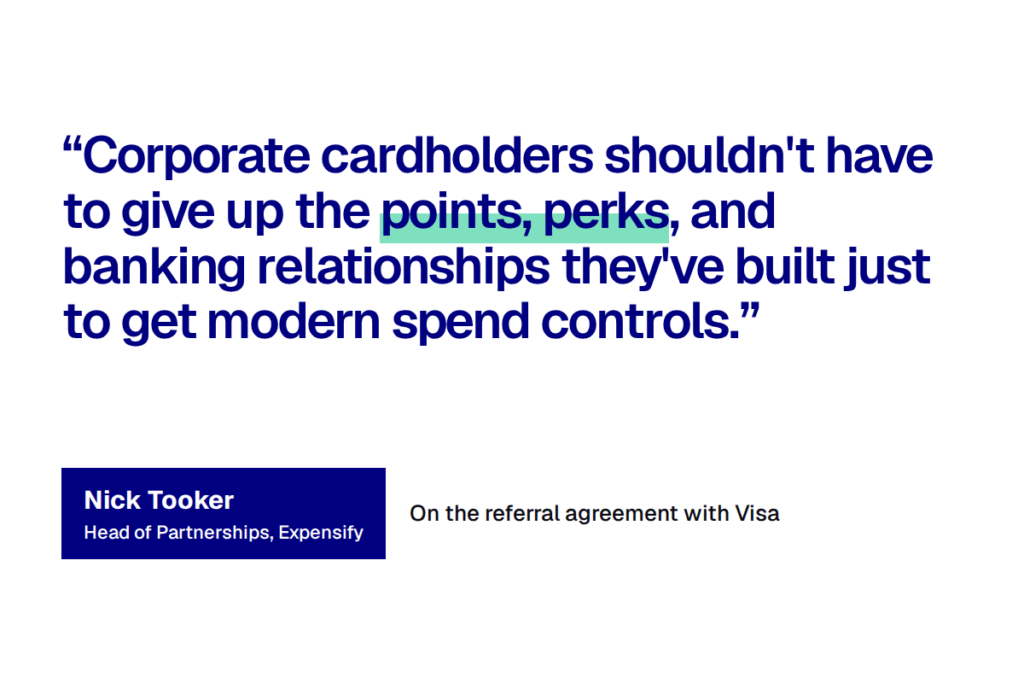
“Corporate cardholders shouldn’t have to give up the points, perks, and banking relationships they’ve built just to get modern spend controls.”
Nick Tooker, Head of Partnerships, Expensify
Tooker added that Expensify’s pitch is simple: link a Visa card and get expense management without changing how the business pays.
“Businesses are looking for simpler ways to manage expenses while continuing to use the card programs they already rely on.”
Edward Galvin, VP of NA Visa Commercial Solutions
Galvin said the agreement gives financial institutions and corporate card programmes another way to help clients simplify expense management and see their business spend more clearly.
Expensify vs Brex on cards and controls
The comparison most finance teams make is between a tool that works with the card they hold and a platform that issues the card itself. In the Expensify vs Brex decision, that difference matters more than any single feature.
Brex and Ramp both issue corporate cards and attach spend software to them. Their controls apply to cards they issue, so adopting either usually means moving the card programme as well as the expense workflow.
Expensify’s pitch is the reverse. It sells the software layer and lets the card come from a bank the business already uses, with points and perks intact.
Expensify also issues its own card. Its filings say the Expensify Card runs on the Visa network and is issued by The Bancorp Bank, N.A. under a licence from Visa U.S.A. Inc. The Visa referral is a separate arrangement, aimed at cards other institutions issue. The details of the card programme are in the company’s annual report filed with the SEC.
Does the deal change Expensify vs Brex for buyers
On the evidence published so far, it changes the route to Expensify more than the product. Card issuers and banks with Visa programmes now have a formal channel to point clients at Expensify, and clients who arrive that way keep their existing card.
It does not change what Brex offers. A finance team that wants one provider for cards, limits and expense reporting still has a reason to look at Brex or Ramp, and a team that wants to keep its bank card still has a reason to look at Expensify.
The Expensify vs Ramp and Brex vs Ramp comparisons set out where those choices differ. Ramp has grown fast on the bundled model, as its $1.85 billion round at a $60 billion valuation shows.
Against that scale, a referral agreement with no disclosed volume is a modest development. It gives Expensify a distribution route into Visa’s card issuers. Whether that route produces customers depends on how actively Visa’s clients use it.
What finance teams should check before choosing
Teams comparing Expensify vs Brex should test the decision against their own card programme before reading much into the announcement. Four questions cover most of it.
- Does the business want to keep its current card, its rewards and its banking relationship?
- Does the expense tool apply spend limits and policy checks to that card, or only to the provider’s own?
- How closely does receipt matching tie to each transaction as it posts?
- Which accounting or ERP system receives the coded entries, and how are they reconciled?
Eligibility is the first check. Expensify and Visa both describe the referral as covering “eligible” clients and card programmes, and the announcement does not define the term. A business that holds a Visa card should ask its issuer whether its programme qualifies.
Controls are the second. Expensify says customers who link an eligible Visa card get limits, policy enforcement and reconciliation, but the extent of control over a third-party card depends on what that issuer’s data feed allows.
Teams that want side-by-side pricing and features can use Accountio’s vendor comparisons.
What comes next for Expensify and Visa
The next facts to watch are the ones the announcement leaves out: the terms of the agreement, the Visa programmes and markets it covers, and any customer numbers. Expensify’s next quarterly filing with the SEC is the first place a material effect on its results would appear.
Accountio.
The go-to weekly newsletter for accounting professionals. Trusted by 10,000+ industry leaders to deliver the tech trends and insights that matter most. Join them today.