Autumn Budget 2026 Brings Rates Relief for Businesses
Chancellor John Healey’s first Budget takes 70,000 high street firms out of business rates and sets 2029 deadlines for e-invoicing and sole trader payments.
Chancellor John Healey took about 70,000 retail, hospitality and leisure businesses out of business rates in his first Autumn Budget on October 28, 2026, by raising the Small Business Rates Relief threshold in England.
For accountants, the Autumn Budget 2026 changes client work more than client tax rates. The main corporation tax rate is unchanged, but a higher Living Wage, a smaller Business Asset Disposal Relief allowance and two April 2029 deadlines will all reach practice workloads within months.
HM Treasury said half of all retail, hospitality and leisure properties will now pay no business rates. Remaining properties in those sectors get a two-year real-terms freeze in business rates bills, the Treasury said in its Budget announcement.
Accountio.The go-to weekly newsletter, straight to your inbox.Weekly newsletter, straight to your inbox.
Autumn Budget 2026 rates relief: what accountants check
The Small Business Rates Relief threshold for these sectors rises to £18,000 of rateable value from £12,000, and the relief applies from April 2027. Clients with a rateable value near the new line need a fresh calculation before their next bill arrives.
The package is paid for by requiring online marketplaces to collect VAT, a higher gambling tax on higher-risk machine games and an extended 1p supplement for businesses whose bills fell or rose less. Vape shops and adult gaming centres lose access to certain rates reliefs.
The extra 20% cut for pubs and most large live music venues was announced in July and is not new in this Budget.
Accountants advising retail and hospitality clients should list every property, its rateable value and the relief it now qualifies for. The freeze also changes cash flow forecasts for the next two years, and the tax law change client letters pack gives firms a starting point for telling clients what moves and when.
Autumn Budget 2026 accountants and the wage bill
The National Minimum Wage and National Living Wage rise 3.9%, taking the Living Wage to £13.21 an hour from April 1, 2027. The Treasury put the gain at £910 a year in gross earnings for a full-time worker.
The cost lands on employers. Adam Owens, Head of Tax Advisory (UK North & Mids) at Xeinadin, said the pay rise helps lower-income households and small businesses through extra spending, but the two effects are not equal.
“But for employers paying for the minimum wage increase, the higher payroll cost is guaranteed while the extra sales are not.”
Adam Owens, Head of Tax Advisory (UK North & Mids), Xeinadin
Martin Jones, Head of Hospitality and Leisure at UHY Hacker Young, said the Living Wage has risen 61% from £8.21 an hour at the start of 2020. He said annual increases are making more businesses in the sector unprofitable.
Firms that run client payroll should rerun April 2027 projections now, including the knock-on pressure on pay for more experienced staff. Practices with large payroll books will also need to check that payroll software carries the new rate before the tax year starts.
Sole traders face an April 2029 payment squeeze
The Budget document says that from April 2029, taxpayers who already make Payments on Account will make smaller, more regular contributions. The change is separate from Making Tax Digital, but it hits the same clients.
Andy Oury, Tax Partner at Oury Clark, said the change turns a long-feared outcome into a fact for sole traders.
“The transition will be brutal. It will mean roughly eighteen months of tax squeezed into twelve. This could be a solvency event for some.”
Andy Oury, Tax Partner, Oury Clark
The transition year is the exposure. A sole trader who pays a final balance and moves onto more frequent instalments at the same time carries a heavier load than in any normal year. Accountants should flag clients with irregular income first.
The Budget did not bring Making Tax Digital forward. Taxpayers joining MTD for Income Tax in April 2027 will have late-submission penalty points waived for their first four quarterly updates.
That easement gives firms room to run a first quarter of updates without penalty exposure. It does not change the sign-up work, and the MTD for Income Tax pack remains the quickest way to standardise onboarding across a client list.
E-invoicing and the Autumn Budget 2026 for accountants
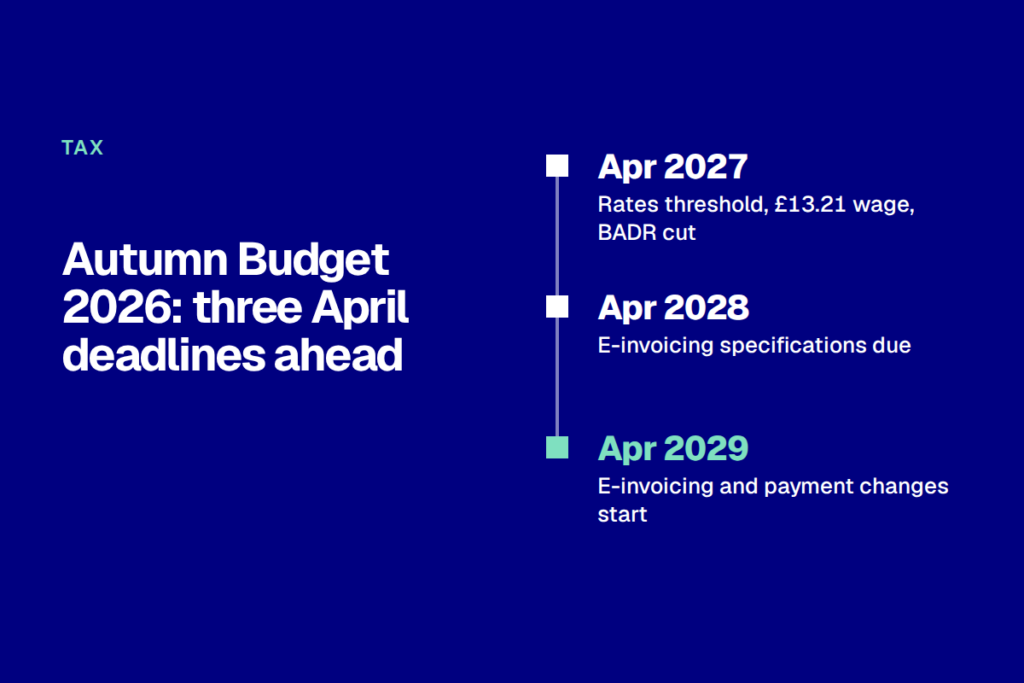
The Budget sets out an implementation roadmap for requiring VAT e-invoicing from April 2029. Under the plan, VAT invoices must be exchanged in a specified electronic format from April 1, 2029, with full policy and technical specifications due by April 2028.
That timetable puts the UK alongside the EU states already moving to structured invoicing. The comparison with ViDA and other mandates matters for clients that trade across borders.
Abigail Myers-Antiaye, VP of Global Compliance at Basware, said businesses cannot afford to wait until 2029 to start preparing. She said France’s rollout showed that choosing an approved provider did not fix inaccurate customer records or bills that did not match what had been ordered.
The better-prepared French businesses put finance in charge, she said, and brought purchasing and tax colleagues in early. For mid-sized clients, the first job is a data clean-up, not a software purchase.
Exit planning after the Autumn Budget 2026
The lifetime limit for Business Asset Disposal Relief falls from £1 million to £500,000 from April 2027. Healey said the cut means no change for three in four claimants.
The remaining quarter are owner-managers with larger gains, and their exit plans need modelling again. Any sale due after April 2027 should be tested against the lower limit.
The Budget also introduces Founders’ Relief, which offers a 10% Capital Gains Tax rate on up to £10 million of lifetime gains for eligible founders. HM Treasury has opened a technical consultation on Founders’ Relief, so the eligibility rules are not final.
The Budget also raises the Bank Corporation Tax Surcharge from 3% to 6% for 15 months, raising £1.5 billion, until it ends on March 31, 2028. The government also kept the headline corporation tax rate, which it describes as the lowest in the G7.
The full detail of each measure sits in the Budget 2026 document, which runs to 166 pages.
What accountants should do after the Budget
Professional bodies were cautious. Abdul Goffar, UK Director at ACCA UK, said the quality of the announcements matters as much as the amount raised, and that tax reform should simplify the system rather than add a layer of complexity.
Gail Boag, CEO of ICAS, said short-term measures are no substitute for a credible, detailed, long-term plan for growth. Andrew Harding, Chief Executive, Management Accounting at AICPA & CIMA, said much of the detail has been deferred.
The practical list for practices is short. Reprice the rates position for every retail, hospitality and leisure client. Rerun payroll forecasts for April 2027. Model BADR disposals against the £500,000 limit, and mark sole traders with the heaviest payment on account balances for early conversations.
The first deadline from the Autumn Budget 2026 arrives for accountants in April 2027, when the new rates threshold, the £13.21 Living Wage, the lower BADR limit and the first MTD for Income Tax quarter all take effect. The e-invoicing specifications follow by April 2028, ahead of the April 2029 start.
Accountio.
The go-to weekly newsletter for accounting professionals. Trusted by 10,000+ industry leaders to deliver the tech trends and insights that matter most. Join them today.
Companies in this article
BaswareAP AR and PaymentsView listing →