
Tax Technology: What MTD, ViDA and Wayfair Mean for Finance Teams
Mandates in the UK, EU and US are setting the buying calendar for tax technology, with deadlines running from April 2026 to January 2035.
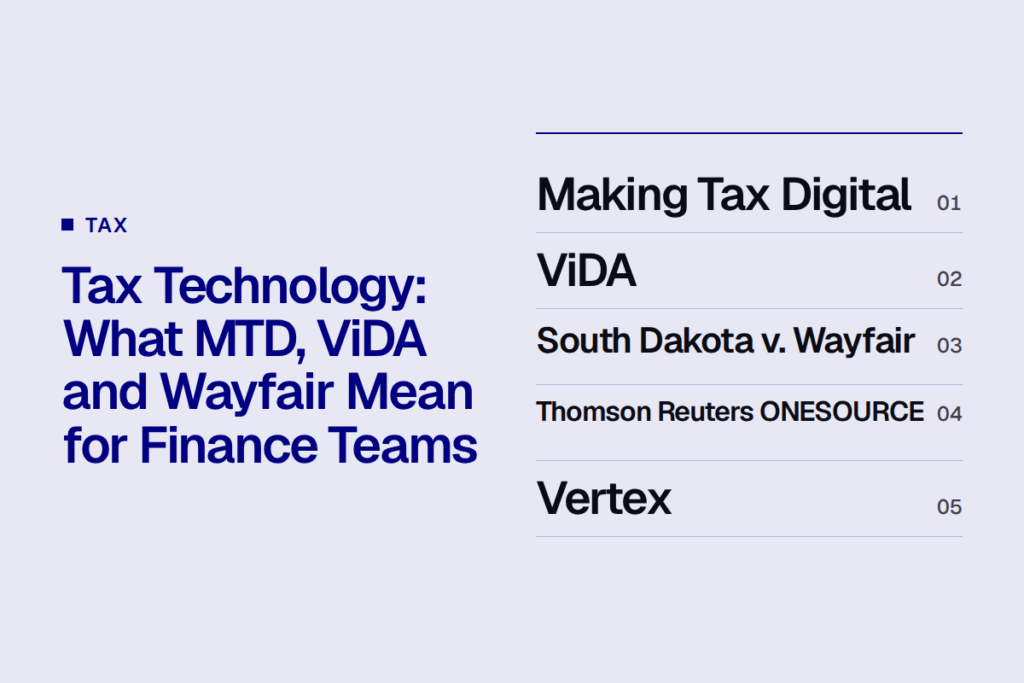
Tax technology, the software finance teams use to calculate, report and defend what they owe, is now being bought to a regulatory calendar that runs from April 2026 to January 2035 across the UK, the EU and the US.
Three sets of rules drive the spending. Making Tax Digital for Income Tax began in the UK on April 6, 2026, EU member states are rolling out e-invoicing mandates ahead of the bloc’s VAT in the Digital Age package, and US states have taxed remote sellers since the Supreme Court’s 2018 Wayfair ruling.
For a finance team, the result is that tax is no longer a once-a-year return. It is a stream of transaction-level data that must be correct when it is created. Spreadsheets and annual reconciliations were built for the old model.
What tax technology covers
Tax technology is software that calculates, files and reports taxes, and the data feeding those calculations. The market splits into five main categories, with a sixth for the data underneath.
Direct tax provision software computes the income tax charge in the accounts. Thomson Reuters sells ONESOURCE direct tax products, including a tax provision tool built for the corporate financial close. Bloomberg Tax also sells a provision product, and CSC Corptax is on state approved-vendor lists for corporate income tax returns.
Indirect tax and VAT determination engines decide which rate applies to each transaction and then support the return. Vertex, Avalara, Sovos and Thomson Reuters ONESOURCE Indirect Tax all sell into this category. Buyers weighing them can start with Accountio’s guide to the best indirect tax software.
E-invoicing and real-time reporting tools exchange structured invoices and send transaction data to tax authorities. Sovos sells an indirect tax suite that covers more than 185 countries, a figure the company publishes itself.
Transfer pricing software documents and tests intercompany pricing. Exactera, Aibidia and Commenda all sell products in this category.
Tax data management sits beneath the rest. It covers the extraction, mapping and storage of ledger and sub-ledger data so that provision, indirect tax and reporting tools draw on one set of numbers.
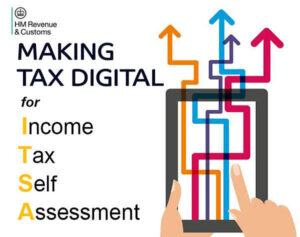
Tax technology and Making Tax Digital in the UK
HMRC’s Making Tax Digital for Income Tax applies from April 6, 2026 to sole traders and landlords with qualifying income above £50,000, the government said. The threshold falls to £30,000 in April 2027 and £20,000 in April 2028.
Qualifying income is gross self-employment and property income before allowances or expenses. The government expects about 780,000 people to be covered from April 2026 and a further 970,000 from April 2027.
Affected taxpayers must send quarterly summaries of income and expenses to HMRC. The government said penalties for late quarterly updates would not apply during the testing phase.
“MTD for Income Tax is the most significant change to the Self Assessment regime since its introduction in 1997,” said Craig Ogilvie, HMRC’s Director of Making Tax Digital.
For practices, the workload lands on clients with income between £20,000 and £50,000, who have the least bookkeeping infrastructure. Accountio’s MTD for Income Tax pack sets out the client onboarding steps.
Tax technology and the EU’s ViDA mandates
The Council of the EU adopted the ViDA package on March 11, 2025, and it entered into force on April 14, 2025. The European Commission lists the dates that matter for software buyers.
ViDA brings forward platform rules on July 1, 2028, when a deemed supplier measure starts for short-term accommodation and passenger transport platforms. Member states may delay that measure until January 1, 2030.
Digital reporting requirements for cross-border B2B supplies take effect on July 1, 2030, the Commission said. Member states must align domestic real-time reporting with the EU system by January 1, 2035.
Since entry into force, member states have been able to introduce mandatory e-invoicing under specific conditions. Several have moved first.
- Germany: every domestic business has had to be able to receive e-invoices since January 1, 2025. The obligation to issue them starts on January 1, 2027 for companies with prior-year turnover above €800,000, and covers all domestic B2B companies from January 1, 2028.
- Belgium: structured B2B e-invoicing has applied to VAT-registered businesses since January 1, 2026, with a grace period that ran until March 31, 2026.
- France: from September 1, 2026 all companies established in France and subject to VAT must be able to receive e-invoices through an approved platform. Large and intermediate-sized companies must also issue them from that date, and small and medium-sized businesses follow on September 1, 2027.
The French deadline has already passed. Of about 10 million companies concerned, only 500,000 had designated a platform by mid-January 2026, according to one industry summary of French government data.
Finance teams with entities in several member states face different formats and dates. Accountio’s e-invoicing readiness pack gives a checklist for mapping them.
Tax technology after Wayfair in the United States
The US Supreme Court decided South Dakota v. Wayfair on June 21, 2018. It overturned the Quill rule and held that a state may require out-of-state sellers to collect sales tax without the seller having a physical presence there.
The Court pointed to South Dakota’s threshold of $100,000 in sales or 200 separate transactions, along with its membership of the Streamlined Sales and Use Tax Agreement. It sent the case back to the state courts on remaining Commerce Clause questions.
Nearly every state with a sales tax then adopted an economic sales tax nexus standard modelled on South Dakota’s. A 2018 summary by the National Conference of State Legislatures counted 24 states using $100,000 or 200 transactions and 17 using $100,000 alone. Georgia uses 200 transactions or $250,000.
The transaction prong is fading. Wisconsin dropped it in 2021, and a 2026 analysis from Eide Bailly points to a continuing trend away from it.
The practical effect is that a seller must monitor thresholds in dozens of jurisdictions, each with its own definition of countable sales. That is the problem the indirect tax engines were built to solve.
What tax technology buyers should plan for
The three regimes ask for the same thing in different forms: clean transaction data, tagged at source and available to authorities on a schedule. A provision tool or a determination engine is only as good as the ledger feeding it.
Sequence matters. UK practices face the nearest dates, with the £30,000 threshold arriving in April 2027. Groups with German subsidiaries must be issuing e-invoices by January 1, 2027 if turnover exceeds €800,000, which leaves less than three months from today.
US sellers need nexus monitoring first and a determination engine second. EU groups should map ViDA’s July 1, 2030 reporting date against whichever national mandate arrives earlier.
Vendor claims about coverage and accuracy are published by the vendors themselves, and the sources reviewed for this article included no independent benchmark across the categories. Buyers should test any engine against their own transaction data. Accountio’s tax determination entry explains what to test.
The next fixed date is January 1, 2027, when Germany’s issuing obligation begins for companies above €800,000 in turnover. The UK follows on April 6, 2027 with the £30,000 MTD threshold.
Accountio.
The go-to weekly newsletter for accounting professionals. Trusted by 10,000+ industry leaders to deliver the tech trends and insights that matter most. Join them today.