Capgemini Survey Finds AI Spending Overruns Averaged 24% Above Plan
Large companies that overspent on AI ran 24% over plan, Capgemini found, and finance teams now face a forecasting and accrual problem.

Large companies that overspent on artificial intelligence exceeded expectations by an average 24%, a Capgemini survey of 500 executives, published in November, found. For any pricing analyst in a finance team, the Capgemini figure is a baseline, not a forecast.
The Capgemini Research Institute surveyed executives at organisations with annual revenue above $1 billion in September 2026. Nearly three in five, 59% by the count in the company’s release, said AI spending in the past 12 months was significantly higher than expected or budgeted.
For finance teams the finding matters because AI is billed by use, not by seat. A budget set in January against a fixed licence cannot absorb a bill that grows with every new workflow, and the survey suggests many large companies learned that the hard way.
Accountio.The go-to weekly newsletter, straight to your inbox.Weekly newsletter, straight to your inbox.
How Capgemini gathered the AI overrun data
The AI economics snapshot draws on 500 senior executives at the CXO level in 10 countries: the United States, China, India, the United Kingdom, France, Germany, Japan, the Netherlands, Italy and Spain. They work across 13 industries. Capgemini added two in-depth expert interviews.
The respondents are not a panel of finance chiefs. Capgemini says they hold roles in AI strategy and leadership, platforms and engineering, value realisation, technology finance and AI cost management. CFOs are therefore a subset at most, and the report page does not break respondents down by title.
Two further limits apply. Capgemini conducted the survey itself and sells AI consulting and implementation services to the same kind of large organisation. And the 24% describes only those that overspent, not every respondent.
The company reports that 21% of organisations exceeded their AI budget by more than 30%. Two-thirds of those with overruns reported adverse financial effects, such as lower free cash flow or reduced discretionary spending.
What the Capgemini data says about forecasting
The report does not rank the causes of the overruns, so it cannot say whether inference and compute, licensing, integration or data work did most of the damage. It points instead to visibility. Six in 10 organisations lack consistent, enterprise-wide visibility into AI costs, and half of executives say AI spending was approved without sufficient insight into the total.
Direct costs such as tokens are visible, according to Capgemini. Indirect costs, among them human oversight, rework and governance, often are not.
Confidence is thin. Only 56% of executives are fully confident they can forecast how AI costs will evolve as adoption scales. Capgemini also reports that 61% of AI spending can be tracked systematically, but only 45% can be connected to verified business value.
More than half of executives, 53%, now call AI costs a concern, up from 45% twelve months earlier. CFOs help approve major AI investments at 52% of organisations, up from 42% a year ago.
Volker Darius, chief executive of Capgemini Invent, said organisations should “stop treating its cost as a technology or procurement issue.” He added that “by continuously measuring AI Yield, organizations can make more informed capital-allocation decisions.” Capgemini defines AI Yield as its measure of value against cost, and only one in five organisations calculates it.
What a pricing analyst should take from the Capgemini data
The Capgemini numbers give a pricing analyst three inputs to test against vendor rate cards: an average overrun of 24%, a tail beyond 30% at one in five organisations, and a visibility gap that hides indirect costs. A plan that carries no contingency for consumption is already below the survey average.
Deloitte’s guide to AI tokenomics, published in April 2026, puts the underlying issue in one line: “AI spend behaves like a variable input cost, not a fixed overhead.” Its authors propose a driver-based forecast: average tokens per user, multiplied by user volume and cost per token, then adjusted for the mix of models in use.
Deloitte cites a health care enterprise whose token use grew 8% to 10% a month, which created more than $6 million in annualised costs nobody had planned. Its survey of 550 US enterprise leaders found many companies already exceed 10 billion tokens a month.
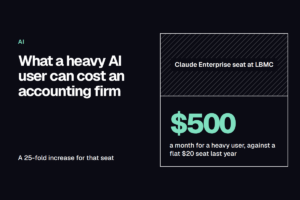
That is the same dynamic accounting firms are reporting as a sharp rise in AI spending on usage pricing. The mechanics sit under usage-based billing, where the invoice follows consumption rather than headcount.
Accruals and cash flow under usage-based pricing
A pricing analyst will find no explicit accrual guidance in Deloitte’s guide, and the Capgemini report offers none either. The practical point is one of timing. Token charges are spread across SaaS contracts, cloud bills and professional services invoices, and usage in the last week of a month may not be invoiced until the next.
A finance team that books AI cost only on receipt of the invoice will understate the period’s expense. The alternative is to accrue from metered usage reports at the period end, which requires asking each supplier for that data. Deloitte advises leaders to ask SaaS providers about token management terms and visibility into metered usage during contracting.
The cash effect follows the same pattern. A monthly bill that rises 8% to 10% a month compounds quickly, and Capgemini reports that two-thirds of the overspenders felt it in free cash flow. Teams that already run a 13-week cash flow forecast can add AI vendors as a separate line, with a high case set at the 24% overrun. The wider discipline is covered in Accountio’s glossary entry on cash flow forecasting.
Deloitte also points to chargebacks as a way to push consumption costs back to the teams that cause them. It reports that Kumo AI, a 60-person startup, tracks token use per engineer and treats it as a research and development expense.
Controls firms are putting in place
Capgemini reports that 53% of organisations with overruns responded by tightening expenditure controls. Only one in five reconsidered tools or processes, or changed models, configurations or model routing.
That split suggests most firms are capping spend rather than changing what drives it. Deloitte recommends the CFO set economic guardrails, meaning thresholds and escalation points, even where the CFO does not choose the architecture. Seun Salami, chief financial officer of TIAA Nuveen, told technology leaders in the Deloitte guide: “Please befriend your CFO.”
Capgemini also says more than three in five executives expect to adopt a multi-model strategy within 12 months, and nearly three in five plan to use more open-weight models. Each added model brings another rate card to forecast. Capgemini’s October paper, The Era of AI Yield, sets out its method for weighing those choices.
For accounting firms the audit trail matters as much as the budget. A cost that cannot be traced to a task is hard to defend to a client or a partner, which links this problem to the auditability concerns finance leaders have raised about AI. Finance chiefs mapping the tools themselves can start from the AI tools finance leaders are actually deploying.
The pricing analyst’s checklist for 2027 budgets
A pricing analyst building next year’s budget from the Capgemini data has a short list of tests. Model each AI supplier’s usage, not its licence count. Set an overrun band no narrower than the Capgemini average. Ask for metered data monthly. Separate direct token cost from oversight and rework, since Capgemini says the second group is the one organisations see least.
The survey’s own caution applies to its author as well. Capgemini measures spending against expectation, and an expectation set too low in the first place produces an overrun without any change in what the company buys.
Capgemini found that 60% of organisations currently prioritise total AI spend against budget, but only 44% expect to do so over the next six to 12 months. It expects first-pass success rate to become the leading metric, with cost per completed task gaining ground. Finance teams will find out in the next budget cycle whether their suppliers can report either figure.
Accountio.
The go-to weekly newsletter for accounting professionals. Trusted by 10,000+ industry leaders to deliver the tech trends and insights that matter most. Join them today.