Letter of authority template for accountants
Your client signs it, and their bank, lender or pension provider can then send you the statements and figures you need. This letter of authority template is one page in Word, for individuals, joint accounts and companies.
UK practices- In the pack
- Client onboarding and disengagement pack
- Files
- 8, Word
Get the pack by email
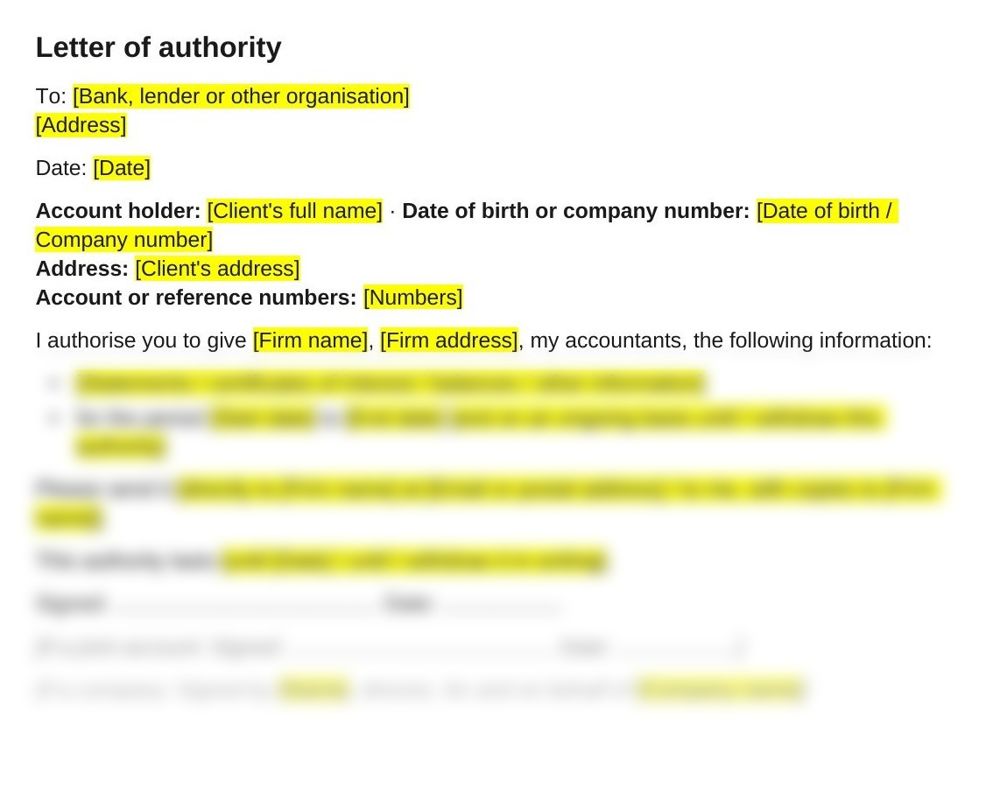
What the letter looks like
When you need it
Use it whenever an organisation other than HMRC or Companies House needs your client's permission before it will talk to you. For tax, HMRC uses its own authorisation instead.
- You need bank statements or year-end balances to finish the accounts
- You need certificates of interest for a client's tax return
- A lender, pension provider or investment platform asks for written permission before sharing figures
- A client with a joint account, or a company, needs every signatory to agree
How to use the letter of authority template
- Address it to one organisation. Use a separate letter for each bank or lender, with the account numbers it holds.
- List exactly what you need. Name the statements, certificates or balances, and the dates they cover.
- Choose where the information goes. Straight to your firm, or to the client with copies to you.
- Set how long it lasts. A fixed end date, or until the client withdraws it in writing.
- Get every signature. Both holders sign for a joint account, and a director signs for a company.
Questions
What is a letter of authority?
It is a signed letter in which your client gives an organisation, such as a bank, permission to share their information with you. It names the account, the information, the period it covers and how long the permission lasts.
Does HMRC accept a letter of authority?
For tax matters, HMRC needs formal authorisation instead. Set it up online through your agent services account, or have the client complete form 64-8 if online authorisation is not possible. The pack's HMRC and Companies House authorisation guide covers this tax by tax.
Who signs a letter of authority?
The account holder. For a joint account, both holders sign. For a company, a director signs on the company's behalf.
How long does a letter of authority last?
As long as the letter says. The template gives two choices: until a set date, or until the client withdraws it in writing.
Can a letter of authority cover more than one account?
Yes, if the accounts are with the same organisation. List every account or reference number. Use a separate letter for each organisation.
Also in the client onboarding and disengagement pack
Who it's for
Sole practitioners and small firms who need clients' bank and lender information to prepare accounts and tax returns.
Last checked
Checked against HMRC guidance on agent authorisation in October 2026.