Accounting Firms Report Sharp Rise in AI Spending on Usage Pricing
A $20 seat can now cost $500 a month in tokens, firm technology leaders say, as AI consumption pricing reaches accounting firms.
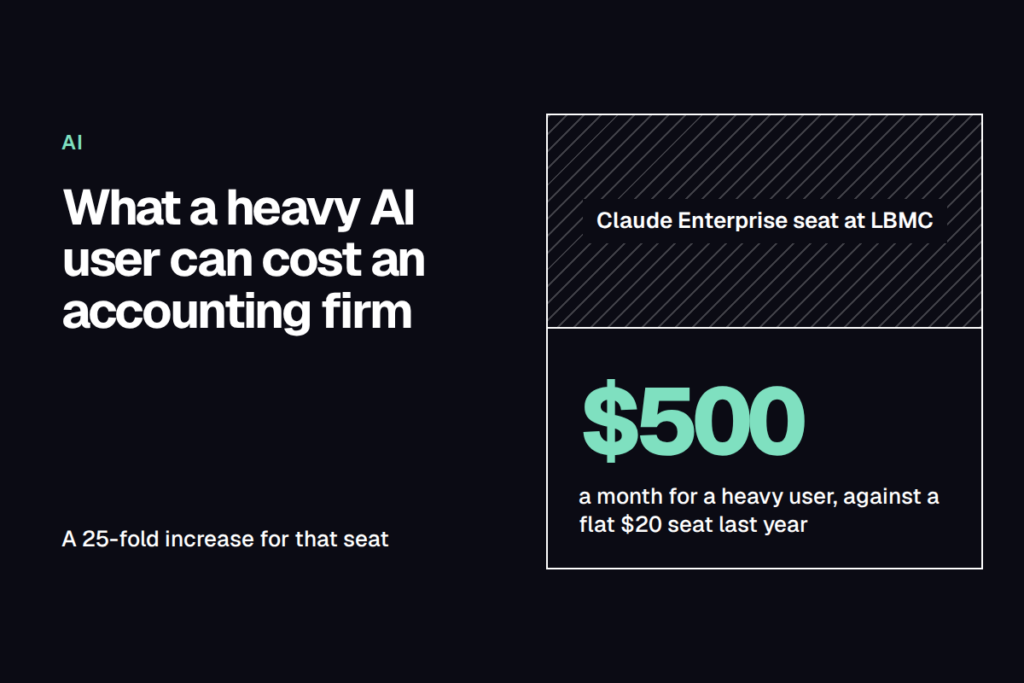
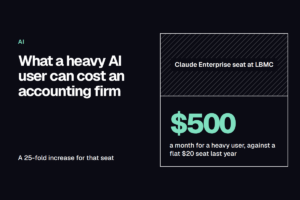
A heavy user of Anthropic’s enterprise AI assistant at LBMC can now cost the accounting firm $500 a month or more, against a flat $20 seat last year, as AI consumption pricing reaches accounting firms in 2026, the firm’s AI practice leader said.
Charlie Apigian, AI practice leader at the top 50 US firm, called the increase in costs since January “substantial”. The cause is a move from the standard plan to Claude Enterprise, which charges the same $20 seat fee plus token usage at API rates, according to Anthropic’s billing documentation.
For finance leaders the change breaks a budgeting habit. A subscription produced roughly the same invoice every month. A metered bill moves with every user, every model and every workflow, and the usage-based billing now reaching practice software is harder to forecast and harder to pass on to clients.
Accountio.The go-to weekly newsletter, straight to your inbox.Weekly newsletter, straight to your inbox.
Technology leaders at three US accounting firms, LBMC, PKF O’Connor Davies and Wiss, said their AI spending has climbed sharply over the past year as consumption pricing spread. None gave a total budget figure or a percentage increase for the firm as a whole. All three said pricing explains most of the rise, but not all of it.
How AI consumption pricing hit accounting firm budgets
Apigian said LBMC paid $20 a month per seat for the assistant before this year. Light users still sit near that level. Heavy users can reach $500, a 25-fold increase for that seat, and Apigian said he expects some to exceed it.
Philip Comerford, chief financial officer of PKF O’Connor Davies, a top 25 firm, said the variability is the biggest change in how the firm thinks about AI spending.
“It would be like if Netflix charged you for binging based on how many minutes you watched.”
Philip Comerford, Chief Financial Officer, PKF O’Connor Davies
Hrishikesh Pippadipally, chief technology officer of Wiss, a top 100 firm, described a vendor that moved the firm from seat-based to consumption pricing within the past year. The vendor included 3 million tasks a month in the subscription. Wiss reached its annual limit in two and a half months.
“We did some optimizations, but it’s still not enough,” Pippadipally said. He did not name the vendor.
Why token prices fell while AI bills rose
Unit prices are not the problem. Enterprise data provider Modern reported that token prices have fallen roughly 3,000 times in three years. In June, OpenAI and Anthropic cut prices by a further 80%.
For accounting firms on AI consumption pricing, volume has outrun the discount. Each task now consumes far more tokens, particularly where agents plan, retrieve data and call other agents.
EY illustrated the effect in an April report on agentic AI economics. A customer service chat that once cost $0.04 can become a $1.20 orchestration once it involves tool retrieval, planning and subagents. The report added that knowledge-base updates, agent evaluation and human collaboration design may not appear on the model vendor’s invoice but still reach the enterprise.
Wiss follows the same pattern. Pippadipally said the firm once asked AI to extract data from documents, a single small task. It now wants end-to-end workflows: a work paper accountants can edit, a route into the reviewer’s queue and the tax systems, and automated delivery of finished PDFs to clients.
What share of the rise is pricing, and what is usage
No firm could split its increase precisely between the two causes. Their accounts point to at least four separate drivers.
- Pricing model: seats that now carry token charges, as at LBMC.
- Adoption: Comerford said PKF O’Connor Davies has added users, and higher adoption rates raise the cost of tools it already owned last year.
- New tools: the firm is also piloting additional products to test what suits its way of working, which adds to the base.
- Add-on features: Cheryl M. Burke, project management officer at PKF O’Connor Davies, said AI functions inside existing software lift per-person prices even where the product remains a subscription.
Apigian put add-ons ahead of tokens in some cases. He said products now sold as the same thing with AI added can cost another $10 a person a month, “probably more so than the tokens”.
Infrastructure is moving too. Apigian said services LBMC used on Microsoft Azure and AWS, once covered by the right to use them, now charge per token.
The result is that accounting firms cannot treat the rise in AI consumption pricing as a single repricing event, and a negotiation with one vendor will not reverse it.
How firms control AI consumption pricing costs
Model choice is the main lever. Marc Staut, shareholder and chief innovation and technology officer at accounting consultancy Boomer, said one member of the firm’s CIO community ran the same prompt on the same email through two models, got nearly identical results and paid 50 times more for one.
“If staff default to the most expensive model for everything, the firm pays for it,” Staut said.
Pippadipally has made control a condition of accepting metered pricing. He wants to choose the model himself, using the top-tier model about 1% of the time and a cheaper model as the default. He put that default at one-tenth of the price. “If I’m not in control, I’m not going to pay consumption-based,” he said.
He also described staff habits as a cost control, comparing it with switching off lights at home, and said he can teach them. Wiss tried optimisation work on the vendor contract that used up its task allowance, which did not solve it.
Pippadipally would accept consumption pricing in principle. His concern is that he cannot see whether a vendor has built its product to economise on tokens. He said he would move once the margin for error on the vendor side is small.
The accounting firms interviewed did not describe client pass-through or renegotiated contracts for AI consumption pricing in detail. Firms exploring those routes could start with value pricing, which separates the fee from the hours and the compute behind the work, and with the vendor comparison pages when judging seat prices against metered ones.
Anthropic’s documentation says administrators can monitor usage on enterprise plans, and customers on legacy seat types keep their terms until renewal, then move to the usage-based seat. Firms on older plans therefore have a renewal date to plan against.
Firms keep spending despite the higher bills
No firm said it would cut back. Comerford said the firm expects AI to transform staff productivity and takes a longer view of the spending.
“We’re not optimizing for earnings today but we are optimizing to create the most valuable platform over the next 20, 30 years,” he said.
Survey data points the same way. Inside Public Accounting found that 70% of firms raised their AI budgets in the past year, and Wolters Kluwer found that 87% plan to increase investment in AI-enabled technology.
Deloitte reported in January that cloud bills were rising nearly 20% a year, driven by AI workloads. The pattern is not confined to US practices, and UK and EU firms buying the same models through the same vendors face the same metering.
Firms that want to run AI-native workflows will need to price the compute before they scale it. Legacy seat plans reach their renewal dates through 2027, and each one is the next point at which a flat $20 seat can become a metered one.
Accountio.
The go-to weekly newsletter for accounting professionals. Trusted by 10,000+ industry leaders to deliver the tech trends and insights that matter most. Join them today.