Grant Thornton Says Over-Reliance on AI Threatens Audit Quality
Grant Thornton’s UK head of audit has said over-reliance on AI could set off a race to the bottom and weaken the quality of company audit checks.
Grant Thornton’s UK head of audit has said that over-reliance on artificial intelligence could set off a race to the bottom among audit firms and damage the quality of checks on company accounts.
The warning matters to audit committees and finance leaders in the UK, the US and the EU because AI is now built into the tools their auditors use to test transactions and assess risk. If firms compete mainly on how cheaply AI lets them deliver an audit, the person paying the fee may end up with less evidence behind the opinion.
Grant Thornton is the UK’s largest audit firm outside the Big Four, and its audit practice is led by Wendy Russell. The firm has made AI a central theme of its public statements on audit quality, so the warning comes from a firm that is itself investing in the technology.
Accountio.The go-to weekly newsletter, straight to your inbox.Weekly newsletter, straight to your inbox.
What Grant Thornton said about the race to the bottom
The concern is that AI could reduce the cost and time of audit work to the point where firms undercut each other, with quality as the casualty. The “race to the bottom” phrase describes that dynamic: if the technology does the testing and the fee falls, the pressure to cut the human review behind it grows.
The firm has set out the same tension in its own material for audit committees. In its audit committee brief, Grant Thornton wrote that “the most significant development shaping audit quality in the coming period is AI”. It added that “AI can genuinely strengthen audit quality, but it can also introduce new risks if not properly governed.”
The brief says audit firms already use AI for data analysis, transaction testing and risk identification. It also says that audit quality “is also shaped by culture, not just capability”, which places the responsibility on firm leadership as well as on the software.
What the regulator has published on AI in audit
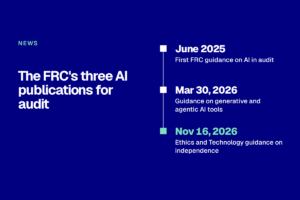
The Financial Reporting Council has issued three pieces of guidance on the subject. The first, in June 2025, covered the uses of AI in audit and documentation expectations. The second, published on March 30, 2026, covered generative and agentic AI tools and how firms should manage the risks they pose to audit quality.
The FRC said the March guidance gives firms a framework for deciding how much confidence to place in the output of an AI tool, with mitigating steps depending on the tool and its intended use. Firms should also consider how AI fits within their quality management obligations under ISQM (UK) 1, and the human auditor stays accountable under auditing standards.
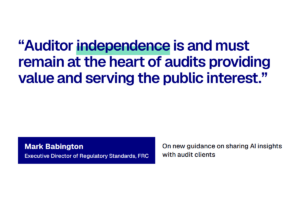
“AI adoption in audit is accelerating, and agentic AI is expected to follow,” said Mark Babington, executive director of regulatory standards at the FRC. He added that accountability for audit quality rests with firms and Responsible Individuals.
The regulator went further on November 16, 2026, with new guidance on auditor independence when using technology, including AI. It warns that sharing technology-derived insights with management or those charged with governance can threaten integrity, objectivity or independence, and that the risk is higher when the underlying work falls outside the audit of the financial statements.
“The use of AI by auditors can enhance the quality of audit work done and the insights provided to audited entities,” Babington said on the same date. The guidance builds on the two earlier publications. The FRC has also published a separate release for audit firms and a warning over overhyping AI in sales to clients.
How Grant Thornton and rivals are deploying AI
Grant Thornton is not alone in building AI into its audits. Deloitte has put Omnia Agentic Intelligence in front of 85,000 auditors, a network of AI agents that exchange information with each other. Caseware has added AI-suggested risks to its audit platform through its Verity agent.
In the US, the AICPA has set out what auditors will ask about client AI use in its AI audit guidance, so the quality question applies on both sides of the Atlantic.
Audit quality is also under pressure on the enforcement side. The FRC fined Deloitte more than £6 million over its Go-Ahead audits, a reminder that the regulator measures firms on the evidence behind their opinions, not on the tools used to gather it.
Questions audit committees should ask about Grant Thornton and other auditors
The FRC’s guidance and Grant Thornton’s own brief point to the same practical questions. Audit committees can put them to any auditor, including Grant Thornton, at the planning stage rather than after the fieldwork is done.
- Ask where AI is used in the audit and for which areas, such as transaction testing, risk assessment or reviewing contracts for revenue recognition.
- Ask how the engagement team satisfies itself that the output of each tool is reliable, and who reviews it.
- Ask whether the use of AI has changed the fee, the hours or the seniority of staff on the engagement, and if so, how the firm shows that quality has not fallen.
- Ask how the firm manages AI within its quality management system under ISQM (UK) 1.
- Ask whether the use of technology, including any insights shared with management, creates a new threat to auditor independence.
Grant Thornton’s brief frames the last two as questions of whether AI “enhances rather than erodes quality” and “whether its use introduces any new risks to auditor independence”.
What finance leaders should check in their own reporting
Finance teams have a stake in the answers because the auditor’s tools work on the data the company supplies. Cleaner ledgers and well-documented controls make AI-assisted testing more reliable, and they shorten the time an audit takes. The same discipline supports the company’s own financial reporting and any going concern assessment the auditor will review.
Committees that see a lower audit fee tied to AI efficiency should ask for the reasoning in writing. A fee reduction is not itself a sign of weaker work, but the “race to the bottom” warning puts the burden on the firm to show where the saved hours went.
The next point of reference is the FRC’s own work. The regulator has said its March guidance lays the groundwork for further work, and its November 16 independence guidance is the most recent publication in that series. Audit committees agreeing 2027 audit plans can use both documents as the basis for their questions.
Accountio.
The go-to weekly newsletter for accounting professionals. Trusted by 10,000+ industry leaders to deliver the tech trends and insights that matter most. Join them today.
Companies in this article
CasewareAuditView listing →