HMRC Details Late Penalties for Making Tax Digital for Income Tax
HMRC’s guidance sets a £200 penalty at four late submission points for Making Tax Digital for Income Tax, with new late payment charges alongside.
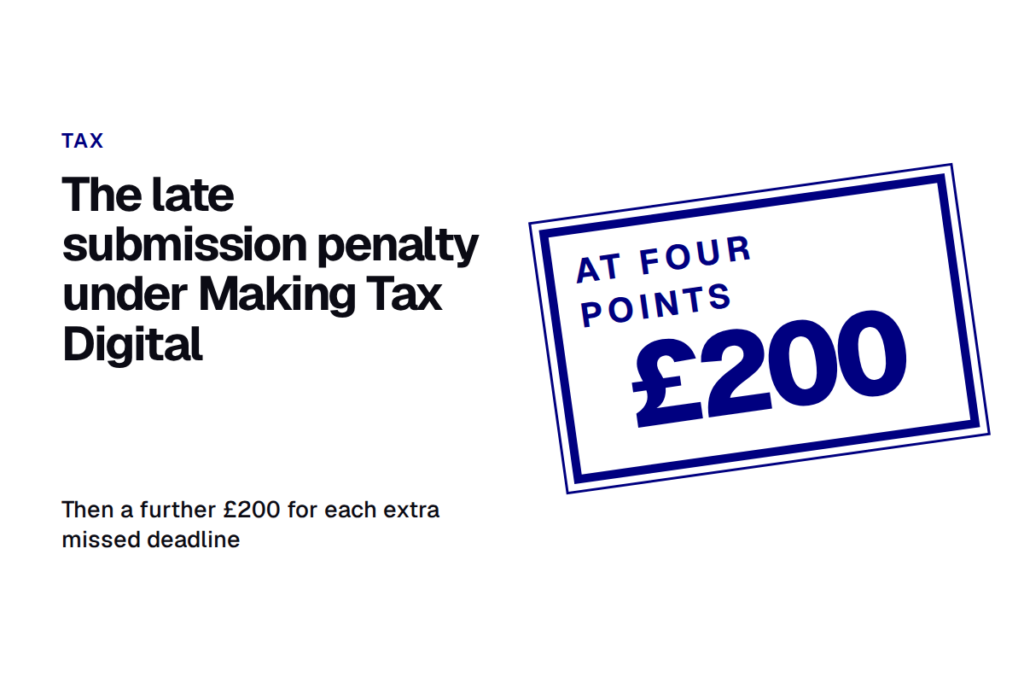
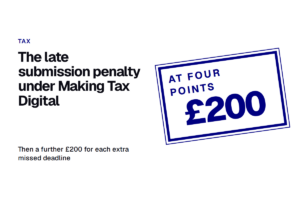
HMRC has set a £200 penalty for taxpayers who reach four late submission points under Making Tax Digital for Income Tax, in guidance last updated on November 19, 2026. The making tax digital penalties start with the 2026 to 2027 tax year for those who join in April 2026.
The new regime replaces the late submission and late payment penalties that currently apply to a personal tax return for anyone required to use the service. Late payment interest is unchanged, so it continues to run alongside any penalty.
For accountants and bookkeepers acting for sole traders and landlords, the guidance fixes the calendar that clients’ MTD for Income Tax obligations will follow. Quarterly updates now carry their own consequences, and the size of a late payment charge depends on the tax year and on how long the balance stays unpaid.
Accountio.The go-to weekly newsletter, straight to your inbox.Weekly newsletter, straight to your inbox.
Making Tax Digital penalties replace the current regime
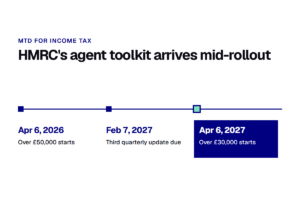
The new penalties apply from the tax year in which a taxpayer joins Making Tax Digital for Income Tax, while the current penalties still apply to earlier years. Someone who joins from April 6, 2026 faces the new penalties on the 2026 to 2027 return due on January 31, 2028, and the current penalties on the 2025 to 2026 return due on January 31, 2027.
Someone who joins from April 6, 2027 follows the same pattern one year later. The new penalties apply to the 2027 to 2028 return due on January 31, 2029, and the current penalties to the 2026 to 2027 return due on January 31, 2028.
Three kinds of Self Assessment return stay outside the new rules: a non-resident company return submitted on behalf of the company, a trust or estate return submitted by a trustee, and a partnership return submitted by a nominated partner. HMRC said the current late payment and late submission penalties still apply to those returns.
The quarterly update deadlines are August 7, November 7, February 7 and May 7. The deadline to submit the tax return and pay any tax owed is January 31 after the end of the tax year. The sign-up process determines which of the two start years applies to a client.
How late submission penalty points work
The late submission penalties are points based, with one penalty point for each quarterly update or tax return deadline that is missed. A taxpayer reaches the threshold at four points and receives a £200 penalty, followed by a further £200 each time another submission deadline is missed.
No penalty points are given for late quarterly updates in the first tax year. Taxpayers must still create digital records and send quarterly updates before they can submit the return, and a missed return deadline earns a point. Following the guidance update of November 19, 2026, this first-year relief applies to people who join from either April 2026 or April 2027.
Points for missed quarterly deadlines begin after the last quarterly update deadline of the first year. For a taxpayer who joins from April 6, 2026, the first point that could be issued would be for missing August 7, 2027, the first quarterly deadline of the second tax year.
Only one point can be given for each deadline, even when a taxpayer has more than one business and sends more than one quarterly update late. Taxpayers who are also registered for VAT hold separate points for Making Tax Digital for Income Tax and for VAT.
The quarterly deadline guidance HMRC issued earlier covers how the updates themselves work.
Late payment under Making Tax Digital penalties
The late payment penalties are not points based and apply to each late payment. HMRC said they are more proportionate to how long a taxpayer takes to pay, so a quicker payment means a lower penalty. They cover a balancing payment for an outstanding amount on the tax bill and amounts due after an amendment or assessment to the return, but not payments on account.
In the first year of the new penalties a taxpayer has 30 days from the due date to pay in full or to contact HMRC to set up a payment plan. After the first year the period falls to 15 days. The 30-day period is available only once, so a taxpayer who volunteered for the service and is now required to use it continues with 15 days.
The rates differ by tax year, as the table in the guidance sets out:
- Payment up to 15 days late: no penalty in either tax year.
- Payment 16 to 30 days late: 3% of the tax owed at day 15 for 2026 to 2027, or 4% for 2027 to 2028, and no penalty in the first year.
- Payment 31 days or more late: 3% of the tax owed at day 15 and 3% at day 30 for 2026 to 2027, or 4% at each point for 2027 to 2028.
For payments 31 days or more late, an annual rate of 10% on the outstanding amount is added in both years. It is charged daily from day 31 until the tax is paid, or for up to two years. HMRC corrected the 2027 to 2028 figure to 4% on March 30, 2026.
Late payment interest is charged separately from the first day a payment is late until it is paid in full. Firms can estimate that cost with the late payment interest calculator template.
A taxpayer who cannot pay on time should contact HMRC as soon as possible. If a payment plan is agreed and the payments are made, penalties are paused from the date of contact. A penalty may still be charged if a plan cannot be agreed or the taxpayer does not follow it.
Removing points and appealing making tax digital penalties
A taxpayer below the four-point threshold has each point removed automatically 24 months after the missed deadline. The date appears in the taxpayer’s HMRC online services account.
Once a taxpayer reaches the threshold, individual points are no longer removed automatically. Removing all of them requires two conditions: sending quarterly updates and submitting the tax return on time for 12 months, and sending any outstanding updates and returns for the previous 24 months. In exceptional circumstances such as insolvency, HMRC may cancel a penalty or a point, or remove all points.
HMRC will send a letter for a late payment penalty, a late submission penalty point or a £200 late submission penalty. The letter explains how to appeal if the taxpayer disagrees.
Penalty rules for taxpayers who become exempt
Exemption changes the outcome depending on the year. A taxpayer who becomes exempt from Making Tax Digital for Income Tax in 2026 to 2027 returns to the current Self Assessment late payment and late submission penalties.
A taxpayer who becomes exempt in 2027 to 2028 stays under the new penalties, because from April 2027 they apply to everyone who submits a personal Self Assessment return. The point threshold for that taxpayer falls from four points to two.
Existing points are reduced when the threshold moves so that the taxpayer is no closer to it. HMRC gave the example of a taxpayer with three points, one short of four, whose total would fall to one, still one short of the two-point threshold.
Volunteers who use the service by choice are covered by separate HMRC guidance on penalties for volunteers.
What practices should check before January 2027
The first practical test comes with the 2025 to 2026 return due on January 31, 2027, which stays under the current penalties for clients who join in April 2026. The first deadline under the new regime is January 31, 2028 for the 2026 to 2027 return.
Practices can map each client to a start year and a penalty year using HMRC’s guidance on using Making Tax Digital for Income Tax, then track quarterly deadlines against the first-year relief. The MTD for Income Tax pack offers a starting point for the client records. The first points for missed quarterly updates could be issued from August 7, 2027 for clients who join in April 2026.
Accountio.
The go-to weekly newsletter for accounting professionals. Trusted by 10,000+ industry leaders to deliver the tech trends and insights that matter most. Join them today.