FRC Warns Audit Firms Over Overhyping AI in Sales to Clients
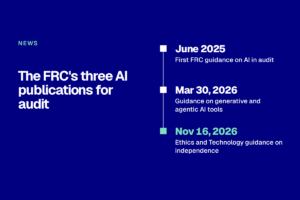
The FRC published guidance on November 16 warning auditors that selling AI insights to audited clients can threaten independence, and the Ethical Standard still applies.
The Financial Reporting Council in the UK published guidance on November 16, 2026 telling auditors that sharing technology-derived insights with audited clients, including those produced by AI, can threaten their independence, particularly when the firm uses those insights to win further work.
The guidance matters to every firm that sells advisory or technology services alongside an audit, and to the audit committees that approve those services. The Financial Reporting Council UK regulator said it does not create new rules, so the existing Ethical Standard, including its limits on non-audit services for public interest entities, governs every case.
The document, titled “Ethics and Technology: Ethical considerations relating to the provision of insights obtained through the use of technology to an audited entity”, is non-authoritative. It explains how current requirements apply and, in its own words, “does not set any additional requirements”.
Accountio.The go-to weekly newsletter, straight to your inbox.Weekly newsletter, straight to your inbox.
What the Financial Reporting Council UK published
The guidance covers two situations: an auditor communicating an insight obtained through technology to management or those charged with governance, and an auditor giving the audited entity’s staff access to technology so they can generate insights themselves. It was written after auditors asked the regulator for help applying the Ethical Standard in cases that often involve technology.
The regulator does not treat technology as the problem. It sees value in tools that help identify risks of material misstatement or strengthen internal controls, but it says sharing what those tools find can create threats to integrity, objectivity or independence, especially when the work behind the insight sits outside the financial statement audit.
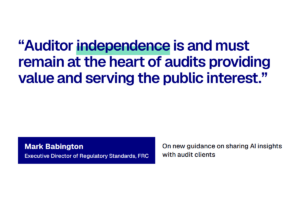
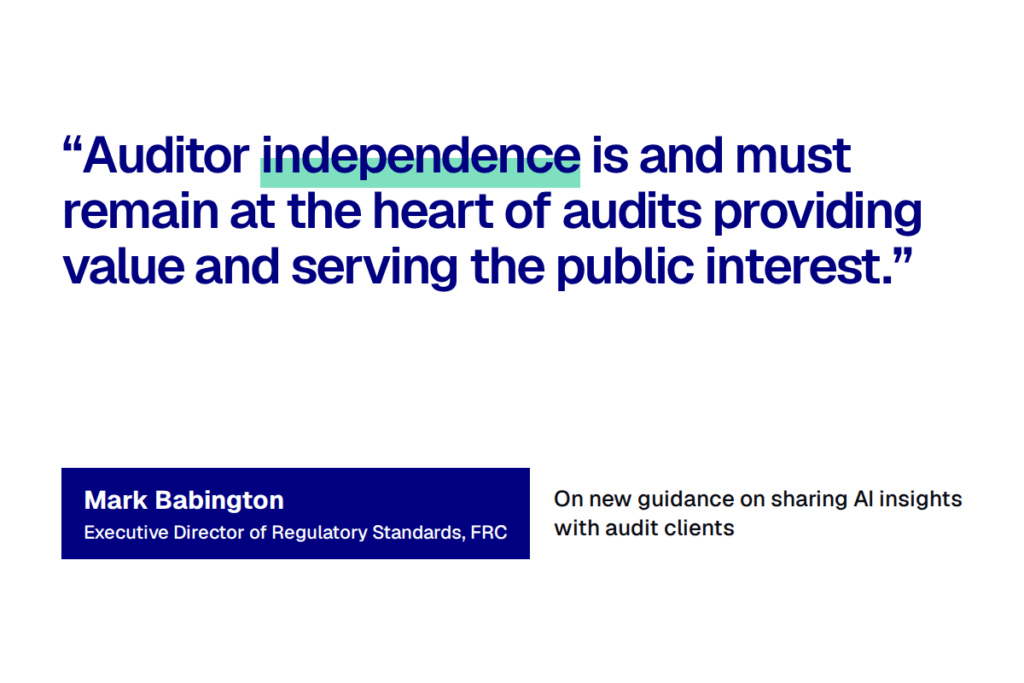
“Auditor independence is and must remain at the heart of audits providing value and serving the public interest,” said Mark Babington, Executive Director of Regulatory Standards at the FRC.
The guidance builds on earlier publications from the Financial Reporting Council on generative and agentic AI tools in audit engagements and on potential AI use cases in UK audit. Those papers sit alongside the regulator’s earlier AI guidance for audit firms, which focused on audit quality rather than commercial conduct.
Where overhyping AI creates an independence threat
The guidance has no section headed “overhyping”, but three passages address the behaviour directly. On automation bias, it says a heightened threat may arise where an insight is accompanied by “claims about the reliability of the relevant technology”, because management may rely on the output without testing it.
On self-review, it says the threat may increase where the firm “refers to the technology in its marketing material”. On self-interest, it says a threat may arise where the insight is seen as “demonstrating the capabilities of their technology as a basis for winning future work”.
Taken together, these passages describe a pattern the regulator wants firms to avoid: presenting an audit tool’s findings to a client in a way that doubles as a sales pitch for the firm’s advisory, technology or data practice. The guidance excludes general thought leadership pieces from its scope, so published commentary is treated differently from insights given to a specific audited entity.
Neither the guidance nor the FRC’s announcement names any firm, and neither says the regulator has reviewed any firm’s sales practices. That leaves the document as a statement of how the FRC expects the existing rules to be read, not a finding against anyone.
How the non-audit services rules and fee cap apply
The guidance says a communication is a non-audit service only if it is not part of the audit and amounts to an engagement, which can be tacit. A firm cannot assume that an insight handed over informally falls outside the rules because no engagement letter exists.
For public interest entities, the guidance points to the list of permitted non-audit services, which are allowed only with audit committee approval, and to the fee cap. The Revised Ethical Standard 2024, which took effect on December 15, 2024, keeps a 70% cap on non-audit fees for PIE auditors, and the FRC has said it has no power to change that cap, which is set by law.
The guidance does not explain how the cap is calculated. Its first worked example involves a PIE audit in which an AI tool produces customer discount insights that are shared with management, and because no fee is charged the guidance says the cap is “not a relevant consideration”.
Free work does not escape scrutiny, however. Where market fees are not charged, the guidance says a favour may arise, and a favour is permitted only if an objective, reasonable and informed third party would consider its value trivial or inconsequential. The value is measured by the audit firm’s cost of generating the insight, not by what it is worth to the client.
In that first example the auditor concludes the communication is a permitted non-audit service, with audit committee approval, and that the favour is trivial. In the second example, an expense analysis carried out as part of the audit, passing on the observation is neither a non-audit service nor a favour, so no formal threat assessment is needed. The guidance cautions that both examples lack much of the information available in real engagements.
What changes for audit committees and cross-selling
For audit committees, the practical effect is that approval of non-audit services now has to cover insights that arrive as a by-product of audit technology. A committee that sees only signed engagement letters may miss work that the guidance would classify as a tacit non-audit service.
For firms, the main change is to how audit teams and advisory teams talk to the same client. A partner who describes an AI-generated finding as proof of what the firm’s wider technology practice can do is close to the self-interest threat the guidance describes. The same applies to marketing material that cites the tool behind the insight.
The guidance is silent on enforcement, penalties and inspections. The FRC has not said it will test firms’ compliance with it, although the Ethical Standard itself remains enforceable, and the FRC has used it before. In 2024, for example, it fined Deloitte more than £6 million over its Go-Ahead audits.
Firms are also adding AI to their audit methodology, as with the AI-suggested risks in Caseware’s Verity agent, so the volume of technology-derived findings that could be shared with clients is likely to grow. Each one raises the same question of whether it is part of the audit, a non-audit service or a favour.
What to watch after the guidance
The Financial Reporting Council has not set a date for reviewing how UK firms apply the guidance. The practical test will come in the next audit committee cycle, when committees decide whether technology-derived insights shared with management are recorded as non-audit services and approved as such, and when firms decide how their advisory teams may refer to the audit tools behind them.
Accountio.
The go-to weekly newsletter for accounting professionals. Trusted by 10,000+ industry leaders to deliver the tech trends and insights that matter most. Join them today.
Companies in this article
CasewareAuditView listing →