Financial Reporting Council Releases AI Guidance for Audit Firms
The Financial Reporting Council published guidance on November 16 on how auditors can share AI-derived insights with clients without compromising independence.
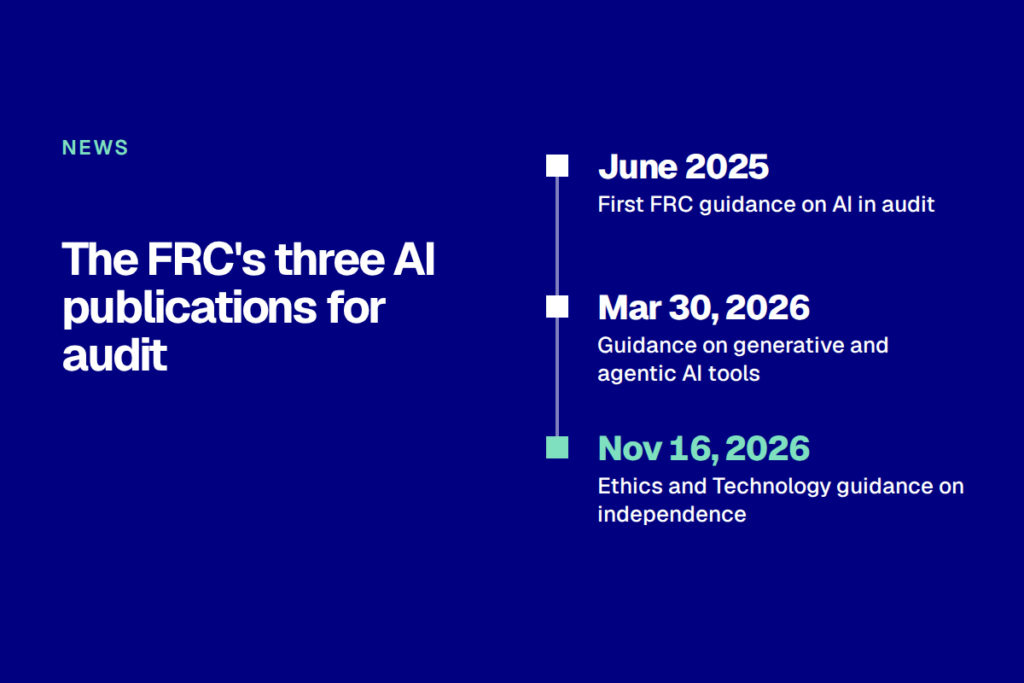
The Financial Reporting Council published guidance on November 16, 2026 on how auditors can pass on insights gained from technology, including artificial intelligence, to audited clients without compromising their integrity, objectivity or independence. The FRC AI guidance for auditors runs to 25 pages.
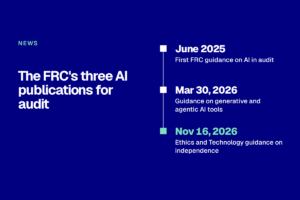
The document, titled Ethics and Technology, is the third AI-related publication the UK audit regulator has issued in 17 months, and the first to focus on ethics rather than audit quality. For audit firms that now use AI to flag misstatement risks or weak internal controls, it answers a practical question: what happens when the tool finds something the client would like to know?
The answer matters well beyond the UK. Firms in the US and the EU face the same tension between selling insight and preserving independence, and the AICPA’s guidance on AI in audit shows US regulators asking auditors similar questions about the technology.
Accountio.The go-to weekly newsletter, straight to your inbox.Weekly newsletter, straight to your inbox.
What the FRC AI guidance for auditors covers
The FRC said the guidance helps auditors apply the Ethical Standard in two situations. The first is communicating insights obtained through technology to management or to those charged with governance, and the second is giving those parties access to tools that let them generate such insights themselves.
The FRC stated the aims of the guidance in two parts. It wants to reduce the risk that auditors provide insights that compromise their integrity, objectivity or independence, or their ability to discharge their duties as statutory auditor. It also wants to give auditors confidence in applying the ethical requirements, so that they can still provide insights that do not compromise those principles.
The FRC said auditors had asked for this guidance on AI. The FRC’s release describes the publication as guidance on applying the relevant ethical requirements, and it does not present the document as a new standard or as an amendment to an existing one. The release does not give an effective date, so firms should treat it as applying to current engagements.
Why AI insights can threaten auditor independence
The FRC sees real benefits in the technology. It said AI and other emerging tools can give auditors deeper insight and improve audit quality, for example by identifying risks of material misstatement or opportunities to strengthen internal controls.
The concern lies in what happens next. According to the guidance, reporting those insights to management or to those charged with governance can create threats to integrity, objectivity or independence in some circumstances, especially where the work performed to obtain the insight does not form part of the audit of the financial statements. The FRC guidance ties the risks auditors face from AI insights to automation bias, self-review and management influence.
Self-review is the easiest of the three to picture. An auditor who helps a client act on an AI-generated finding, and later audits the result, is in effect reviewing their own advice. Automation bias is a separate risk, because an auditor who trusts a tool’s output too readily may fail to test it, while management influence arises when a client steers what the tool is asked to find.
“The purpose of an audit is to enhance the confidence of the intended users in the financial statements, and achieving this is the principal way that an audit serves the public interest. The auditor should not provide insights that would undermine this objective, for example by compromising the actual or perceived integrity, objectivity or independence of the auditor.”
Financial Reporting Council, Ethics and Technology guidance
That passage sets the test firms will be measured against. The question is not only whether independence is intact but whether it appears to be, which is the standard the Ethical Standard has long applied to non-audit services.
Regulator comment on AI guidance for auditors
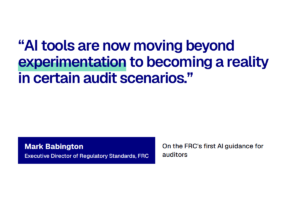
“The use of AI by auditors can enhance the quality of audit work done and the insights provided to audited entities. However, auditor independence is and must remain at the heart of audits providing value and serving the public interest. Today’s guidance will support auditors understand and apply ethical requirements and appropriately communicate any insights gained through the use of technology.”
Mark Babington, Executive Director of Regulatory Standards, Financial Reporting Council
Steve Collings, a director at Manchester firm Leavitt Walmsley Associates and author of A Practical Guide to UK Accounting and Auditing Standards, said auditors will need to consider whether the use of AI will result in valid conclusions which stakeholders can place trust in. He added that “AI is not a replacement for humans and human oversight will still be needed to interpret the results of procedures carried out using AI.”
Collings also noted that the guidance explains how auditors might reduce the risk of compromising their independence, as well as how to apply the ethical requirements with confidence.
How it follows the FRC’s earlier AI publications
The November document completes a sequence. The FRC issued its first guidance on AI in audit in June 2025, and on March 30, 2026 it published guidance on generative and agentic AI tools in audit engagements.
The March document offered a framework for judging how much confidence to place in an AI tool’s output and used examples such as summarising board minutes and reviewing contracts for revenue recognition testing. It also made clear that the human auditor stays accountable, and that firms and Responsible Individuals, rather than tools, are accountable for audit quality.
The three documents deal with different questions. The earlier two concern how auditors use AI to do the audit, while the latest concerns what auditors may tell clients about what the tools find, which is a question of ethics rather than methodology.
Where AI audit tools meet the new guidance
The timing reflects how quickly vendors and firms are building tools that generate findings. Caseware’s Verity agent suggests risks to auditors, KPMG has begun piloting audit agents, and platforms such as Inflo already put analytics and client collaboration in one place.
Each of those products produces output that a client might value. A list of unusual journal entries or a map of control weaknesses is useful to a finance director, which is exactly the situation the FRC is addressing. The guidance gives firms a reason to decide in advance which findings belong in the audit report to the audit committee and which would amount to advice.
For firms, the practical steps follow from the regulator’s wording. Engagement teams should record why an insight was shared and with whom, and should be able to show that a person interpreted the tool’s output before it went to the client. Partners should also decide whether giving a client direct access to a tool changes the relationship, since the guidance treats that as a separate scenario from simply passing on a finding.
What to watch after the FRC guidance
The FRC guidance on AI leaves several points to the judgement of firms and auditors, and the regulator has said little about how it will test compliance. Its inspection teams review audit quality at the largest firms every year, so the first sign of how seriously the regulator takes the document is likely to be the questions asked about AI-derived insights in future reviews.
Firms that have not yet written down a policy on sharing technology insights with clients have the shortest route to compliance, because the guidance is written to be applied through existing ethics procedures. Those that already sell advisory services built on audit tooling face the harder task of showing that the work does not feed back into the audit opinion.
The 25-page document is available on the FRC website, and its next test will be the 2026 year-end audits now under way, when firms will first apply it to real client conversations.
Accountio.
The go-to weekly newsletter for accounting professionals. Trusted by 10,000+ industry leaders to deliver the tech trends and insights that matter most. Join them today.