
Client Accounting Services: What They Are and How Firms Deliver Them
Surveyed US firms grew client accounting services 17% in 2023 as fixed monthly fees replaced hourly billing, the AICPA and CPA.com said.
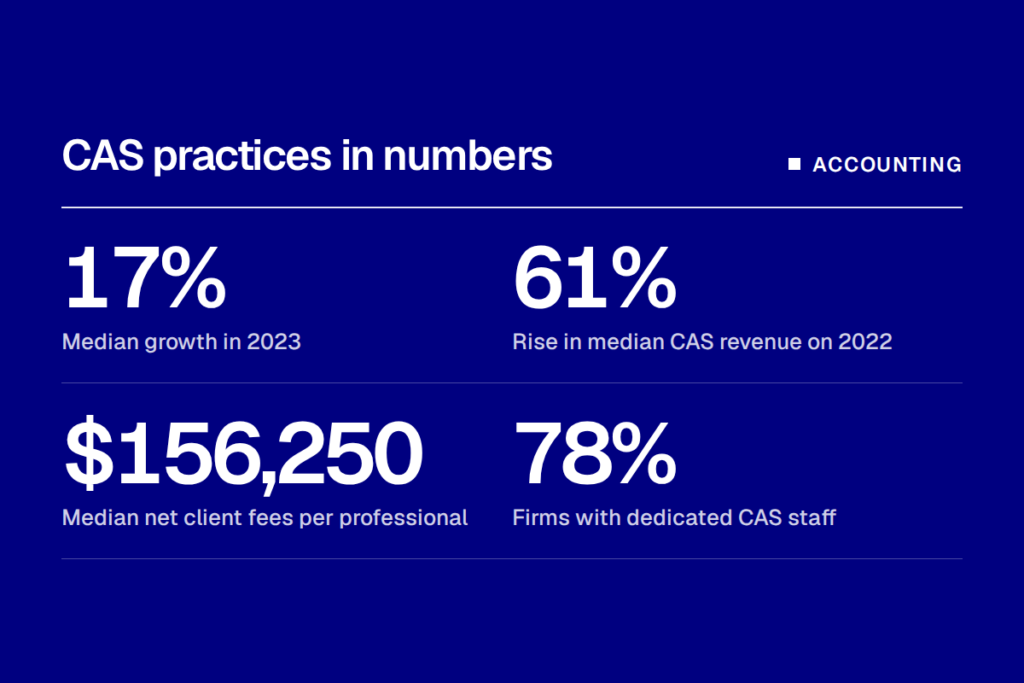
Client accounting services practices at 206 US firms reported median growth of 17% in 2023 and a 61% rise in median revenue on 2022, the AICPA and CPA.com said on December 9, 2024.
The survey is the most detailed public measure of a service line that now sits beside tax and audit in many firms. It matters to partners because the work is billed monthly, not once a year, and it changes how a firm hires, prices and chooses software.
The AICPA and CPA.com call the survey “Client Advisory Services”, but the practices it counts are the same ones. The 2026 edition is due in December, so the 2024 figures remain the latest published.
What client accounting services include
Client accounting services are a bundled, recurring offer in which a firm runs a client’s day-to-day finances and adds ongoing guidance. Intuit describes the model as tiered, from transactions up to advisory work.
The base tier is bookkeeping: payables, receivables and bank reconciliations. Payroll, tax support and monthly or quarterly financial statements sit above it.
The top tier is controllership and advisory work, covering budgeting, cash flow forecasting, financial modelling and outsourced finance director or virtual CFO services. In effect, it is outsourced accounting sold as a subscription.
The ladder matters commercially. Firms offering CFO-level and business insights services reported more than 30% higher monthly recurring revenue than the rest of the sample, the CPA.com release said.
The client accounting services growth numbers
Median net client fees per professional rose to $156,250, up 29% on the 2022 survey. Respondents projected 15% growth in 2024 and median growth of 99% over three years.
Structure explains part of the gap between firms. Practices with a formal written CAS business plan reported a median of $10,000 more annual revenue per client. Practices built around an industry niche reported 38% higher median CAS revenue and 51% higher net revenue per client.
Staffing has followed. Some 78% of practices have staff dedicated only to CAS work.
“Firms are continuing to double-down on client advisory services as a key growth area, but there’s still so much more potential for those that take an intentional and strategic approach to building and scaling their CAS practices,” said Kimberly Blascoe, senior director of CAS professional services at CPA.com.
The technology stack behind client accounting services
The stack starts with cloud ledgers. Intuit lists QuickBooks Online, QuickBooks Online Accountant for workflow management, automated bank feeds and transaction categorisation, and integrated payroll and reporting as the core tools. Firms choose bookkeeping and accounting software to match the clients they serve, and the wider accounting tech stack adds reporting and workflow layers on top.
Technology spending separates the leaders. About 51% of CAS practices invest in technology continually, and those firms serve a median of 100 clients, against 67 across all respondents, the survey found.
That gap is the economic case. A firm that automates feeds, coding and reconciliations can take on half as many clients again with the same professionals.
Clean intake matters as much as software. A consistent client onboarding process fixes the chart of accounts, the bank connections and the close calendar before the first month is billed.
How firms price client accounting services
Hourly billing has largely gone. Only 10% of respondents use it as their primary method, against 53% in the first survey in 2018, the Journal of Accountancy reported.
Intuit sets out four common approaches. A fixed fee bundles the work at one price. A subscription is a monthly retainer for set deliverables. Hourly billing remains but is less common in modern CAS.
The fourth is value pricing, where fees reflect the outcome for the client rather than the time spent. Fee levels vary with transaction volume, reporting complexity, the number of entities and integration needs.
Fixed monthly fees reward the technology investment described above. Hours saved by automation stay in the firm’s margin instead of reducing its invoice.
Why UK and US firms are expanding client accounting services
In the US, the draw is revenue that recurs and is less seasonal than tax. The survey ties the growth to firms standardising processes and billing fixed fees on a recurring basis.
In the UK, the pressure comes from clients. A Thomson Reuters study published on July 15, 2026, found that 33% of accounting clients take advisory work to rival firms even where their main firm offers the same services. Censuswide polled 500 UK businesses in May 2026 for Ravical, an AI software company, and Thomson Reuters reported the results.
Small practices lose the most. Some 42% of sole practitioners’ clients and 48% of clients of firms with two to 10 staff use other providers, against 12% at Top 50 firms.
The study found price was not the main reason. Some 92% of clients said they would spend more for the support they need, by 16% on average, and 94% said they would consider returning if quality matched.
The same technology is open to firms in both markets. The difference is the starting point: US practices are scaling an established line, while many UK firms are building one to stop advisory work leaving.
Client accounting services versus client money accounting
The terms are easily confused. Client accounting services are the work a firm does on a client’s books. Client money accounting concerns funds a firm holds on a client’s behalf, and the records that keep those funds separate from the firm’s own.
A firm can run a large CAS practice without ever holding client funds. A firm that does hold them needs the controls set out in Managing Client Money: The Essentials of Client Accounting Explained.
The AICPA and CPA.com will publish the 2026 CAS Benchmark Survey in December, the first update since the 2024 report. It will show whether the 17% median growth rate held and whether hourly billing fell below 10%.
Accountio.
The go-to weekly newsletter for accounting professionals. Trusted by 10,000+ industry leaders to deliver the tech trends and insights that matter most. Join them today.