AML risk assessment template for accountants
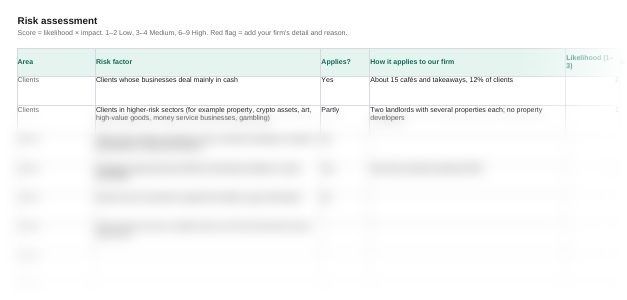
Write down the money laundering risks your firm faces, rate each one and record how you control it. This AML risk assessment template is one Excel workbook that scores every risk for you and flags any row that still needs your firm's own detail.
UK practicesGet this pack and 100 more for $129
What the spreadsheet looks like
Who needs one
Every practice supervised for anti-money laundering must assess, in writing, the risks of money laundering, terrorist financing and proliferation financing that its business faces. Regulations 18 and 18A of the Money Laundering Regulations 2017 require it, and your supervisor can ask to see it along with the information it was based on.
- You are setting up a practice and registering with HMRC, ICAEW, ACCA or AAT for AML supervision
- You don't yet have a written risk assessment, or the one you have doesn't describe your own firm
- Your yearly review is due
- You add a service, take on a new type of client or start using new technology such as electronic ID checks
How to use the AML risk assessment template
- Fill in the firm profile. Use your real numbers: how many clients, which sectors, how many you have never met and whether you hold client money. These figures are your evidence.
- Answer every risk factor. Mark each one Yes, Partly or No, then describe how it applies to your firm. Add your own risks in the blank rows at the end of each area.
- Score likelihood and impact from 1 to 3. The spreadsheet multiplies them: 6 or more is High, 3 or 4 is Medium, 1 or 2 is Low.
- Clear the red flags. Any row that applies without detail, scores or a reason stays red until you complete it. The summary counts the rows still to do.
- Write your conclusion and get it approved. Record your main risks and what you will change in your policy, procedures and training. The senior manager in charge of AML compliance signs it off, and the next review date is set a year later.
Questions
What is an AML risk assessment?
It is your firm's written assessment of how it could be used for money laundering, terrorist financing or proliferation financing. It looks at your clients, the countries you deal with, your services, the transactions you see and how you take on clients, and it decides how much checking your policy and procedures require.
Is an AML risk assessment a legal requirement?
Yes. Regulation 18 of the Money Laundering Regulations 2017 requires every firm in scope to identify and assess its money laundering and terrorist financing risks and keep an up-to-date written record. Regulation 18A adds proliferation financing. You must give the assessment to your supervisor when asked.
What should a firm-wide risk assessment include?
At least the five risk factors the regulations name: customers, countries or geographic areas, products or services, transactions and delivery channels. It must also take account of the risk information your supervisor publishes. Each risk needs a rating, the controls you use and the reason for your rating.
How often should we review our AML risk assessment?
The accountancy sector's AML guidance says at least once a year, and again whenever something changes your risks, such as a new service, a new type of client or new technology.
Who should prepare and approve it?
The MLRO can prepare it, but senior management must approve it, including the senior manager in charge of AML compliance if that is someone else. In a sole practice with no staff, you do both.
Can I use a template for my AML risk assessment?
Yes, as long as what you write in it describes your own firm. The regulations require the assessment to reflect the size and nature of your business. The spreadsheet flags every row that applies but has no firm detail or reason, so a generic answer doesn't get through.
Also in the AML compliance pack
Who it's for
Sole practitioners and small accountancy firms that need a written firm-wide risk assessment their supervisor can follow.
Last checked
Checked against the Money Laundering Regulations as amended on 30 June 2026 and the sector's July 2026 guidance.