Deloitte Launches AI-Powered Green Claims Navigator for Greenwashing Checks
Deloitte’s Green Claims Navigator tests sustainability claims against EU and Swiss rules, as the Deloitte AI agent push reaches ESG assurance.
Deloitte has launched Green Claims Navigator, an AI-powered tool that checks sustainability claims on websites, reports, packaging and marketing material against EU and Swiss rules, the firm said in early November 2026.
The launch matters to finance teams because the rules it targets turn marketing language into a compliance and audit question. The EU’s Empowering Consumers for the Green Transition Directive (EmpCo) has applied since September 27, 2026, and requires environmental claims to rest on objective, verifiable evidence. Any claim that reaches a sustainability report, a prospectus or an investor deck now needs a documented basis.
Deloitte has framed the product as a governance tool for large companies. It is one more sign that the Deloitte AI agent push, which already covers audit through Deloitte Omnia, a network of AI agents for 85,000 auditors, is now reaching ESG assurance.
Accountio.The go-to weekly newsletter, straight to your inbox.Weekly newsletter, straight to your inbox.
What the Deloitte AI agent tool does for green claims
Deloitte describes Green Claims Navigator on its Swiss website as an AI-powered compliance solution that detects misleading sustainability claims across a company’s whole content estate. It cross-references each claim against the regulatory requirements that apply and flags where substantiation is missing.
The product has three parts. Compliance assessment tests claims against current standards and sets up governance around them. Claims validation produces an action plan to substantiate claims or remove them. Monitoring and assurance tracks regulatory changes and enforcement trends as they happen.
Recommendations include rewritten claims, informed by expert consultation and regulatory best practice. That puts human advisers in the loop, which is how Deloitte has chosen to sell the tool.
Lay Boon Tan, Swiss Assurance Leader at Deloitte, announced the product in a post. She tied it directly to the EU directive.
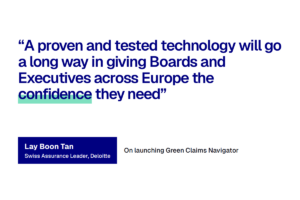
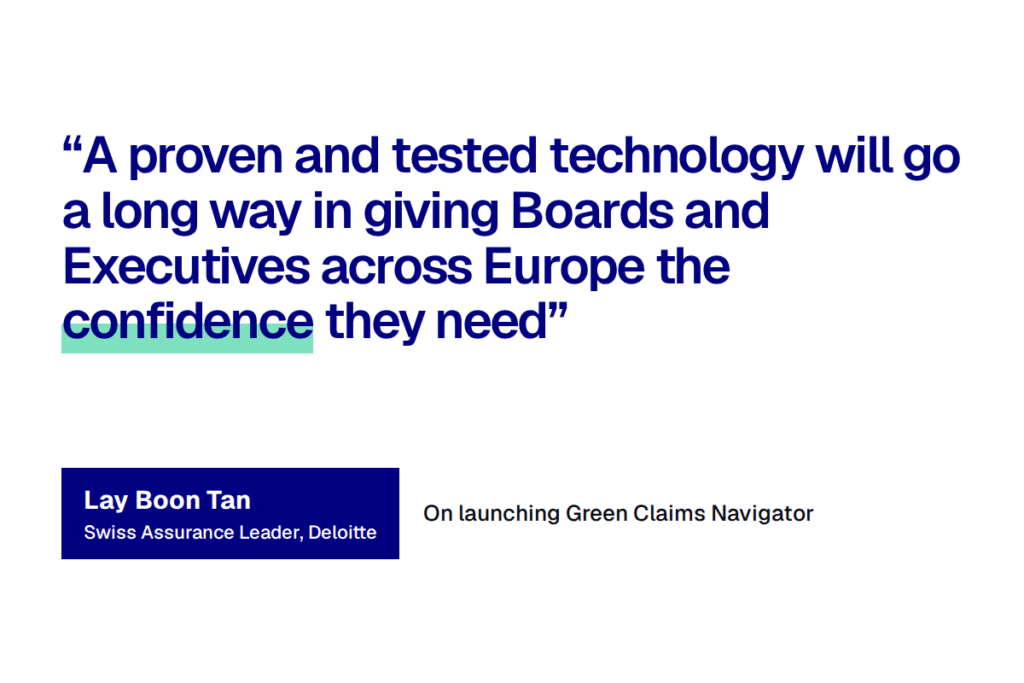
“With the recent EU Empowering Consumers for the Green Transition Directive, the importance of environmental claims that are clear, credible and supported by evidence is now enshrined by law – A proven and tested technology will go a long way in giving Boards and Executives across Europe the confidence they need against these regulatory demands.”
Lay Boon Tan, Swiss Assurance Leader, Deloitte
Deloitte’s product page names two regimes: Switzerland’s Unfair Competition Act, as updated in January 2025, and EmpCo. Contact details on the page are for Deloitte’s Swiss sustainability and assurance team, which points to a Europe-first rollout.
Deloitte has not published pricing or a general availability date. The page does not say whether clients buy software, a managed service or an advisory engagement, and it directs interested companies to contact the firm.
Why the EmpCo Directive drives demand for the tool
Directive (EU) 2024/825 amends EU consumer law to restrict vague environmental claims, claims of climate neutrality that rely on carbon offsetting, and unverified sustainability labels. Member states had to transpose it by March 27, 2026. The rules apply from September 27, 2026.
The directive sits in consumer law, so enforcement runs through national authorities rather than auditors. Finance teams still feel it. The same claim a marketing department puts on a pack often appears in the annual report, and the finance function signs the report.
The wider EU picture is less settled. The European Commission has signalled that it intends to withdraw the separate Green Claims Directive, which would have set detailed substantiation rules and mandatory third-party verification. Its 2027 work programme, published on November 4, 2026, lists the proposal among those to be withdrawn, and it remains formally pending until the procedure is complete.
Without that directive, EmpCo is the operative EU rule. It bans misleading claims but does not prescribe a verification process, which leaves companies to design their own evidence trail. That gap is the market Green Claims Navigator is aimed at.
UK rules reach the same claims under the DMCC Act
The UK follows a different route to a similar place. Since April 6, 2025, the Competition and Markets Authority has been able to decide for itself whether consumer law has been broken and to fine companies, under the Digital Markets, Competition and Consumers Act 2024. The CMA’s published guidance sets the ceiling at 10% of global turnover, or £300,000 where that is higher.
The Act has no greenwashing-specific provisions. Misleading environmental claims fall under its rules on unfair commercial practices, and the CMA’s Green Claims Code continues to apply as guidance.
For a multinational selling in the EU, Switzerland and the UK, that means three overlapping tests for the same sentence on a product page. Deloitte’s tool is built for that cross-referencing problem, though the firm has not said whether UK law is among the regimes it covers.
Where the Deloitte AI agent fits in ESG assurance
Marketing claims and reported disclosures are separate legal categories, but auditors and finance teams see them together. The EU’s Corporate Sustainability Reporting Directive requires assurance of reported sustainability information, and ISSB standards leave assurance to each jurisdiction. A claim in a brochure that contradicts the sustainability statement is a problem for both.
Scoping of CSRD is still changing. Readers tracking which entities remain in the reporting perimeter can use the CSRD scoping pack, and the debate over weaker non-EU requirements is covered in Accountio’s report on the EU Sustainable Finance Platform.
A tool that inventories claims and ties each to evidence could shorten the work of reconciling marketing copy with reported data. Companies already running ESG data platforms will want to compare it with the tools described in how ESG software solves reporting challenges for accounting firms.
Deloitte audits and advises at the same time, so independence is a live question for any client that buys the tool from its auditor. Independence rules for audit clients limit some non-audit services, and a company would need to settle with its audit committee whether a claims review sits inside those limits. Deloitte has not addressed the point in the material it has published.
Limits and liability a Deloitte AI agent leaves open
Deloitte’s description does not say how the tool treats evidence it cannot read, such as supplier certificates, lifecycle assessments or offset registry records. Nor does it give accuracy figures, error rates or a method for testing the model against enforcement outcomes.
The liability position is also unstated. If the tool clears a claim that a regulator later finds misleading, it is unclear who bears the cost, the company or the adviser. A rewritten claim that passes a software check is still the company’s statement, and the directors answer for it.
Finance leaders deploying any Deloitte AI agent or a rival product should treat the output as a working paper, not a sign-off. That means a named owner for each claim, retained evidence, and a record of who reviewed the tool’s suggestions. The checklist in AI agent governance for finance teams applies as much to a claims checker as to a reconciliation bot.
No independent sustainability assurance practitioner has yet published a view on how well Green Claims Navigator performs. The product is days old, and Deloitte has released no client names or case results.
What comes next for green claims checks
EmpCo enforcement is now a matter for national authorities across the EU, and the first cases will show how strictly they read “verifiable”. The Commission has up to six months from its November 4 work programme to complete the withdrawal of the Green Claims Directive.
Deloitte has pointed interested companies to its Swiss assurance team, and pricing and wider availability are the next facts to watch for.
Accountio.
The go-to weekly newsletter for accounting professionals. Trusted by 10,000+ industry leaders to deliver the tech trends and insights that matter most. Join them today.