AML policy template (UK) for accountancy firms
Set out who does what, how you take on and check clients, and how staff report a suspicion. This AML policy template is one Word document of policy and step-by-step procedures, built around your own risk assessment.
UK practicesGet this pack and 100 more for $129
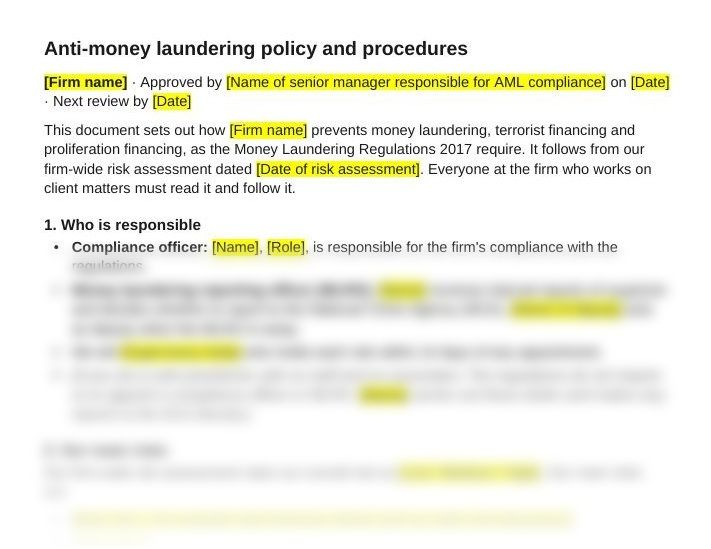
What the policy looks like
Who needs one
Every accountancy practice covered by the Money Laundering Regulations 2017 must have written policies, controls and procedures for the risks found in its risk assessment. Regulation 19 requires them to be proportionate to the size of the firm and approved by senior management.
- You are registering a new practice with HMRC, ICAEW, ACCA or AAT for AML supervision
- Your supervisor has asked to see your policy, or a monitoring visit is coming up
- Your current policy doesn't match your latest risk assessment
- The law or your supervisor's guidance has changed, as it did on 30 June 2026
How to use the AML policy template
- Finish your risk assessment first. The policy refers to its date, your overall rating and your main risks.
- Fill in the names. Your compliance officer, MLRO, deputy MLRO, the senior manager who approves high-risk clients and your supervisor.
- Make your choices. Pick whether you use simplified due diligence, set your review periods for High, Normal and Low clients and choose how you check training.
- Delete what doesn't apply. For example, the sole practitioner paragraph or the electronic ID check line.
- Approve it and tell your staff. The approval line at the end is for the senior manager. Log each later change in section 14 with the date and how staff were told.
Questions
Do I need an AML policy?
Yes, if your firm is covered by the Money Laundering Regulations, as accountancy practices offering accountancy or tax services are. Regulation 19 requires written policies, controls and procedures, a record of any changes and a record of how you told your staff.
What should an AML policy include?
Risk management, internal controls, customer due diligence, reliance, record keeping, monitoring compliance and how the policy is shared within the firm. It must also cover scrutiny of unusually complex or unusually large transactions, new products and technology, and the duty to report suspicions.
Who has to approve the AML policy?
Senior management. In a small firm that is usually the partners, directors or owner. The policy ends with an approval line for their name, role and date.
How often should an AML policy be reviewed?
The regulations require regular review. The policy sets a review at least once a year, and again whenever the law, your supervisor's guidance or your risk assessment changes.
Does a sole practitioner need an AML policy?
Yes. A sole practitioner with no staff and no associates doesn't have to appoint a compliance officer or MLRO, but still needs a risk assessment and written policies and procedures. The policy has an optional paragraph for this case.
Who should staff report a suspicion to?
The MLRO directly. Reporting to a line manager or colleague is not enough under the Proceeds of Crime Act 2002. Staff must not discuss it with the client, as that could be tipping off.
Also in the AML compliance pack
Who it's for
Sole practitioners and small accountancy firms that need written AML procedures staff can follow.
Last checked
Checked against the Money Laundering Regulations as amended on 30 June 2026 and the sector's July 2026 guidance.