VAT on Cryptoassets UK: Registration, Place of Supply, Records
HMRC’s new GfC21 guidance sets out registration, place of supply and record-keeping rules for crypto businesses, with no new VAT rules.
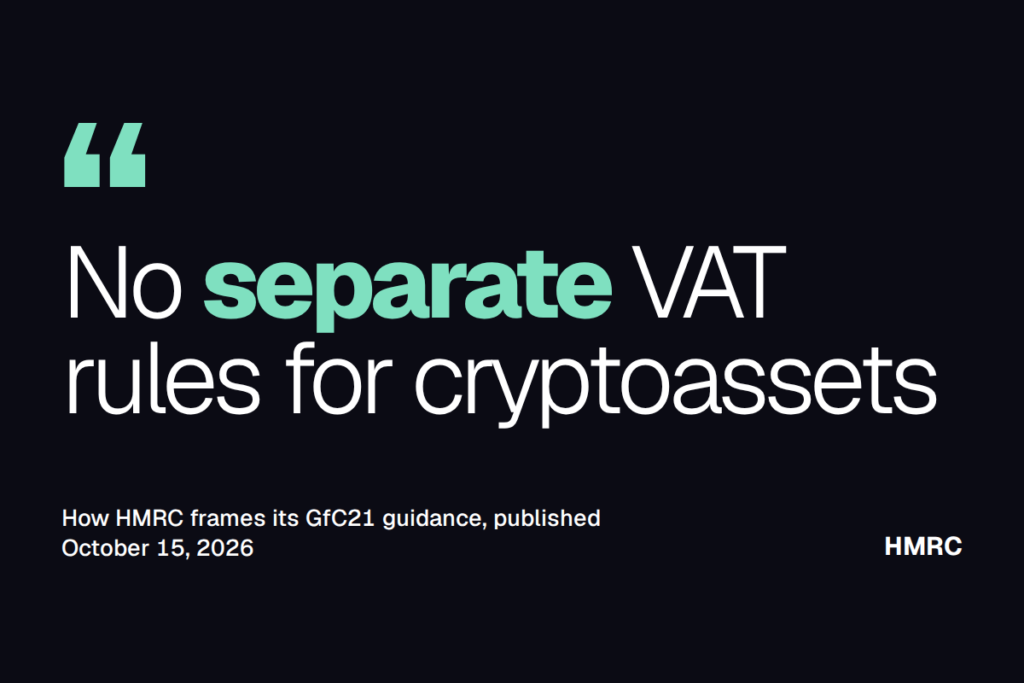
HMRC published Help with VAT on cryptoassets, known as GfC21, on October 15, 2026, setting out how VAT on cryptoassets UK businesses sell, exchange or facilitate applies to registration, place of supply and records.
The page carries no change notes, and the guidance introduces no new tax. HMRC states plainly that “there are no separate VAT rules for cryptoassets”. What GfC21 adds is a single compliance document that applies existing VAT law to crypto businesses, with worked examples.
For accountants, the value lies in the evidence standard. The guidance tells businesses what customer information to hold, and it warns that under-declaring VAT can bring compliance checks, adjustments, interest and penalties. Practices advising exchanges, NFT sellers and token platforms can use it as a benchmark for client files.
Article Sponsor · your logo, one line and a link inside every article
What GfC21 says about VAT on cryptoassets UK businesses face
GfC21 sits in HMRC’s Guidelines for Compliance series. It covers businesses that sell, exchange or facilitate cryptoasset transactions and addresses five questions: how VAT applies, when to register, what customer information is needed, where VAT is due and who must account for it.
The guidance does not set out exchange-specific, mining or staking treatment. Those points sit elsewhere in HMRC’s material, covered below. The core principle in GfC21 is that VAT depends on what is supplied and how it is used, not on the fact that a cryptoasset is involved.
NFTs follow the same logic. The treatment follows the underlying asset, so digital art is treated as digital art and a physical car as a car.
Registration: the £90,000 threshold and exceptions
Businesses must register for VAT when taxable turnover over the last 12 months exceeds £90,000. GfC21 points readers to the register for VAT guidance and VAT Notice 700/1.
It lists cases where registration may not be needed:
- all UK sales are zero-rated;
- an overseas seller makes all its UK sales through an online marketplace to non-business customers;
- an EU-based seller sells only goods to a non-taxable customer in Northern Ireland;
- all UK sales go to a VAT-registered Great Britain business that accounts under the reverse charge.
The consequence of getting this wrong is spelled out. If a business should have registered, HMRC may register it without its agreement, and penalties can follow.
Place of supply decides where VAT on cryptoassets is due
For business customers, the place of supply is usually where the customer is based. A UK customer means UK VAT applies. An overseas customer means no UK VAT, but the seller must apply that jurisdiction’s rules.
For digital services sold to private customers, the place of supply is where the customer is located. Direct sales to UK customers attract UK VAT. Sales to customers outside the UK generally do not, though obligations may arise in the customer’s country. The same logic underpins VAT on digital services generally.
HMRC accepts a VAT number as evidence of business status. A business website or commercial documents may also be accepted. For private customers, sellers should collect two pieces of evidence of where the customer normally lives, unless a presumption simplifies the position for a particular service.
Reverse charge services are supplied by an overseas supplier to a UK relevant business person. The customer accounts for the VAT. Non-digital services follow the general place of supply rules, and use and enjoyment provisions may apply to digital services. GfC21 gives no definitive list of digital services and tells readers to contact HMRC if unsure.
Records: the blockchain is not enough
VAT-registered businesses must keep complete, up-to-date records under VAT Notice 700/21. GfC21 adds that businesses need enough information to determine the correct treatment, even when customer details are not on the blockchain.
Three facts are required: who the customer is, where they are established and whether they are a business or an individual.
The guidance illustrates the point with Marie, an NFT artist. She added account creation to checkout, collected location evidence, asked buyers whether they were acting as a business or a consumer, and recorded the sterling value of each sale. Wallet addresses and token amounts were not enough on their own.
The sterling value matters because the Cryptoassets Manual values a transaction at the pound sterling value of the exchange tokens at the point it takes place. A firm reviewing a crypto client’s VAT file should look for a dated conversion on every sale. Clients can build the control into an internal controls register, and indirect tax software can automate the location checks.
Who accounts for VAT on cryptoassets platforms
A platform operator is liable for VAT on third-party sales unless all of three conditions are met. The contracts must identify the supplier. Invoices, bills or receipts must identify that supplier and the service. The platform must not authorise the charge to the consumer, authorise delivery or set the general terms of sale.
If any condition fails, the platform treats the third-party e-service as its own supply and declares the VAT. The treatment resembles marketplace facilitator rules in other jurisdictions.
GfC21 gives two contrasting examples. In one, a platform set the terms, required accounts and held customer details, so it accounts for the VAT. In the other, an artist sold through a payment link outside the platform, the platform had no customer data or control of terms, and the artist’s invoice named the artist, who therefore accounts for the VAT.
Payment-only providers are not digital platforms and do not account for VAT on the sale. They may need to supply the consumer’s two-letter country code. Businesses unsure of their position can apply for a non-statutory clearance, quoting “VAT Cryptoassets GfC21”.
Exchange, mining and staking sit in the manual
The treatment of specific activities comes from HMRC’s Cryptoassets Manual, section CRYPTO45000, which tracks HMRC’s 2019 policy paper for businesses and its earlier 2014 position.
VAT is due in the normal way on goods or services sold in exchange for exchange tokens. No VAT is due on the supply of the token itself. Exchanging tokens for legal tender, and the services needed to do so, are exempt from VAT under Group 5 of Schedule 9 to the Value Added Tax Act 1994. That follows the Court of Justice of the European Union ruling in Hedqvist (C-264/14).
Mining rewards are generally outside the scope of VAT. The manual’s reasoning is that the activity is not an economic activity for VAT purposes, because the link between services and consideration is too weak and there is no customer for the mining service.
The manual’s VAT page does not address staking, and neither does GfC21. Firms should not read an exemption or a charge into that silence.
HMRC describes the manual’s VAT treatments as provisional, pending further developments in the regulatory and EU VAT positions.
What to check next
Practices with crypto clients can use GfC21 as a review checklist: registration status against the £90,000 threshold, customer-location evidence for every private sale, sterling valuations and a clear answer on who the supplier is on each platform. Teams assessing automation should read how ready tax teams are for AI indirect tax tools first.
HMRC invites corrections to GfC21 by email at ccgguidelinesforcompliance@hmrc.gov.uk, quoting the reference. The manual’s provisional status means any change to the exchange and mining treatments would arrive through an update to CRYPTO45000, the page to watch.
Accountio.
The go-to weekly newsletter for accounting professionals. Trusted by 10,000+ industry leaders to deliver the tech trends and insights that matter most. Join them today.