Crowe Starts Shared Ownership Program for All Employees
Crowe launched CroweONE on October 19, giving every employee a share in the firm with no upfront cost, two months after KKR closed its investment.
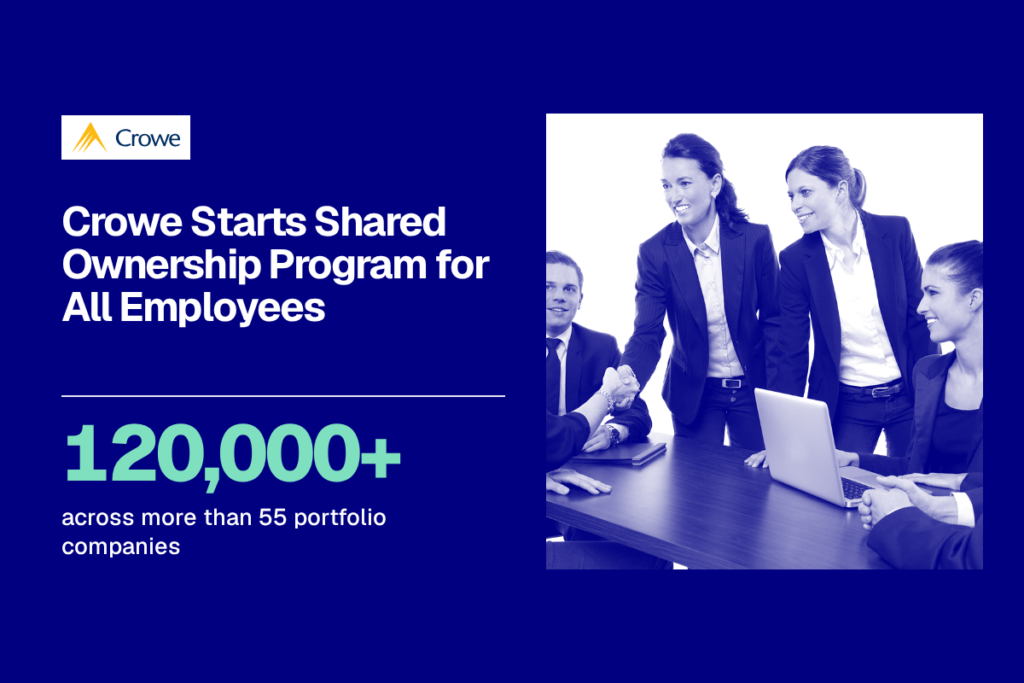
Crowe launched CroweONE on October 19, a shared ownership program open to every employee at the Chicago-based top-15 US firm, with no upfront investment, 10 weeks after KKR closed its equity investment. The launch makes it one of the broadest cases of accounting firm employee ownership in the US market.
The name is short for “Crowe: Our Next Era”. Crowe said in its announcement that the program goes beyond senior leaders or select groups to all eligible employees across the firm. Future hires will also be eligible.
The program was developed with KKR, the global investment firm that completed its investment in Crowe on August 7. Crowe said the scheme gives employees an opportunity to share in the growth of the firm in addition to existing compensation and benefits.
Article Sponsor · your logo, one line and a link inside every article
For finance professionals the question is how private equity money changes who benefits from a firm’s growth. Until now, the capital flowing into the profession has largely rewarded partners. Crowe is testing whether ownership can reach a much wider group, at a time when firms compete hard for experienced staff.
What Crowe has said about accounting firm employee ownership
Crowe has disclosed the headline terms and not the mechanics. Employees invest nothing up front, and the program sits on top of salary and benefits rather than replacing any of it. All eligible employees can take part, and so can people hired later.
The announcement does not say whether ownership takes the form of equity, phantom equity, a profit share or a trust. It does not give a vesting schedule, a valuation method or the size of the pool, and it does not state when employees first receive their interests. Those are the terms that decide what a stake is worth to an associate or a manager.
Steven Strammello, Crowe’s chief executive, put the aim in terms of participation.
“CroweONE empowers our people to participate more directly in the firm’s success” Steven Strammello, Chief Executive, Crowe
Chris Harrington, a partner at KKR, described the thinking behind the structure.
“Broad-based ownership is about giving employees the opportunity to share directly in the value they help create” Chris Harrington, Partner, KKR
Crowe said the program is meant to build an ownership culture by helping employees understand the business and play a larger part in its future. It is one of several people measures the firm described. These include Forward Together Awards, special cash awards given in August 2026, and a record bonus pool earlier in the summer. Crowe is also setting up an employee assistance fund for staff facing unexpected financial hardship and launching a new recognition program.
KKR and the Crowe private equity deal
KKR announced its investment on June 11, 2026. KKR and co-investors take a majority stake, and Crowe partners keep a minority interest. KKR invests through its North America Fund XIV.
The deal required a reorganisation. Crowe Advisory LLC, a newly formed entity, provides tax, advisory and other non-attest services. Crowe LLP remains a licensed CPA firm and continues to perform audits, reviews and other attest work. Both belong to Crowe Global, a network of more than 300 firms in more than 150 countries as of July 2026.
That alternative practice structure is the template private equity has used across the top tier of US accounting. It keeps the investor out of the attest firm, where independence rules apply, while giving it ownership of the larger advisory and tax business. Accountio has covered how private equity is reshaping accounting and why firms on both sides of the Atlantic are weighing outside capital.
When the deal was announced, Strammello said: “The only thing that changes is our capacity to do even more for our clients.” Eight weeks after closing, the firm has pointed to a change that reaches its own people.
Where the KKR model comes from
CroweONE follows a pattern KKR has applied across its portfolio. KKR says more than 55 portfolio companies have awarded equity to over 120,000 non-senior employees, and that it intends to use the model in all new control investments across its Americas private equity platform.
Earlier examples came from industrial and services businesses. When KKR sold Geostabilization International in 2024, more than 900 employees received payouts on their stakes. At Potter Global, all 850 employees became owners after KKR bought the company in November 2023.
As an accounting firm, Crowe is among the first professional services businesses of its size to adopt this employee ownership approach. The model matters here because it gives a way to answer a question every private equity-backed firm faces. Partners sell part of their equity and receive cash, while staff below partner level see no change in their pay or prospects.
How Crowe compares with other private equity-backed firms
Crowe has joined a group of top-15 US firms with private equity backing. Baker Tilly, Grant Thornton, CohnReznick and EisnerAmper are in the same group.
Baker Tilly’s 2024 transaction with Hellman & Friedman and Valeas Capital Partners put equity in the hands of partners, who hold interests alongside the investors in the advisory business. Crowe has not said whether its partners hold their minority stake through the same kind of arrangement, and has not said how CroweONE interests relate to partner equity.
The practical difference is the population covered. A partner-only structure reaches hundreds of people. A program open to all employees reaches thousands, in every grade from graduate hires to senior managers. That has a cost to the firm and a benefit in retention, and the balance depends on the terms Crowe has yet to publish.
Retention is a live concern. Large firms are cutting entry-level hiring as AI takes over routine work, and Accountio has reported that top accounting firms are cutting graduate roles. At an accounting firm, an employee ownership stake for new hires is one way to compete for a smaller pool of experienced staff.
What firm leaders should watch next
For firm owners, the Crowe announcement sets a reference point for any discussion of accounting firm employee ownership with private equity investors. Staff will ask whether they receive a stake, how it is valued and when they can sell it.
The terms that will decide whether CroweONE is a retention tool or a communications exercise are the vesting period, the valuation formula, and what happens to an interest when someone leaves. Broad programs elsewhere in KKR’s portfolio have paid out on a sale of the business, which ties the value to an exit rather than to annual profit.
Crowe has not announced a sale process or an exit date for KKR. The firm said it will continue its people initiatives, with the employee assistance fund and recognition program still to be launched, and the next test is when it sets out how CroweONE interests are granted and valued.
Accountio.
The go-to weekly newsletter for accounting professionals. Trusted by 10,000+ industry leaders to deliver the tech trends and insights that matter most. Join them today.