TreasurUp and Apideck Partner on ERP Embedded Banking for Banks
TreasurUp and Apideck will let business banks offer branded payments, FX and cash forecasting inside QuickBooks, Xero, NetSuite and 50+ other systems.
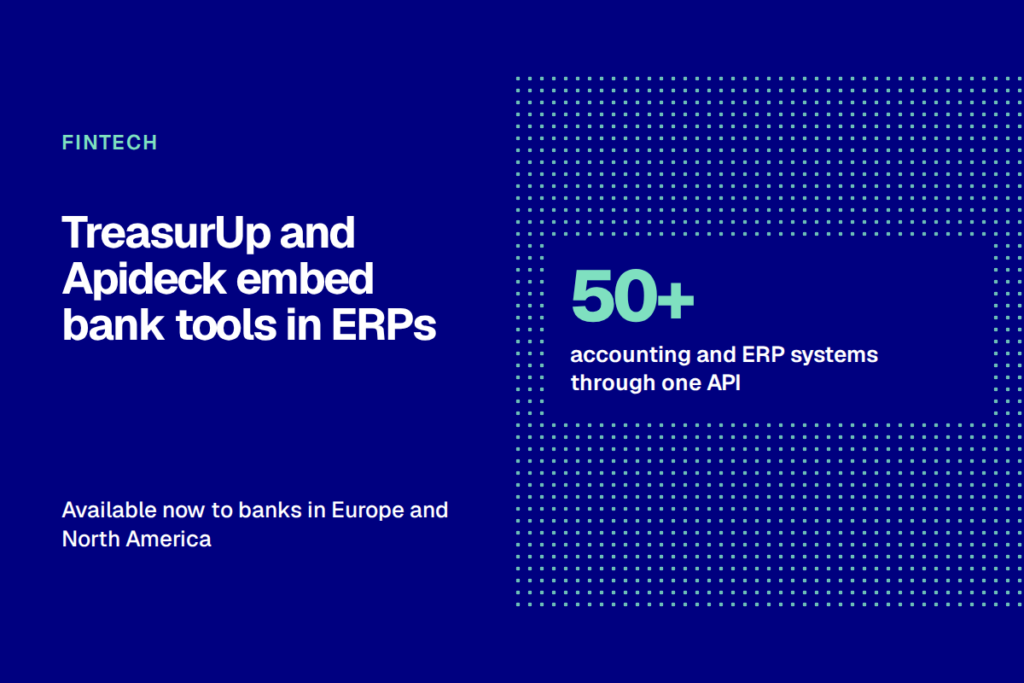
TreasurUp, the Utrecht-based supplier of white-labelled channel software to banks, and Belgian integration company Apideck have launched an ERP embedded banking offer that connects a bank’s payments, FX and liquidity tools to more than 50 accounting and ERP systems through one API.
The joint solution is available now to banks in Europe and North America, the companies said. Apideck published the announcement on September 24, 2026.
For finance teams, the change is where the bank shows up. Instead of logging in to a separate portal, a finance manager would approve payments, review currency exposure and see a cash forecast from inside the accounting package, under the bank’s own brand.
Article Sponsor · your logo, one line and a link inside every article
The companies did not name any bank that has gone live on the joint offer. They also did not disclose pricing or customer numbers. Commercial terms are proposed after an intake, based on the modules a bank chooses and the number of clients it expects to connect.
What ERP embedded banking covers at launch
TreasurUp supplies the bank-side capabilities in, or next to, the ERP. It starts with account balances, payment orchestration and bank reconciliation.
Banks can add FX execution, FX hedging, cash flow forecasting and liquidity management. Every component is white-labelled and carries the bank’s branding.
Apideck handles the connection to the accounting software. It reads and writes data across 50+ systems through one API, with embedded authentication and connection management. Its pass-through design keeps no copy of the client’s accounting data.
The companies listed the systems available at launch by region:
- North America: QuickBooks Online, Sage Intacct, NetSuite and Microsoft Dynamics 365 Business Central.
- Benelux: Exact Online, Twinfield, Yuki and Moneybird.
- UK: Xero and Sage.
TreasurUp’s own bank footprint sits in the Nordics, Benelux and Germany. Additional connectors are added on request, Apideck said.
How the integration works for a finance manager
The finance manager connects the company’s accounting system to the bank’s embedded app once. Approved supplier bills then appear in the app as payment proposals for review and approval, and the payment status flows back into the books.
Bank transactions land in the accounting system’s reconciliation screen. That targets the manual matching work behind account reconciliation at month end.
Foreign-currency invoices show up as an FX exposure, with a hedging proposal that follows the company’s own policy. The cash flow forecast is built from real receivables, payables and balances, with no spreadsheet upload.
If the company changes ERP, it reconnects. The bank does no further work.
The division of labour is fixed. The bank provides the accounts, payment rails, FX pricing and liquidity products, and keeps the client relationship. TreasurUp builds and runs the bank’s ERP-embedded app. Apideck does the technical build and certification work and guides the bank through each ERP programme where needed.
Why banks want ERP embedded banking
The pitch rests on a shift in where business decisions are made. Clients decide what to pay, what to hedge and how much cash they will hold next month inside their accounting software, the companies said, and most banks are absent from those journeys.
“Banks that are not present there risk losing flow or even the daily relationship.”
Niels van Daatselaar, CEO and co-founder, TreasurUp
Van Daatselaar said the partnership lets a bank offer a complete ERP-embedded product “in months”, in its own brand, on top of the Transaction Banking and Markets channels it already runs.
Gertjan De Wilde, Apideck’s CEO and co-founder, framed it as an integration problem. “Every accounting and ERP system has its own API, its own data model and its own partner programme,” he said. A single integration replaces a separate project for each ERP.
That matters because each ERP vendor runs its own certification programme. A bank building directly would have to pass each one in turn.
Who TreasurUp is and who it works with
TreasurUp has built software for banks only since 2016. Its products cover FX risk, liquidity management, digital assets and investment solutions, delivered through web, mobile and API-based modules. The company says its team combines former treasurers, commercial bankers and technology specialists.
Its website lists Nordea, Rabobank, KBC, SEB, Handelsbanken, Sparkasse, LBBW and OP as banks it works with, and says the platform is live at more than nine European banks. Those references describe TreasurUp’s existing channel business. Neither company has said which of those banks will deploy the ERP-embedded offer.
The companies have not disclosed who owns or funds TreasurUp. Apideck’s partner page says security, hosting and compliance requirements are reviewed per institution and per partner during solution design.
No bank customer, ERP-using finance leader or analyst has commented publicly on how the joint product performs. The reconciliation, payment and forecasting benefits are therefore the companies’ own description of the design, not results from a live deployment.
Competition in embedded banking inside ERPs
The idea of putting banking inside finance software is not new. SAP now runs payments for finance teams inside SAP Cloud ERP, and Brex has launched an accounting API for ERP automation. Both aim to keep payment flow inside the system where the invoice is booked.
Other vendors approach it from the bank side. FISPAN offers an embedded banking platform that works with NetSuite, Sage Intacct, Microsoft Dynamics, QuickBooks and Xero.
TreasurUp and Apideck are selling to the bank rather than to the company. The bank keeps its branding and its client, and the two vendors stay out of sight. That model gives a bank a reason to buy, but it also leaves the bank responsible for adoption among its business clients.
The wider pattern is a move toward embedded payments and other financial services inside business software, a trend Accountio has covered in accounts payable. Quality of ERP integration is what decides whether those features hold up in daily use.
What to watch next
The first test is whether a bank signs on and goes live. Both companies were due to attend Sibos 2026 in Miami Beach from September 28 to October 1, the annual banking conference where such partnerships are usually pitched to banks.
For accountants and finance teams, the practical questions come after that. They are which bank rolls out the app first, which ERPs it supports on day one, and what it charges clients to connect.
Accountio.
The go-to weekly newsletter for accounting professionals. Trusted by 10,000+ industry leaders to deliver the tech trends and insights that matter most. Join them today.
Companies in this article
Sage IntacctERP and General LedgerView listing →NetSuiteERP and General LedgerView listing →Microsoft Dynamics 365 Business CentralERP and General LedgerView listing →MoneybirdBookkeepingView listing →XeroBookkeepingView listing →SAPERP and General LedgerView listing →BrexExpense and Spend ManagementView listing →Compare ERP and General Ledger software
Odoo vs XeroSide by side: features, pricing and who each suitsCompare →Pennylane vs QuickbooksSide by side: features, pricing and who each suitsCompare →Quickbooks vs Sage IntacctSide by side: features, pricing and who each suitsCompare →Odoo alternativesOther ERP and General Ledger tools to shortlistSee list →PennylaneCompany profile: what it does, funding and customersProfile →QuantaCompany profile: what it does, funding and customersProfile →All ERP and General Ledger softwareEvery company in the directory categoryDirectory →