Indirect Tax Technology: What Finance Teams Use for VAT and Sales Tax
Tax engines, e-invoicing and returns filing tools now run to fixed dates in France, the EU, the UK and the US.
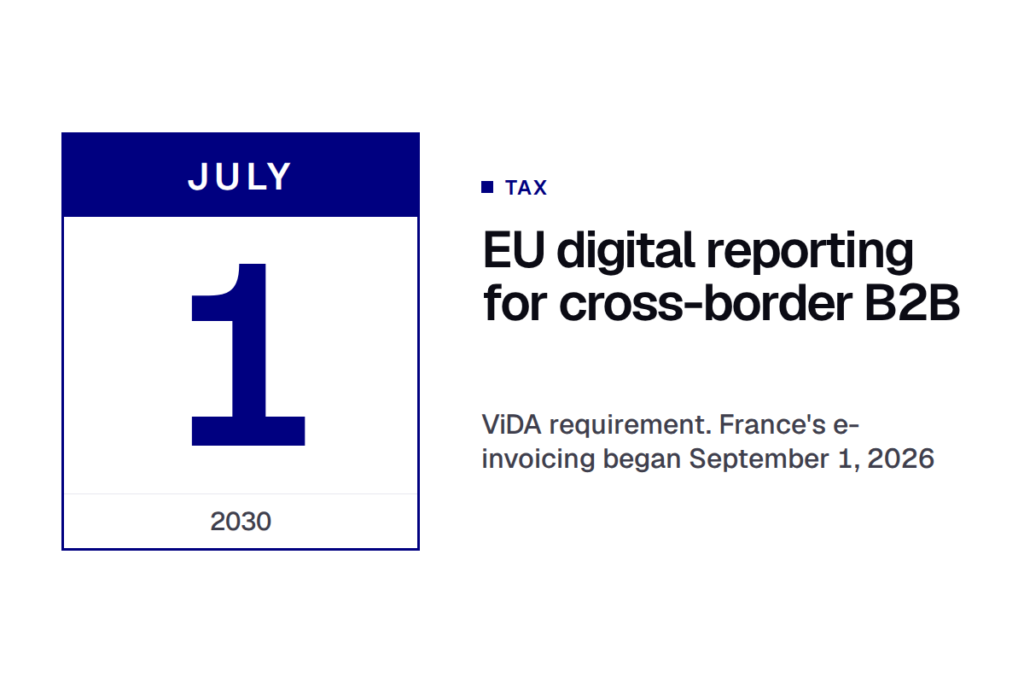
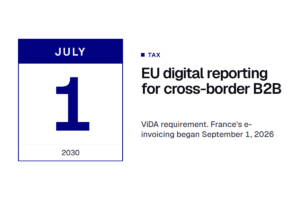
Modern indirect tax platforms are transitioning permanently from periodic reporting to fixed, event-driven timelines: France required large and mid-sized companies to issue e-invoices from September 1, 2026, and EU digital reporting on cross-border B2B sales starts from July 1, 2030.
For a finance team selling across borders, the dates matter more than the vendor list. A business that bills customers in the UK, the EU and the US meets three different tax systems, and each is moving from periodic returns towards transaction-level data sent to the authorities.
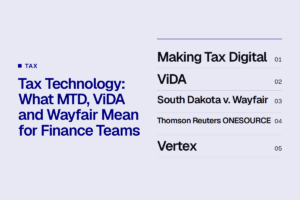
The tools split into three groups: tax engines that calculate the right tax at the point of sale, e-invoicing networks that deliver compliant invoices, and filing software that prepares returns. Avalara, Vertex, Sovos and Thomson Reuters sell products in all three. The choice affects the software budget, the close calendar and the audit trail a firm can show a tax authority.
What indirect tax technology has to cover
Indirect tax is charged on transactions rather than profits. In the UK and EU it is VAT, in countries such as Australia, Canada, India and New Zealand it is GST, and in the United States it is sales and use tax.
The three regimes work differently. VAT is collected at each stage of the supply chain, with businesses reclaiming the tax they pay on purchases. US sales tax is set state by state, with local rates layered on top in many states, and is generally charged only on the final sale. GST systems vary by country in registration thresholds and invoice rules.
A compliant transaction needs the right rate, the right tax treatment of the product, a valid customer tax number or exemption certificate, an invoice in the required format and a return filed on time. Each of those is a point where a manual process can fail.
The AI indirect tax tools now arriving from vendors sit on top of this same chain. A 2026 survey of 170 tax leaders by the Thomson Reuters Institute and the Tax Executives Institute found satisfaction with tax technology had fallen to 34%, from 56% a year earlier.
Where indirect tax compliance breaks down
The failures are rarely in the arithmetic. They come from data and from coverage.
Product and service classification is the first weak point. A tax engine can only apply the correct rate if the ledger or billing system passes it the right product code, ship-to address and customer status. Where those fields are missing or inconsistent, the engine falls back on a default.
Registration is the second. A company that crosses a threshold in a new state or country has to register, collect and file, often in a different format from its home return. Businesses that grow through online sales cross those thresholds without a tax team noticing.
Exemption evidence is the third. In the United States a seller who accepts a resale or exemption certificate that is incomplete or expired can be liable for the tax it did not charge. In the EU, a missing or invalid customer VAT number can undo a zero-rated cross-border sale.
Multiple entities and currencies add reconciliation work. The VAT figure in the return has to agree with the ledger, and the ledger has to agree with the invoices, in every entity and currency a group trades in.
Three categories of indirect tax technology
Tax engines determine the tax on each transaction in real time, through an application programming interface or an ERP connector. Vertex lists a Global Tax Engine covering more than 195 countries and territories, with add-ons for VAT ID validation and address cleansing, and a separate Accelerator+ product for SAP. Avalara sells AvaTax for calculation and Avalara Exemption Certificate Management for the evidence behind exempt sales. Thomson Reuters sells ONESOURCE Determination for the same job.
E-invoicing tools create invoices in the format a country requires and send them through the network or platform the tax authority recognises. Avalara offers E-Invoicing and Live Reporting, Vertex offers Vertex E-Invoicing for clearance and reporting across countries, and Thomson Reuters lists Pagero for global e-invoicing compliance. Sovos describes its Indirect Tax Suite as covering e-invoicing, tax determination, and filing and reporting, with about 200 countries covered by its platform.
Returns and filing software turns transaction data into returns. Avalara Returns and Vertex North America Compliance handle US sales and use tax filings. Vertex Global VAT Compliance covers European sales listings, Intrastat and SAF-T files, and Thomson Reuters sells ONESOURCE Indirect Compliance for VAT, GST and sales tax across jurisdictions.
Most buyers do not choose one category alone. A US retailer may need an engine and filing but no e-invoicing. A European exporter may need the reverse. Accountio’s guide to the best indirect tax software and its vendor comparisons set the products side by side.
Indirect tax technology and the UK, EU and US deadlines
In the UK, Making Tax Digital for VAT has applied to every VAT-registered business since April 1, 2022, when businesses with turnover below the registration threshold joined, HMRC says in VAT Notice 700/22. The rules require digital records and VAT returns submitted through compatible software. Where several programs are used, they must be digitally linked, a requirement in force for return periods starting on or after April 1, 2021. The registration threshold is £90,000 of VAT taxable turnover, according to GOV.UK.
In the EU, the VAT in the Digital Age package was adopted on March 11, 2025 and entered into force on April 14, 2025, the European Commission said. Member States can now mandate domestic e-invoicing under set conditions. ViDA then moves in stages: new deemed supplier rules for short-term accommodation and road passenger transport platforms, and single VAT registration, start on July 1, 2028, although the platform rules can be delayed to January 1, 2030.
The central date is July 1, 2030, when digital reporting requirements apply to cross-border B2B transactions. Member States with their own real-time reporting systems must align them with the EU model by January 1, 2035.
France is the first large market to run a mandate to a date. The government’s business portal says all companies must be able to receive e-invoices from September 1, 2026. Large and mid-sized companies must issue them from that date, and small and medium-sized companies and micro-companies from September 1, 2027. The same calendar applies to transmitting transaction data to the tax administration.
In the United States, the Supreme Court decided South Dakota v. Wayfair on June 21, 2018. Justice Anthony Kennedy wrote for a 5 to 4 court that the physical presence rule of Quill was “unsound and incorrect”. States could now require remote sellers to collect tax based on economic activity.
South Dakota’s law applied to sellers delivering more than $100,000 of goods or services into the state, or making 200 or more separate transactions there, in a year. States set their own versions, so sales tax nexus now has to be monitored state by state rather than assumed from where a seller has staff or stock.
What to watch in indirect tax technology
The next fixed dates are in France and Brussels. French small businesses must issue e-invoices from September 1, 2027, and EU cross-border digital reporting begins on July 1, 2030.
The tool a business buys for those dates also has to connect to its ERP, hold its exemption evidence and produce a file the ledger agrees with. Finance teams comparing vendors in 2026 should test those three points before they test any AI feature.
Accountio.
The go-to weekly newsletter for accounting professionals. Trusted by 10,000+ industry leaders to deliver the tech trends and insights that matter most. Join them today.