Private Equity Accounting Firms Reach Second Ownership Cycles
Citrin Cooperman, EisnerAmper and Smith + Howard show how private equity accounting firms are moving to a second round of owners.
Private equity accounting firms are reaching their second owners, with Citrin Cooperman, EisnerAmper and Smith + Howard each changing or restructuring their investor backing between January 2025 and June 2026.
The first wave of US deals, which began in earnest in 2021, is now maturing. Sponsors that bought stakes from retiring partners are selling to new funds, rolling holdings into continuation vehicles or exiting entirely.
For a finance professional this changes who sets the terms. Partners, clients and staff at a platform on its second investor face a different set of pressures from those at a first-time deal, because a new buyer has paid for growth already delivered and needs more of it.
AP AR and Payments in the Accountio directory
361 AP AR and Payments toolsEvery company in the category, with features, pricing and marketsCompare all →Article Sponsor · your logo, one line and a link inside every article
Private equity accounting firms hit the second turn
The clearest flip so far is Citrin Cooperman. On January 7, 2025, the New York firm announced a definitive agreement for funds managed by Blackstone to invest in it and to acquire the stake held by New Mountain Capital. Terms were not disclosed.
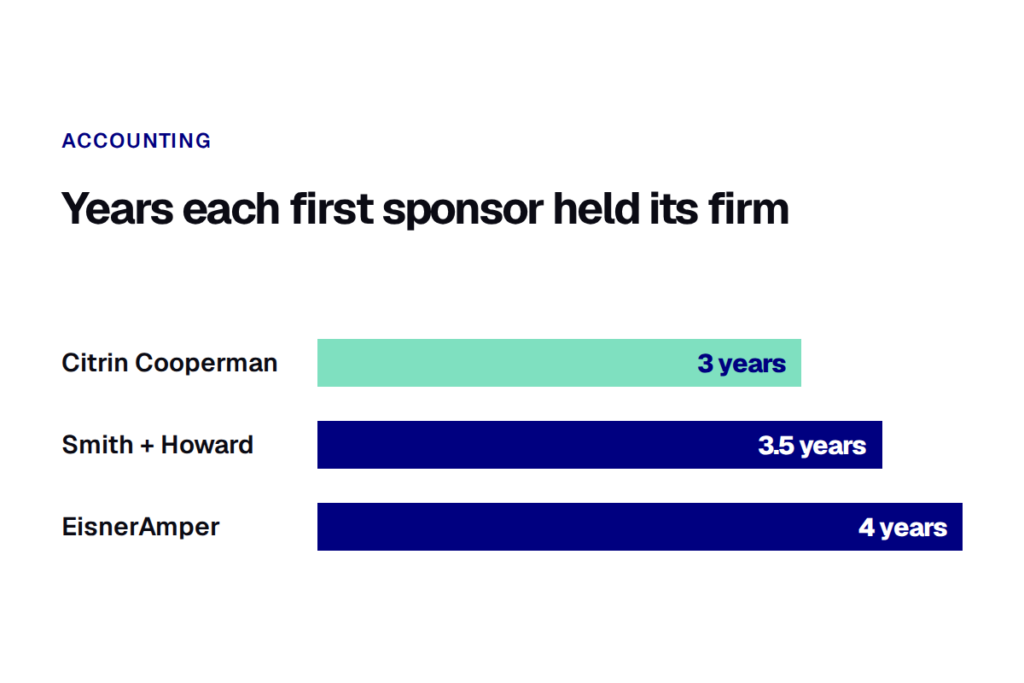
New Mountain had been the firm’s partner for about three years. At announcement, Citrin Cooperman had more than 450 partners, 2,800 professionals and more than 15,000 clients.
Alan Badey, the firm’s chief executive, said in the announcement that Citrin Cooperman was “excited to have reached an agreement for Blackstone to invest” as it entered “our next chapter of growth”. Blackstone’s Eli Nagler and Kelly Wannop said the partners and staff had done an exceptional job making the firm a leader.
Market estimates put the valuation above $2bn, at about 15 times EBITDA, against about 11 times when New Mountain came in. That gap is the number every second-round buyer and seller in the sector now measures against.
EisnerAmper chose a continuation vehicle
EisnerAmper took a different route. On March 25, 2026, TowerBrook Capital Partners announced a continuation vehicle for its investment in the firm, led by Carlyle AlpInvest and co-led by funds managed by Hamilton Lane.
The structure gives existing investors the option to sell while TowerBrook stays on as the sponsor. It is a second ownership cycle in which the first sponsor never leaves.
TowerBrook invested in 2021. Under its ownership EisnerAmper made 27 add-on acquisitions and grew to more than $1.2bn in revenue, about 475 partners and 4,700 employees, making it the 13th largest accounting firm in the US.
The deal size was not disclosed. Walter Weil, a managing director at TowerBrook, referred to the “first four-plus years” of the partnership, which sets the hold at a little over four years.
“Our original investment thesis for the accounting sector proved to be true.” Walter Weil, Managing Director, TowerBrook
Charly Weinstein, EisnerAmper’s chief executive, said the TowerBrook partnership had been “transformational in helping us expand the business”.
Smith + Howard shows the shorter hold
Smith + Howard, an Atlanta assurance, tax and advisory firm, is the third named case. On June 9, 2026, the firm announced that TPG Growth had signed a definitive agreement to make a significant investment. Financial terms were not disclosed.
The announcement puts the firm at about 800 professionals across seven states. Closing was expected in the third quarter of 2026, and Broad Sky Partners has since announced it completed the sale.
Broad Sky had held the firm for 3.5 years and reported nearly fourfold revenue growth over that period. Tyler Zachem, Broad Sky’s chief executive and partner, said the team “executed at every level”.
The new owner arrives with a short runway. Sean Taylor, Smith + Howard’s chief executive, said the firm was “excited to begin our next chapter with TPG”.
Outside the accounting practice itself, Goldman Sachs Alternatives agreed in 2026 to invest in the attestation and compliance provider Schellman, which Lightyear Capital had held for four years, according to Goldman Sachs Asset Management.
What buyers pay for in a second round
Across the three private equity accounting firms the hold periods run from about three to a little over four years. That is short against the multi-decade horizon of a partnership, and it explains why succession-driven first deals can leave partners facing a second sale before the first cohort has retired.
The deals also show what a second buyer is underwriting. The size and acquisition record are visible, so the price depends on what comes next. Revenue per partner, gross margin and overhead as a share of revenue become the figures a buyer checks, and they are the same dashboard metrics any firm leader can track.
Dave Kuhlman, an advisor, and Maggie Miller, a principal at Lotis Blue Consulting, set out a three-stage framework for this problem. Firm value is EBITDA multiplied by a multiple, they write, and the multiple depends on margin, consistent growth, competitiveness, leadership discipline and market conditions.
Their stages are to grow the current model, optimise it, and transform it. Growth covers adding partners, acquisitions and selective hiring while holding margins steady. Optimisation covers productivity, cross-selling and tighter overhead.
Both run into limits, they write: finite partner capacity, labour costs against billability and episodic client demand. Transformation means decoupling revenue from hours through managed services, repeatable diagnostic tools, continuous monitoring and embedded technology.
The authors summarise it this way: “Growth creates opportunity. Optimization creates leverage. Transformation creates longevity.” The framework contains no case studies or figures, and Lotis Blue advises professional services firms, so the argument describes a consulting product as much as a market fact.
Transformation tests private equity accounting firms
The named deals give the framework something to be measured against. Citrin Cooperman and EisnerAmper grew mainly through acquisition and scale, which is Stage One. Neither announcement says how much revenue now comes from recurring or managed work, and that is what a transformation thesis would need to show.
Outside capital does fund some of the Stage Three work. Firms are investing in generative AI tools and in client accounting services, which turn one-off compliance projects into monthly contracts.
Whether that lifts a multiple is untested. A second buyer paying about 15 times EBITDA needs margin and growth that a partnership model alone has struggled to sustain.
What partners and clients should watch
For partners, the second sale sets the price of the remaining equity. Those who sold early took cash at the first multiple, and those who rolled equity are exposed to the second.
For clients, ownership changes rarely alter the engagement partner, but they can change fees, service mix and acquisition activity. Ask what the new sponsor expects in margin and in the number of acquisitions. The background is set out in Accountio’s analysis of how private equity is reshaping accounting and in its report on UK firms exploring private equity.
The next test is the exit. TPG has just taken over Smith + Howard, Blackstone’s Citrin Cooperman holding is under two years old, and the EisnerAmper vehicle has not yet set a sale date. Eide Bailly’s deal with Reverence Capital Partners, announced June 23, 2026, was due to close in the third quarter.
Accountio.
The go-to weekly newsletter for accounting professionals. Trusted by 10,000+ industry leaders to deliver the tech trends and insights that matter most. Join them today.
Companies in this article
LightyearAP AR and PaymentsView listing →Compare AP AR and Payments software
BILL vs TipaltiSide by side: features, pricing and who each suitsCompare →Coupa vs ZipSide by side: features, pricing and who each suitsCompare →Tipalti vs ZipSide by side: features, pricing and who each suitsCompare →Zip alternativesOther AP AR and Payments tools to shortlistSee list →ZipCompany profile: what it does, funding and customersProfile →CentimeCompany profile: what it does, funding and customersProfile →All AP AR and Payments softwareEvery company in the directory categoryDirectory →