Business continuity plan template for accountancy practices
Know who leads, what comes back first and how client deadlines are met when ransomware hits, the office closes or a key person is off. This business continuity plan template is one Word plan that also covers disaster recovery, with a record of every test.
UK practicesGet this pack and 100 more for $129
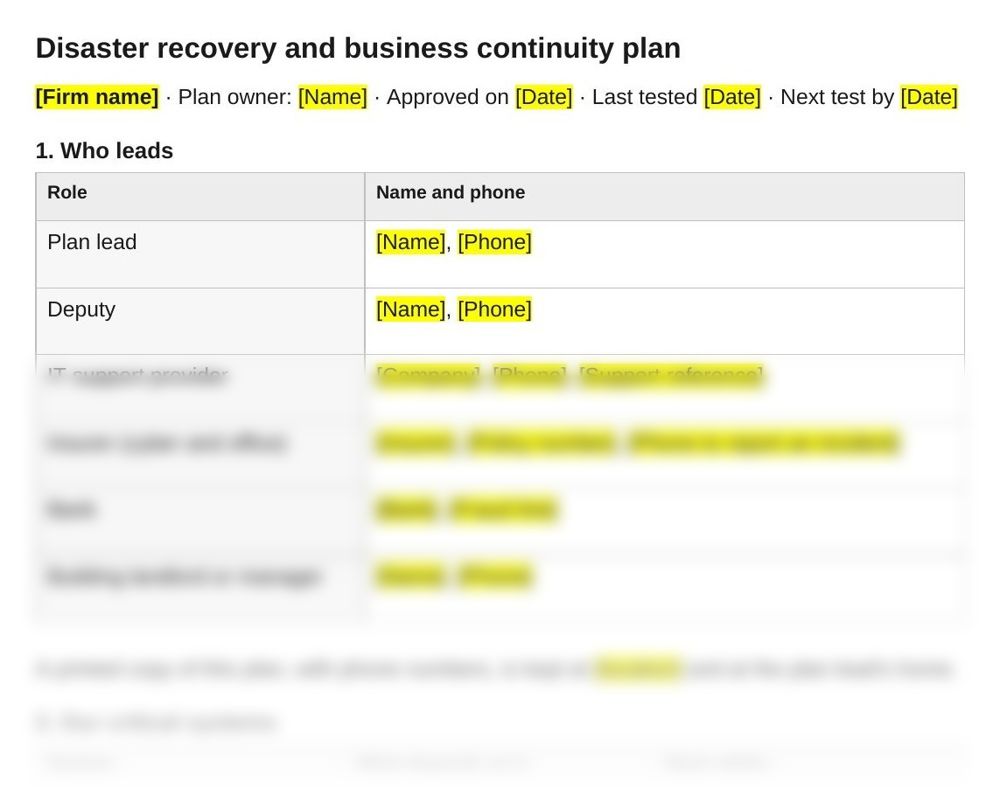
What the plan looks like
When you need it
A continuity plan is written before anything goes wrong, so that on the day nobody has to work out who to call or what to restore first. A small practice needs one when:
- Client files, email and accounting software sit in the cloud or on a few laptops
- One partner holds the HMRC agent credentials or approves every payroll
- You have backups but have never tested restoring from one
- Staff could work from home, but nothing says how phones, post and client deadlines are handled
How to use the business continuity plan template
- Fill in who leads. Plan lead, deputy, IT support, insurer, bank and landlord, with phone numbers. Keep a printed copy at the office and at the plan lead's home.
- Set recovery times. For each critical system, say how soon it must be back, for example four hours for email.
- Name cover for key people. List what only one person can do now and who takes it over.
- Record your backups. For each system, how often it is backed up, where the separate copy is and the date of the last restore test.
- Test it once a year. Run a restore test or a desk exercise, write the result in the test record, and review the plan after any real event.
Questions
What is the difference between business continuity and disaster recovery?
Disaster recovery is getting systems and data back: restoring from backup, resetting accounts and replacing devices. Business continuity is keeping the practice working while that happens: who leads, how clients are told and how deadlines are still met. This plan covers both in one document.
What should a business continuity plan include?
Who leads and how to reach them, the critical systems and how soon each must be back, first steps for any incident, a short plan for each likely scenario, cover for key people, backups, who tells staff and clients, and a record of tests.
What should a practice do first after a ransomware attack?
Disconnect affected devices from the network without turning them off, disable affected accounts, and call your IT support and insurer. Don't pay or contact the attacker. Restore from the separate backup only once the cause is removed.
Do we have to report a cyber attack to the Information Commission?
If personal data was affected, report the breach without undue delay and, where feasible, within 72 hours of becoming aware of it, unless it is unlikely to result in a risk to people's rights and freedoms. The Information Commission took over from the ICO on 30 September 2026.
How should backups be kept?
The NCSC advises backing up all the data the business needs to operate, keeping a storage device disconnected when not in use, turning on 2-step verification for online backups, and checking that you know how to restore. The plan records where the separate copy is and when it was last restored.
How often should the plan be tested?
Once a year, with a restore test or a desk exercise, and again after any real event. Each test goes in the test record with its result and actions.
Also in the practice IT security pack
Who it's for
Small UK accountancy and bookkeeping practices that run on cloud software and a handful of laptops.
Last checked
Checked against UK GDPR article 33 and the NCSC's guidance on backing up data in November 2026.