IASB Adds Crypto Asset and Leases Projects to Its Work Plan
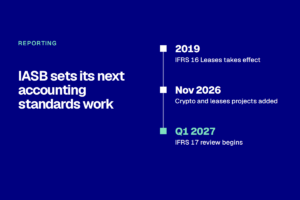
The IASB added projects on cryptoassets and IFRS 16 leases to its work plan in November 2026 and set an IFRS 17 review for early 2027.
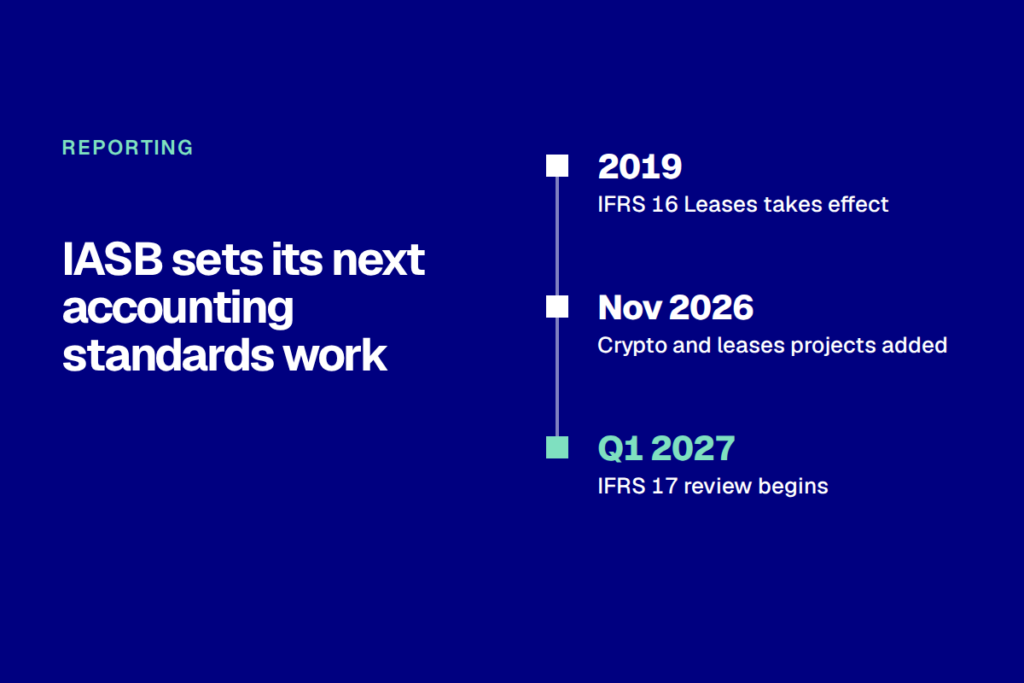
The IASB decided at its November 2026 meeting to add two projects to its work plan, one on accounting for cryptocurrency assets and one on targeted improvements to IFRS 16 Leases. The IASB decisions come as finance teams prepare for IFRS 18 Presentation and Disclosure in Financial Statements, which applies to reporting periods beginning on or after January 1, 2027.
The International Accounting Standards Board also decided to begin a post-implementation review of IFRS 17 Insurance Contracts in the first quarter of 2027. It set out the next stage of its wider review of IAS 38 Intangible Assets as well.
For finance professionals reporting under IFRS in the UK, the EU and the many other jurisdictions that use the standards, the decisions touch three areas of the balance sheet at once: digital assets, right-of-use assets and intangibles. Companies in the US report under US GAAP, where the Financial Accounting Standards Board decided in 2022 to measure digital assets such as cryptocurrency at fair value.
Accountio.The go-to weekly newsletter, straight to your inbox.Weekly newsletter, straight to your inbox.
What the IASB decided in November 2026
The IASB’s meeting updates record the board’s decisions after each session, and the work plan lists each active project. The November decisions add the crypto and leases projects to that plan.
The board noted that cryptoassets have become an important topic in financial reporting. It said the leases project will be narrow in scope and will draw on the post-implementation review of IFRS 16.
The two new projects sit alongside the board’s review of IAS 38 and its coming review of IFRS 17, so the November meeting set direction for four existing standards. Preparers will be applying IFRS 18 over the same period, and the IASB agenda for 2027 will overlap with that first year of adoption.
The IASB crypto project: fair value and stablecoins
The cryptoassets project will focus on holdings of cryptocurrencies and stablecoins, which reflects the areas stakeholders typically identify as higher priorities. The board will explore whether cryptocurrencies should be measured at fair value through profit or loss.
It will also explore whether some stablecoins could qualify as cash equivalents under IAS 7 Statement of Cash Flows. That question matters to treasury teams and to the cash flow statement, because a classification as a cash equivalent would change where a stablecoin balance appears and how it is reported.
The US position gives a point of comparison. FASB decided in 2022 to measure digital assets such as cryptocurrency at fair value, so the IASB is now examining whether to move in a similar direction for IFRS reporters. Companies that hold digital assets and report under both frameworks would see the gap narrow if the board reached the same measurement answer, although the project has only begun.
Firms that also track holdings in their fixed asset accounting records will want to note which standard governs each balance today. IAS 38 is one of the reference points, since the board has been testing cryptocurrencies as part of its intangibles work. The IASB has also said the project will cover tax and reporting questions only to the extent the decision papers set out, so the scope will become clearer as papers are published.
IASB leases project builds on the IFRS 16 review
The leases project is based on the post-implementation review of IFRS 16, the 2019 leasing standard. The IASB began that standard with FASB as part of their convergence work, before the two boards took somewhat different approaches while generally agreeing to move operating leases onto the corporate balance sheet for the first time.
The new project will look at how some of the ongoing costs of applying the standard can be reduced without significantly affecting the usefulness of the information provided to investors. It will also try to clarify the accounting for particular rent concessions.
That focus is on the cost of running the standard rather than on its core model. Lease accountants who maintain schedules, remeasurements and discount rates every period will be the first to see any change, and teams that rely on a lease accounting pack or a similar tool will want to check whether any amendment alters its inputs. Because the IASB has described the project as narrow and targeted, wholesale changes to the standard are not what the board has set out to do.
The timing means the IASB’s IFRS 16 work will run in the same period as the first IFRS 18 reporting cycle. Finance teams will therefore be updating their income statement layouts and their lease processes at roughly the same time, even though the two sets of changes are separate.
IAS 38 and IFRS 17 reviews on the IASB agenda
On IAS 38, the board decided on the next stage of its comprehensive review and plans to begin work on two areas. The first will explore improvements to disclosure requirements, focusing on the main areas identified through the IASB’s research into investors’ information needs.
The second is a targeted review of recognition, which will focus on specific aspects of the existing recognition requirements that may not be operating as intended. The two areas will mainly progress in parallel, with each informing the other. The IASB publishes progress on that work on its intangible assets project page.
The IFRS 17 review is the only item in the November decisions with a stated start date. The IASB released its insurance contracts standard in 2017 and FASB issued its own in 2018, after the two boards had planned the work as a convergence project and then took differing approaches.
The board said insurers have now applied its standard for several years, and that evidence on how it is working is available from successive reporting periods, implementation experience and activities in individual jurisdictions. The review will give the IASB more time to gather and assess further evidence systematically.
What comes next for the IASB and IFRS 18
The next fixed date in the IASB’s timetable is the first quarter of 2027, when the post-implementation review of IFRS 17 begins. The crypto, leases and IAS 38 work will follow the board’s usual sequence of staff papers and public meetings, and the decision papers for each project will appear in the meeting materials on the IFRS Foundation website.
The board’s membership and size are also under discussion, as an earlier Accountio report on CPA Australia’s opposition to a plan to shrink the IASB board set out. Finance teams that need to plan for the standards in force, rather than the ones under discussion, should note that IFRS 18 starts on January 1, 2027, ahead of any of the new IASB projects producing proposals.
Accountio.
The go-to weekly newsletter for accounting professionals. Trusted by 10,000+ industry leaders to deliver the tech trends and insights that matter most. Join them today.