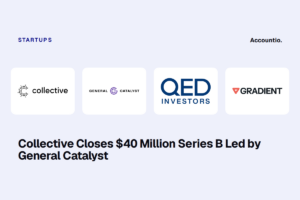
Collective Closes $40 Million Series B Led by General Catalyst
Collective, the AI finance platform for solo businesses, raised $100m: a $40m Series B and $60m from General Catalyst’s Customer Value Fund.
Collective, the AI finance platform for solo businesses, announced $100 million in new funding on October 29, 2026, made up of a $40 million Series B and $60 million from General Catalyst’s Customer Value Fund. The collective software company said the money will fund customer acquisition and new products in banking and insurance.
General Catalyst, QED and Gradient Ventures led the Series B. Intuit Ventures, FT Partners and Sempervirens also took part.
The round matters to accountants because Collective sells the work many small practices do for sole traders: bookkeeping, tax filing, payroll and entity set-up. It does so as a subscription run largely by software. Collective said it has grown 127% year over year and is the largest platform built for solo operators, which puts a venture-funded competitor in the market for the smallest clients on a practice’s books.
Bookkeeping in the Accountio directory
200 Bookkeeping toolsEvery company in the category, with features, pricing and marketsCompare all →Article Sponsor · your logo, one line and a link inside every article
Collective did not disclose its valuation, revenue or the terms of the $60 million. Those figures are left out here.
Collective software company raises $100 million
The $40 million Series B is equity. The $60 million comes from General Catalyst’s Customer Value Fund, which the investor describes as a way to finance customer acquisition without relying solely on equity or debt. General Catalyst reserves it for companies that have reached product-market fit.
Neither company has published the repayment or return terms of the $60 million. Collective said the money is for customer acquisition, so it is best read as growth capital tied to winning members rather than as a second priced round.
Collective has raised from General Catalyst and QED before. The company announced an $8.65 million seed round in 2020 led by the two firms, with Gradient Ventures among the participants. The Series B takes the same investors into a much larger commitment.
“AI is leveling the playing field, making it possible for a single individual to build a powerful, highly profitable enterprise,” said Hooman Radfar, co-founder and chief executive of Collective. The company’s other co-founders are Bugra Akcay and Uğur Kaner.
What the collective software company actually sells
Collective describes its product as an AI-native financial operating system for solo businesses, which it calls Businesses-of-One. The company’s announcement lists the functions it covers:
- Entity formation, including LLCs, set up to give an owner a suitable legal and tax structure.
- Expense categorisation and account reconciliation.
- Invoicing tools.
- Salary processing for owners, aimed at compliant tax savings.
- Autonomous tax preparation, filing and ongoing optimisation.
- Liability insurance and health coverage options.
- A human support team supported by AI.
Collective’s website lists pricing of $199 a month for an LLC and $349 a month for an S corporation. The company says its members have saved an estimated $350 million in taxes and an average of 80 hours a year since launch. It counts more than 12,000 solopreneurs among its members.
The product competes with the practice that handles those tasks by hand. A sole trader who would once have paid a bookkeeper, a payroll provider and a tax preparer now has one subscription that covers all three, at a price set by the platform rather than by hours worked.
“Traditional accounting firms scale by adding people. Collective scales with intelligence,” Radfar said. He added that the company is building toward a world where a Business-of-One can access the financial capabilities of a much larger company without building the team behind it.
The market behind the Collective software round
Collective puts the number of solo businesses in the United States at about 30 million. It cites a Stripe report finding that the number of solo operators earning $1 million a year doubled between 2023 and 2025, while those earning $10 million a year tripled.
Collective’s own blog post, published the same day, gives a higher count of 32 million solo businesses, generating nearly $2 trillion in annual revenue. It says the number grew by more than 5% in 2024.
The audience is a US one. Collective’s tax, payroll and entity products are built around US structures such as LLCs and S corporations. Accountants in the UK and the EU will recognise the client type, the contractor or freelancer who has outgrown spreadsheets, but the product is not sold to them.
For US firms the relevance is direct. Solo clients are often the first to move to a self-service tool, and a platform that files returns and runs payroll leaves a practice with less to bill.
Intuit Ventures and the QuickBooks question
Intuit Ventures is the investment arm of Intuit, the maker of QuickBooks. Its place on the Series B list is notable because Collective’s bookkeeping, invoicing and reconciliation work covers ground QuickBooks has long held with small businesses.
Neither Intuit nor Collective has said what the investment means commercially, or whether Collective’s product connects to QuickBooks. Intuit has been adding to its own small business tools, including the purchase of the revenue management startup Sequence, covered in Intuit Acquires Sequence, Adding Quote-to-Revenue Automation.
The investment is a minority stake in a company that sells the full stack to a segment Intuit also serves. Firms and small businesses weighing their options can compare QuickBooks alternatives and the wider field of bookkeeping and accounting software.
What the funding changes for accountants
Collective said the funding will expand its reach to businesses with employees, deepen its use of AI in accounting, tax, payroll and support, and launch new services. Its announcement names banking and insurance as the next product areas.
That moves the collective software company from a back-office subscription towards a wider financial services provider. Each added product raises the cost of switching for a member, and the $60 million tied to customer acquisition suggests Collective intends to buy growth quickly.
The AI accounting category is attracting similar money elsewhere. Task-level tools for firms are catalogued in AI Accounting Tools by Task: Bookkeeping, Extraction, Close, Tax, and the same investors, General Catalyst among them, are backing platforms that aim to replace work rather than assist it. Collective’s pitch differs in that it sells to the business owner directly rather than to the accountant.
The company’s own account of the round is in its announcement post, where Radfar writes that “it’s still Day 1.” General Catalyst sets out how its capital offerings work on its website.
The next test is whether Collective can show customer growth from the $60 million. It has not yet published revenue or the terms of that fund, and both would show how much of the 127% growth was bought and how much was earned.
Accountio.
The go-to weekly newsletter for accounting professionals. Trusted by 10,000+ industry leaders to deliver the tech trends and insights that matter most. Join them today.
Companies in this article
CollectiveBookkeepingView listing →Compare Bookkeeping software
Quickbooks vs XeroSide by side: features, pricing and who each suitsCompare →ANNA Money vs TideSide by side: features, pricing and who each suitsCompare →Tide alternativesOther Bookkeeping tools to shortlistSee list →XeroCompany profile: what it does, funding and customersProfile →BasisCompany profile: what it does, funding and customersProfile →CollectiveCompany profile: what it does, funding and customersProfile →All Bookkeeping softwareEvery company in the directory categoryDirectory →