Form 5472: The $25,000 Compliance Risk Foreign-Owned U.S. LLC Owners Often Overlook
Form 5472 can carry a $25,000 IRS penalty for foreign-owned U.S. LLCs, even when they have earned no revenue.
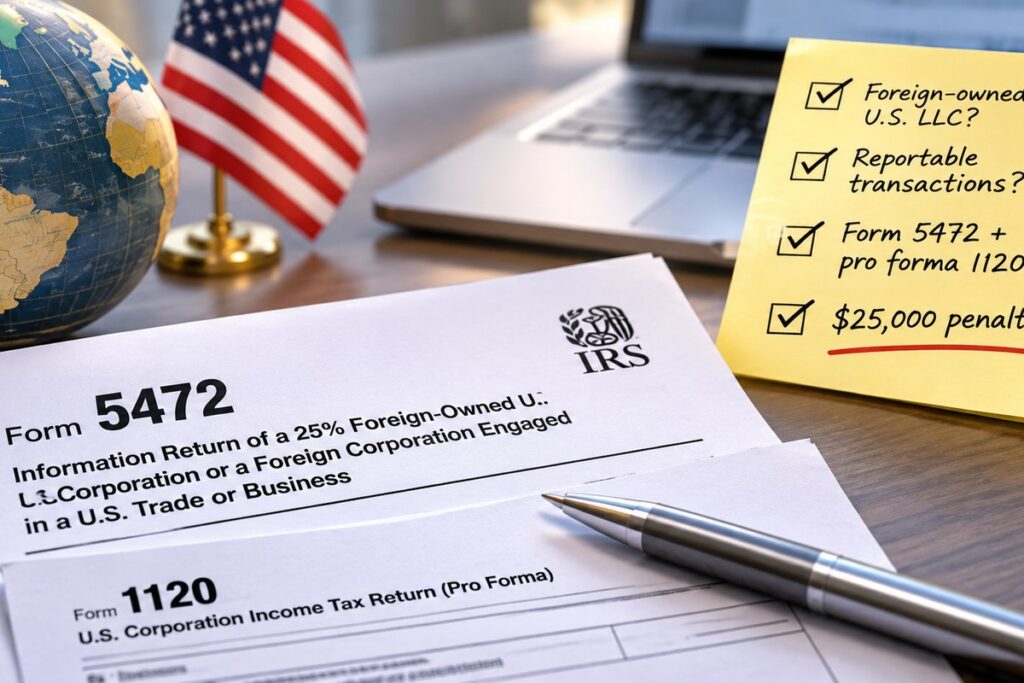
The United States remains an attractive destination for international entrepreneurs looking to establish a business presence. U.S. limited liability companies (LLCs), particularly those formed in states such as Wyoming and Delaware, are popular among non-U.S. residents because of their flexible business structure and relatively straightforward formation process. However, one important compliance obligation is frequently overlooked: Form 5472.
Foreign-owned U.S. LLCs may have IRS reporting obligations even when they generate no revenue or owe no federal income tax. Failure to comply can result in an initial penalty of $25,000, making this an issue that accountants, tax advisers and business formation professionals should understand.
What Is Form 5472?
Form 5472 is an IRS information return used to report certain transactions between a reporting corporation and related parties. Its requirements are established under Internal Revenue Code Section 6038A.
Accountio.The go-to weekly newsletter, straight to your inbox.Weekly newsletter, straight to your inbox.
Although the form is commonly associated with foreign-owned corporations, its scope also includes certain U.S. single-member LLCs classified as disregarded entities for federal income tax purposes.
Under Treasury Regulations Section 301.7701-2(c)(2)(vi), a domestic disregarded entity wholly owned by a foreign person is treated as a separate entity for specific information reporting purposes under Section 6038A.
In practical terms, a European entrepreneur who owns a single-member Wyoming LLC may be required to file the return even though the LLC is not treated as a separate corporation for ordinary federal income tax purposes.
This distinction is particularly important because many foreign business owners assume that a disregarded entity has no independent U.S. reporting obligations.
Does an LLC Need to File If It Has No Revenue?
One of the most common misconceptions is that an LLC with no revenue or business activity automatically has no IRS filing obligations.
This is not necessarily true.
For a foreign-owned U.S. disregarded entity, the reporting requirement generally depends on whether reportable transactions occurred between the LLC and its foreign owner or another related party during the tax year.
Examples may include:
- Initial capital contributions made by the foreign owner.
- Distributions from the LLC to its owner.
- Loans and certain financial transactions between related parties.
- Transactions associated with the formation or dissolution of the entity.
For example, consider a European entrepreneur who establishes a Wyoming LLC and transfers $5,000 from a personal bank account to fund its initial operations.
Even if the company has no customers and generates no revenue, this capital contribution may constitute a reportable transaction.
Consequently, reviewing the LLC’s financial activity alone is insufficient. Accountants should also examine transactions between the entity and its foreign owner.
Why Form 1120 Is Also Required
Another source of confusion is the relationship between Form 5472 and Form 1120.
A foreign-owned U.S. disregarded entity generally does not file Form 1120 as a separate corporation for income tax purposes. However, when reporting is required, the entity generally must submit a pro forma Form 1120 with Form 5472 attached, as the IRS instructions set out.
The pro forma return serves primarily as an administrative filing vehicle. It does not mean that the LLC has elected to be taxed as a corporation.
Only limited identifying information is generally required on the pro forma Form 1120, including the entity’s name, address and applicable identifying details.
Both forms must be submitted by the applicable filing deadline, taking into account any valid extension.
Understanding this distinction is essential for advisers working with international entrepreneurs who may otherwise overlook these filing requirements.
The $25,000 Form 5472 Penalty
The potential financial consequences of non-compliance are significant.
Under Internal Revenue Code Section 6038A(d), the initial penalty for failing to file when required, filing a substantially incomplete form, or failing to maintain the required records is $25,000.
Importantly, the penalty is not calculated as a percentage of company revenue or tax liability. Even a small LLC with no taxable income can face this penalty if it fails to meet its reporting obligations.
The exposure can increase further. If the failure continues for more than 90 days after IRS notification, additional penalties of $25,000 may apply for each 30-day period, or part of a 30-day period, during which the failure continues.
For international business owners who may not regularly monitor U.S. tax correspondence, this can create an especially difficult situation.
Five Practical Form 5472 Steps for Accountants
Professionals advising clients who own U.S. LLCs should consider incorporating the following checks into their onboarding and annual compliance procedures.
1. Identify foreign ownership
Determine whether the LLC is wholly owned by a foreign individual or entity. Ownership structure is the starting point for assessing potential filing obligations.
2. Review related-party transactions
Do not limit the review to business revenue and expenses. Examine capital contributions, distributions, loans and other transactions involving the foreign owner.
3. Confirm the LLC’s tax classification
Establish whether the entity is treated as a disregarded entity or has elected corporate tax treatment. The applicable reporting requirements may differ.
4. Assess Form 5472 and Form 1120 obligations
Determine whether reportable transactions occurred and whether the entity must submit the information return together with a pro forma Form 1120.
5. Maintain supporting documentation
Keep records of ownership information, financial transactions and relevant supporting documents. Proper documentation is important both when preparing the return and in the event of an IRS examination.
A Growing Compliance Issue for International Entrepreneurs
As U.S. LLCs become increasingly popular among international business owners, Form 5472 deserves greater attention from accountants, tax advisers and company formation professionals.
The key issue is that business owners often focus on commercial activity while overlooking information reporting obligations. An LLC does not necessarily need to generate revenue to have filing responsibilities. Its ownership structure and transactions with related parties can be equally important.
For professionals advising international clients, identifying these obligations early can help prevent costly compliance mistakes.
About the Author
Michal Zacik is the founder of 5472forYOU, a specialised service focused on preparing Form 5472 and pro forma Form 1120 for foreign-owned U.S. single-member LLCs. The company helps international business owners navigate U.S. information reporting requirements through a straightforward and professionally reviewed filing process.
Accountio.
The go-to weekly newsletter for accounting professionals. Trusted by 10,000+ industry leaders to deliver the tech trends and insights that matter most. Join them today.