
How to Automate Month End Close: What CFOs Actually Prioritise First
A sequencing guide for CFOs on how to automate month end close, starting with the tasks that matter most.

Only 18% of finance teams close their books in three days or fewer. The median sits at six business days, and half of all teams take longer than five. Those numbers come from Ledge’s 2025 benchmarking survey, and they have barely moved in a decade. APQC’s 2018 survey of 2,300 organisations put the median at eight days. The tools have changed. The timelines have not. The reason is not a lack of software. It is a lack of sequencing. Most finance teams trying to work out how to automate month end close start with the wrong tasks, buy platforms they cannot absorb, and end up automating broken processes faster.
Where the Days Actually Go
A six-day close does not distribute evenly across the accounting cycle. The pattern, consistent across mid-market finance teams in benchmarking data from Ventana Research, BlackLine, and Numeric, looks roughly like this:
Days one and two go to transaction matching and account reconciliations. Bank feeds, subledger-to-GL balancing, intercompany matching, and clearing suspense items. This is the highest-volume manual work in the close and it runs on spreadsheets at the majority of mid-market companies.
Days three and four go to journal entries. Recurring accruals (rent, insurance, depreciation, amortisation), reclassifications, and period-end adjustments. The recurring entries are predictable. The adjustments are not. Both get done together because the reconciliations feeding them only just finished.
Day five is approvals. Controllers and senior accountants reviewing reconciliation sign-offs, journal entry batches, and flux analysis. Most of this happens in email. It waits when people travel or when inboxes are full.
Day six is reporting assembly. Consolidation, elimination entries for multi-entity groups, management reporting, and board pack preparation.
The first two stages consume roughly 40% to 50% of total close labour. Understanding how to automate month end close starts with understanding where the time actually goes.
The Instinct to Start With Reporting Is Wrong
CFOs see the close’s final output: the board pack, the management accounts, the consolidated P&L. When the close feels slow, the instinct is to buy better reporting tools. Dashboards. Consolidation platforms. Real-time analytics.
The problem is obvious once stated. If reconciliations are still running on day three, no reporting tool changes the fact that there is nothing clean to report until day four. A faster engine bolted to a slow fuel supply does not accelerate anything. It idles.
This sequence error explains a persistent gap in vendor case studies. Companies that implement consolidation and reporting tools first rarely show material close time reductions. The reductions show up when reconciliation and journal entry automation go in first. The vendors know this. Their sales teams still lead with the dashboards because dashboards demo well.
How to Automate Month End Close Reconciliations
Transaction matching is a pattern recognition problem. Software handles it well. Bank-to-book matching, subledger-to-GL reconciliation, and intercompany balance confirmation are high-volume, rules-based tasks that machines do faster and more accurately than people working in spreadsheets.
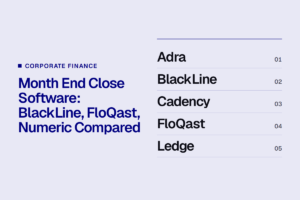
BlackLine, Trintech Cadency, and FloQast all offer reconciliation modules. So do newer entrants like Numeric and Xenett. The core mechanics are similar: import data from the ERP and bank feeds, apply matching rules, surface exceptions, route unmatched items for human review.
To be sure, “automated reconciliation” in vendor marketing tends to overstate what happens on day one of implementation. Matching rules need configuring. Edge cases need human-defined handling. Multi-currency transactions, partial payments, and timing differences across entities still require judgment. The technology eliminates the bulk matching that used to take days. It does not eliminate the exceptions that require someone who understands the underlying accounting.
For multi-entity companies, intercompany reconciliation is the specific bottleneck worth targeting. When entity controllers in different offices or time zones need to agree balances before elimination entries can be posted, delays cascade through the rest of the close. Automating intercompany matching typically saves one to two days by itself, not because the matching is faster (though it is), but because it removes the email back-and-forth that previously stretched across business days.
Journal Entries Come Second
Recurring journal entries follow fixed schedules with predictable amounts. Monthly accruals for rent, insurance, depreciation, payroll-related provisions, and similar items should not require manual preparation every period.
The automation is straightforward: define the entry template, set a recurrence schedule, route it through an approval step, and let the system post it each month. For a mid-market company running 50 to 100 recurring entries per month, this eliminates several hours of preparation and, more usefully, removes the risk of entries being missed, posted to incorrect periods, or duplicated.
FloQast’s published case studies report close time reductions between 29% and 50%. Deputy went from eight days to five. Fanatics went from 12 days to six. ExchangeRight halved a two-and-a-half-week close. FinQuery reported a 50% reduction. FloQast’s blog cites 26% as an achievable reduction through modernisation.
Non-recurring entries remain manual. Period-end adjustments based on new information, unusual transactions, and entries requiring judgment on estimates or provisions are not automation candidates. Vendors who blur this line are selling a capability their software does not have.
The Approval Problem Is Organisational, Not Technical
Finance teams that have automated reconciliations and journal entries typically find the remaining delay is approvals. A completed reconciliation sits in a controller’s inbox. A journal entry batch needs sign-off from someone in a meeting. The accounting work finished on day three. The workflow finished on day five.
Approval routing is technically simple. Threshold-based rules (entries under £5,000 to team leads, over £50,000 to the CFO), escalation paths when an approver is unavailable, and delegation during absence are features in FloQast, Trintech, BlackLine, and even Microsoft Power Automate. The technology is commoditised. The hard part is organisational: getting agreement across the finance team on who approves what, at what thresholds, and what happens when someone is travelling or on leave. That is a conversation, not a software purchase.
The measurable benefit is visibility. When approvals route through a system rather than through email, the close manager can see exactly where the process stands at any point. Delays become visible instead of hidden in someone’s inbox. That transparency alone tends to compress timelines because nobody wants to be the named bottleneck on a dashboard the whole team can see. Ventana’s benchmarking data found that among organisations with fully systematised approval routing, close times were materially shorter not because the approvals themselves were faster, but because the delays were no longer invisible.
How to Automate Month End Close Without Overspending
The vendor landscape for close management software is crowded and the pricing is opaque by design.
BlackLine, the largest player, does not publish prices. Third-party contract data from Vendr and SpendHound paints the picture. The median BlackLine contract sits near £32,000 per year, but the range runs from roughly £10,500 to over £80,000 depending on entity count, module mix, and term length. Implementation costs commonly equal or exceed the first-year subscription on mid-market deployments. SpendHound’s 2026 data shows BlackLine spend climbing 33% year-over-year among smaller customers. Multi-year commitments are the primary lever to control costs: three-year terms can run up to 55% lower per year than a one-year deal, according to Vendr’s buyer data.
FloQast positions itself as the mid-market alternative. It is less expensive than BlackLine but also quote-based and opaque. Third-party data from Vendr and Coefficient puts mid-market FloQast contracts at £24,000 to £48,000 per year, with larger deployments reaching £64,000 or more. Contracts run two to three years with automatic renewal and annual price increases of 3% to 4%. AutoRec, FloQast’s AI-powered reconciliation module, is a separate add-on not included in the core platform price, a detail that frequently surprises buyers after the demo. Numeric targets finance teams on NetSuite and Sage Intacct at a lower price point again.
One trend worth watching with scepticism: every close management vendor now markets “AI agents” for accounting. FloQast launched its AI Agents product in March 2025 and a Visual Agent Builder in March 2026. BlackLine launched Verity AI in September 2025 and an “Agentic Financial Operations” platform in April 2026. The marketing is ambitious. The reality is earlier-stage. Gartner estimates that over 40% of agentic AI projects across all industries will be cancelled by the end of 2027 due to escalating costs, unclear business value, and inadequate risk controls. Gartner also estimates that only about 130 of the thousands of vendors claiming agentic AI capabilities are genuine. For finance teams evaluating close automation in 2026, AI agents are a feature to monitor, not a feature to buy for.
Before committing to any platform, map the actual close process. Quantify time spent per task. Identify which steps are high-volume and repetitive (automate first), which are complex and infrequent (leave manual), and which sit between (evaluate case by case). Companies that buy a full suite before completing this exercise routinely underutilise it. The implementation fails not because the software is wrong but because the organisation cannot absorb that much process change at once.
A pattern that works: start with a single module (reconciliation or close task management), prove the value over two to three close cycles, then expand. The tools matter less than the sequencing.
How to Automate Month End Close in Stages
The vendor pitch is a three-day close within a quarter. The reality for a mid-market finance team starting from a manual baseline looks more like six to nine months.
Months one and two: map the current close in detail. Document every task, its owner, its dependencies, and how long it actually takes. This step alone often reveals five to ten tasks nobody was tracking and two or three bottlenecks nobody had quantified. Select tooling for reconciliation automation and run a parallel close.
Months three and four: go live on automated reconciliations. Begin configuring recurring journal entry templates. Establish standardised approval hierarchies.
Months five and six: activate journal entry automation and approval routing. Measure the close timeline against the baseline. Expect a 20% to 30% reduction at this stage, not 50%.
Month seven onward: evaluate reporting and consolidation automation. By this point, the upstream work is stable enough that downstream tools deliver real value rather than waiting for clean inputs that arrive late.
Ventana Research’s benchmarking data supports this sequencing. Among organisations that shortened their close, 71% credited controlling the process through structured workflows and standards. The gains came from discipline and sequence, not from software features. Companies that achieved a three-day close did not get there in a quarter. They got there over 12 to 18 months of incremental tightening.
What Stays Manual
Not everything should be automated, and vendors that suggest otherwise are selling into a fantasy. Period-end judgments on revenue recognition, complex accrual estimates, impairment assessments, and management commentary on financial performance all require experienced finance professionals applying judgment to specific circumstances. So do UK-specific complications: Making Tax Digital quarterly reporting obligations now in effect from April 2026, CSRD sustainability disclosures affecting UK-listed companies, and FRC audit quality inspection requirements that demand documented human judgment at every material step. No AI agent handles an FRC inspection response.
The goal is not a close with no humans in it. It is a close where humans spend their time on the work that requires human judgment rather than on the work that does not.
The median close has sat at six to eight days for nearly a decade. Vendors have launched reconciliation automation, journal entry templates, approval routing, dashboards, AI copilots, and now AI agents. The number has not moved. The answer to how to automate month end close is not more technology. It is better sequencing, harder organisational conversations about approvals and ownership, and the discipline to start with the unglamorous upstream work that actually consumes the time.
Accountio.
The go-to weekly newsletter for accounting professionals. Trusted by 10,000+ industry leaders to deliver the tech trends and insights that matter most. Join them today.