CPA Exam Adapts to AI as Profession Debates Literacy
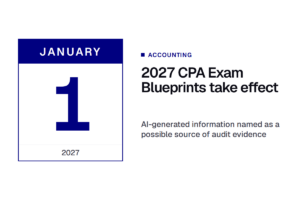
The 2027 CPA Exam Blueprints take effect January 1, 2027, and treat AI-generated information as a possible source of audit evidence.
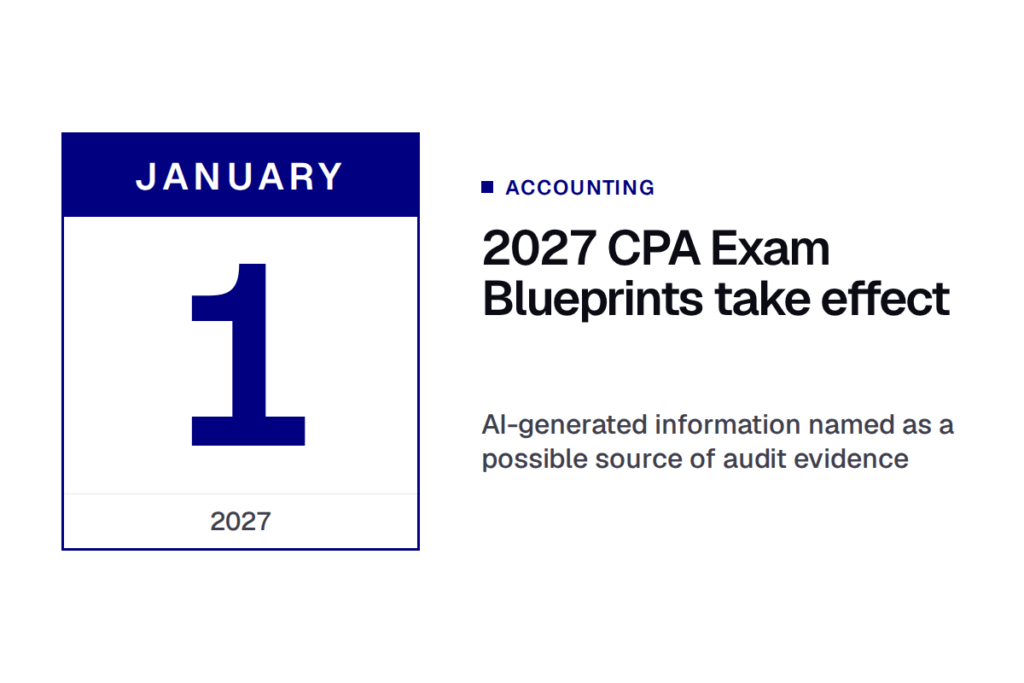
The AICPA’s 2027 CPA Exam Blueprints take effect on January 1, 2027, extending the exam’s treatment of artificial intelligence to information generated by AI tools as a possible source of audit evidence.
For firms hiring newly licensed CPAs, the change bears on what a candidate can be expected to know on the first day of work. A graduate who has sat the exam under the 2027 blueprints will have been tested on the idea that AI output is something to be examined, not accepted, while partners who qualified before generative AI existed carry the same professional responsibility for work that AI tools help to produce. The debate over CPA exam AI literacy is therefore also a debate about training for existing staff, not only for new entrants.
The AICPA publishes its blueprints, the official statement of the content eligible for testing, on its CPA Exam content page, where the 2027 blueprints and a summary of changes effective January 1, 2027 are listed. The AICPA says it typically publishes blueprints one to two times a year, and that once a change becomes eligible for testing, the previous content it affects is removed.
Accountio.The go-to weekly newsletter, straight to your inbox.Weekly newsletter, straight to your inbox.
CPA exam AI literacy in the 2027 blueprints
According to a commentary published on November 20, 2026 by Akhila Chandrashekar, a chief learning officer and qualified CPA, CMA, CIA and CFE, the 2027 blueprints make a narrow but meaningful change to the Auditing and Attestation section. In item AUD17, the wording moves from information “prepared using” technologies, including AI, to information “generated using” those technologies.
The same commentary says item AUD18 now names information generated using AI among the potential sources of audit evidence. That matters because audit evidence has to be sufficient and appropriate before an auditor relies on it, so a candidate must be able to say what would make AI-generated analysis good enough to support an opinion.
The 2027 blueprints do not create a separate AI examination, and they do not introduce AI verification for the first time. They place AI-generated information more squarely inside a section that every candidate must pass, which makes CPA exam AI literacy a matter for all candidates rather than only for those who choose a technology-focused discipline.
What the 2026 blueprints already asked of candidates
AI was already present in the exam before the 2027 update. The 2026 blueprints added artificial intelligence to the Auditing and Attestation section, according to the commentary, and expect candidates to understand confidentiality risks when using AI tools. They also cover how AI adoption could affect the risk of material misstatement and how to evaluate the accuracy, completeness, authenticity and potential bias of information prepared using AI.
Those expectations sit within the structure the AICPA and the National Association of State Boards of Accountancy introduced under CPA Evolution. Candidates sit three Core sections, Auditing and Attestation, Financial Accounting and Reporting, and Taxation and Regulation, and then one of three disciplines: Business Analysis and Reporting, Information Systems and Control, or Tax Compliance and Planning.
The 2027 change therefore builds on content candidates already study, and the commentary describes it as a step forward but not yet a leap. The test of an exam question, in that view, is whether it separates a candidate who can use an AI tool from one who can challenge it.
The model curriculum behind the exam
The exam is only one half of the pipeline. The AICPA and NASBA released the CPA Evolution Model Curriculum on June 15, 2021, a model college accounting curriculum designed to prepare students for the Core and Disciplines structure of the exam. A task force of more than 40 volunteers developed it, including faculty, practising CPAs in public practice and industry, and state board representatives.
The curriculum was built after an AICPA and NASBA study found gaps between existing accounting programmes and the topics the redesigned exam would test, particularly in emerging technology. It sets out suggested modules, topics, learning objectives, examples of course structures and time estimates, and NASBA supports state boards as they update their rules to adopt it.
“A deep understanding of new and emerging technologies is essential for CPAs entering the profession,” said Sue Coffey, CEO of Public Accounting at the AICPA, at the curriculum’s launch. The statement predates the arrival of generative AI tools in everyday practice, but it describes the gap that the 2026 and 2027 blueprints now address in the audit section.
Why the risk is not hypothetical for firms
The commentary frames the issue with a scenario. A CPA asks an AI tool to research a complex tax issue and receives a well-written report with regulatory citations and a confident recommendation, but the regulation cited does not exist. The client holds the CPA accountable, not the software vendor.
It sets out two accountants using the same tool. One copies the output into a report for management, while the other checks the underlying data, questions unusual assumptions, verifies the calculations, investigates inconsistencies and documents the review. Both can use AI, but only the second is, in the commentary’s terms, responsibly literate.
Chandrashekar defines AI literacy as understanding the limits of AI, detecting fabricated information, protecting confidential data, recognising bias and knowing when human judgement must override a machine’s recommendation. She argues that it is not about writing clever prompts or knowing which tool is popular. She proposes that foundational AI literacy be assessed across the Core sections of the CPA exam, with more advanced competencies handled through the disciplines.
“In a profession built on skepticism, evidence and trust, the greatest risk isn’t what AI doesn’t know. It’s that accountants may not know what AI doesn’t know.”
Akhila Chandrashekar, Chief Learning Officer
Beyond the exam: AI literacy for qualified CPAs
An exam reaches only people who have not yet qualified. The commentary points out that a CPA who passed 15 years ago may never have studied generative AI, hallucinations or algorithmic bias, yet may now approve AI-assisted tax advice, supervise automated audits or sign off financial reports prepared with AI. It argues that continuing professional education should teach those CPAs to identify errors, challenge outputs, protect client information and remain accountable.
Practices that want to move ahead of any change in professional education have material to work from. Accountio has set out what auditors will ask about client AI use under AICPA guidance, and has covered the profession’s attention to AI tax risk and CPA duties. For teams writing their own policy, the AI literacy and AI use pack provides a starting point for staff training and review rules.
Firms choosing tools can compare them by task in Accountio’s guide to AI accounting software for bookkeeping, extraction, close and tax. Whichever tool a firm uses, the review step the commentary describes, checking the data, the calculations and the completeness of the dataset, is the part that no vendor can perform on a CPA’s behalf.
What comes next for the CPA exam
The 2027 blueprints are not the only change on the exam calendar. The AICPA has said the CPA Exam will move to a new technology delivery platform in July 2027, with no testing appointments available between July 1 and July 11, 2027, and testing resuming on the new platform on July 12, 2027. The AICPA has also said score release will be delayed for 12 months after launch while exam items are recalibrated using response data from the new platform.
That platform change is separate from the content change, so candidates sitting in the first half of 2027 will face the new blueprints on the existing system. The first test of whether CPA exam AI literacy has moved beyond the blueprint page will come after January 1, 2027, when the first candidates answer questions on AI-generated audit evidence under the new content outline.
Accountio.
The go-to weekly newsletter for accounting professionals. Trusted by 10,000+ industry leaders to deliver the tech trends and insights that matter most. Join them today.