92% of Accounting Professionals Say Technology Drew M&A Interest
A survey of accounting professionals found 92% said technology helped attract M&A opportunity, and 30% called its contribution significant.
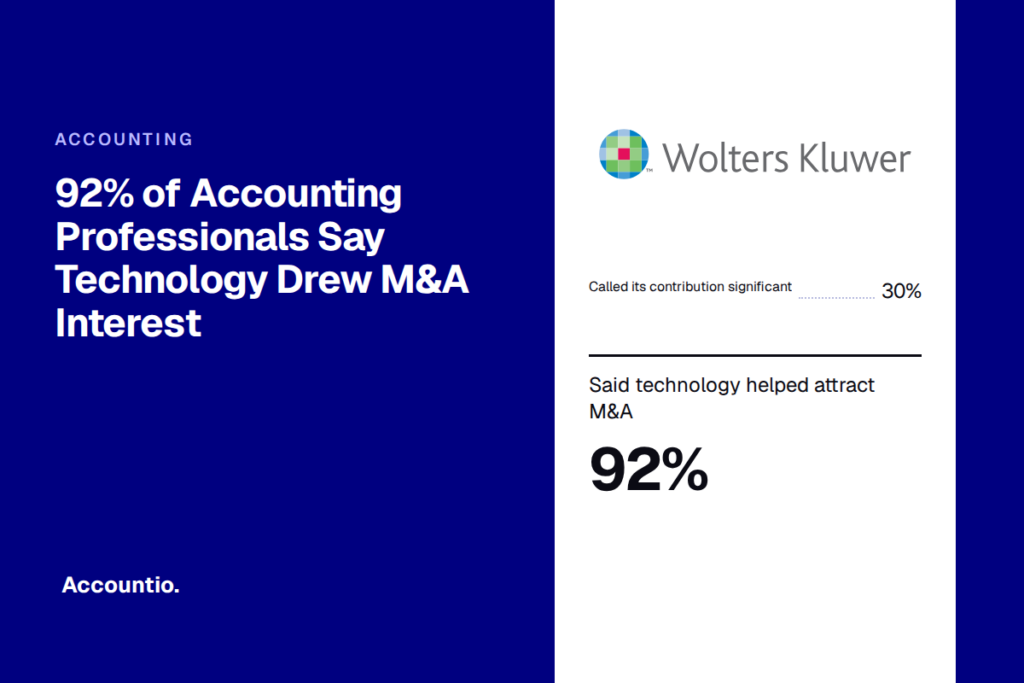
A survey of accounting professionals found that 92% said technology contributed at least moderately to attracting M&A opportunity, and 30% described its contribution as significant, results that put accounting firm M&A technology at the centre of deal conversations.
For partners weighing a sale, a merger or an outside investor, the figures indicate that the software a firm runs is part of what a counterparty evaluates, alongside client lists and fee income. A firm that spends the next 12 months on its systems, as a result, may be preparing its price as well as its efficiency.
A second survey, from Wolters Kluwer Tax & Accounting, points the same way. Among firms that received private equity investment or completed M&A, 90% said their technology infrastructure helped attract the deal, according to Wolters Kluwer’s Future Ready Accountant release of November 17, 2026.
Accountio.The go-to weekly newsletter, straight to your inbox.Weekly newsletter, straight to your inbox.
What the first survey found
The first survey asked accounting professionals how much technology contributed to attracting an M&A opportunity. Of those who responded, 92% said it contributed at least moderately, which means only a small minority saw no meaningful role for it.
The 30% who called technology’s contribution significant form the top tier of the answers, while the remainder of the 92% placed it at the moderate level. In the survey’s terms, then, technology was a factor in nearly every deal, and a leading one in roughly three of every ten.
Wolters Kluwer’s figures on technology and deals
The Wolters Kluwer research is the third edition of its Future Ready Accountant report. It draws on more than 2,600 accounting professionals worldwide, and the company released it on November 17, 2026.
The 90% figure applies to a subset of respondents, those whose firms had taken private equity investment or completed M&A. Those firms said their technology infrastructure helped attract the deal.
The report also measured appetite for outside capital among all respondents. Some 58% said they were highly interested in partnerships or joint ventures, and 53% said they were highly interested in private equity or third-party investment.
Firms reported strong results alongside that interest. Some 85% said revenue had increased and 81% said profitability had improved, according to the report.
Why accounting firm technology matters to buyers
Buyers of accounting practices, including private equity-backed platforms, are acquiring client relationships, staff and processes. A practice whose systems are already connected is easier to fold into a larger group, which is one reason technology can carry weight in an accounting firm M&A negotiation. Deals such as the acquisition of the dental tax and accounting firm JWW by PE-backed Earned show how investor-backed groups continue to add practices.
Integration is where the Wolters Kluwer data shows the most room to improve. Only 11% of firms globally said at least 75% of their technology solutions were integrated.
Firms are planning to spend on that gap. Some 55% plan to invest in AI-enabled tools, 52% plan to improve technology integration and 51% plan to increase workflow automation, according to the report.
Jason Marx, chief executive of Wolters Kluwer Tax & Accounting, tied those plans to how firms operate day to day.
“Adopting AI is only the first step. The real advantage comes from connecting it to how the whole firm works.” Jason Marx, CEO, Wolters Kluwer Tax & Accounting
The tools firms choose for the day-to-day work are the same ones a buyer sees during due diligence. Related reading includes comparisons of AI coding, reconciliation and close tools and a look at the digital tools used to raise firm efficiency.
Governance and advisory shape the deal picture
Wolters Kluwer found that 36% of firms have a written, firm-wide AI policy, while 44% provide general AI guidance without a formal policy. Among firms with a policy or guidance, 57% require professional review of all AI-generated technical outputs.
Firms with formal AI governance were more optimistic about the profession’s future, with 95% saying so against 77% of firms with no governance. Only 1% of firms saw AI as a threat to their business model.
Advisory work is the other area the report tracked. Some 96% of firms offer advisory and consulting services, up from 93% in 2025, and 62% consider advisory a key service.
More than half of firms monitor client transactions in real time, according to the report. Among firms where advisory is not yet core, 40% said clients see them mainly as “tax people”, and the same share said compliance workload leaves too little time for advisory.
That matters in a sale because advisory revenue and the systems behind it are part of what firms present to a buyer. Describing a practice as an AI-native accounting firm is one way of making that case.
What firm owners are doing before a deal
The practical steps that follow from the figures are mostly about integration and documentation. Firms that report few connected systems have a clear item to address, and those without a written AI policy have another.
The Wolters Kluwer results show that owners are acting on the first of those. With 52% planning to improve technology integration and 51% planning more workflow automation, the spending is aimed at the connections between tools as well as at the tools themselves.
Firms that have already taken outside investment reported that their technology helped attract it. For firms still considering a transaction, the 92% and 90% figures from the two surveys are the benchmarks owners now have for how much weight technology carries in a deal.
Accountio.
The go-to weekly newsletter for accounting professionals. Trusted by 10,000+ industry leaders to deliver the tech trends and insights that matter most. Join them today.