Record retention policy template for finance teams
Set where your company keeps its finance records, how long each type is kept and how old records are deleted, with a checklist for the permanent year-end file. This record retention policy template is one Word policy with a retention table for UK and US records.
Finance teamsGet this pack and 100 more for $129
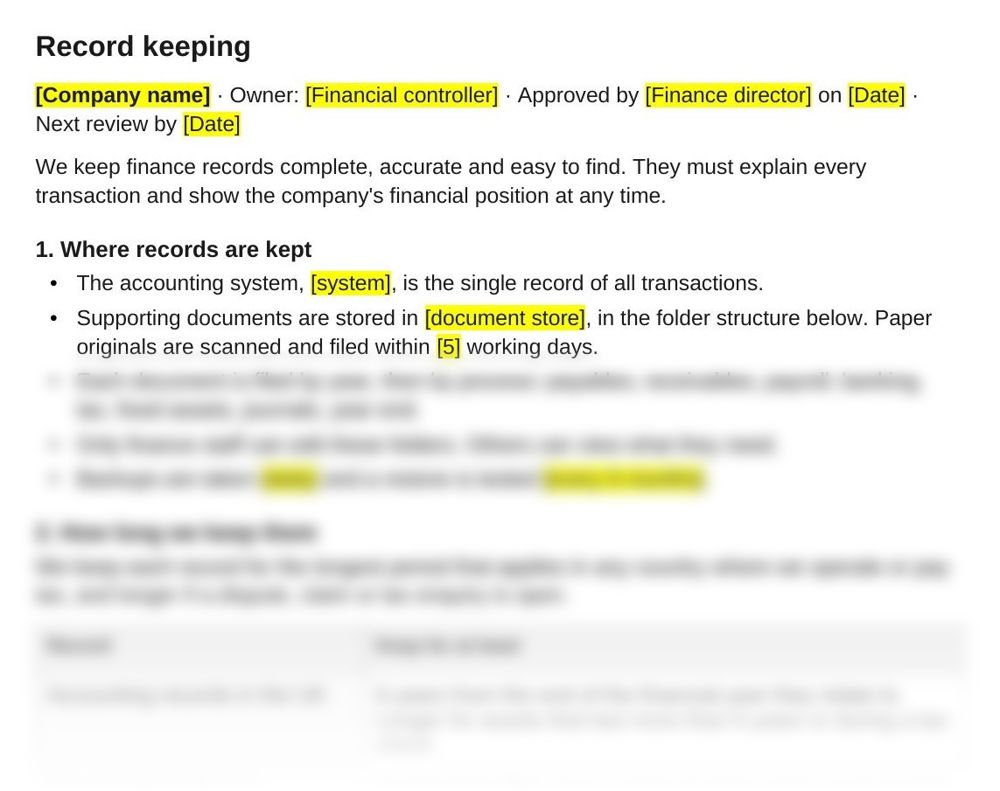
What the policy looks like
Why you need one
Under the Companies Act 2006, every company must keep accounting records that show and explain its transactions and disclose its financial position at any time. HMRC asks for records to be kept for six years. A written policy sets out how long each record is kept and who deletes it. Adopt the policy or review it when:
- You move to a new accounting system or document store
- You set up a company in another country
- You are clearing out old paper files or archive storage
- Auditors or HMRC ask for records from earlier years
- Your data protection policy needs retention periods for finance records
How to use the record retention policy template
- Name your systems. Fill in your accounting system and document store, and set the folder structure.
- Check the retention table. Keep the UK and US rows that apply, and add the local period for each other country you operate in.
- Fill in the bracketed periods. Contracts, deeds, fixed assets and payroll have suggested periods you can change.
- Name who deletes old records. They check with the FD that nothing is needed for an open dispute, claim or tax enquiry, then log the deletion.
- Build the year-end file. Tick off each item on the checklist at every year end.
Questions
How long should a company keep financial records in the UK?
GOV.UK says to keep company records for six years from the end of the last financial year they relate to. Keep them longer if a transaction covers more than one accounting period, you bought something expected to last more than six years, you sent your Company Tax Return late or HMRC has started a compliance check.
What does the Companies Act say about keeping accounting records?
Section 386 says every company must keep adequate accounting records, and section 388 says they must be preserved for three years from the date they are made for a private company, and six years for a public company. HMRC's six-year period is longer than the Act for private companies.
How long do you keep VAT records?
HMRC's VAT record keeping notice says you must generally keep all business records for VAT purposes for at least six years.
How long should US tax records be kept?
The IRS says three years in most cases, seven years if you claim a bad debt deduction or a loss from worthless securities, and at least four years for employment tax records after the tax is due or paid, whichever is later.
Which records should be kept permanently?
This policy keeps annual accounts, audit reports, board minutes and statutory registers permanently, along with a year-end file for each year.
Also in the finance policies and procedures manual
Who it's for
Finance directors and financial controllers who want one clear rule for where records live and how long they are kept.
Last checked
Checked against the Companies Act 2006, GOV.UK, HMRC's VAT record keeping notice and IRS guidance in November 2026.