Journal entry policy template for finance teams
Set the rules for every manual journal: what evidence it needs, who approves it, what the month-end review looks at and who can reopen a closed period. This journal entry policy is one Word procedure that also sets your reconciliation schedule and fixed asset rules.
Finance teamsGet this pack and 45 more for $69
You save $546 on buying them one by one
Buy the US library · $69Want every pack, for every region? Global library, 101 packs, $129
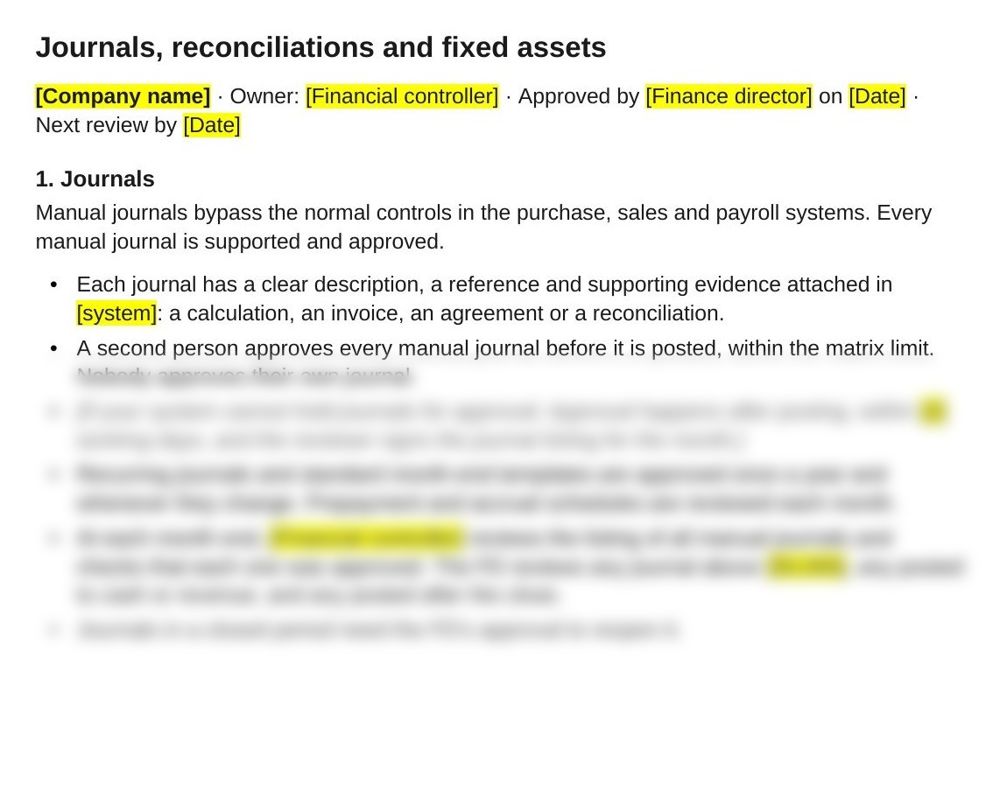
What the policy looks like
When you need it
Manual journals are the easiest way to change the numbers without going through the controls in your other systems, so auditors, investors and lenders ask how they are approved. Put this policy in place when:
- More than one person posts journals and nobody reviews them
- Your company is preparing for its first audit or a lender's review
- You move to a new accounting system and set up approval workflows
- Month-end journals are posted from spreadsheets with no support attached
- You want reconciliations signed by a preparer and a reviewer every month
How to use the journal entry policy
- Name the owner and approver. Fill in the company, the policy owner and who approved it, with a review date.
- Set your limits. Choose the amount above which the FD reviews a journal, and copy the journal limits from your delegated authority matrix.
- Choose the approval wording. Keep approval before posting, or use the optional line if your system cannot hold journals for approval.
- Fit the reconciliation table to your ledger. Delete accounts you don't have, set the deadlines and the limits for differences.
- Set the fixed asset rules. Your capitalisation limit, useful lives and depreciation method.
- Have it approved and tell the team. Record the approval date and show everyone who posts or reviews journals where the policy lives.
Questions
What is a journal entry policy?
The written rules for manual journals: what support each one needs, who approves it, how the month-end listing is reviewed and who can post to a closed period.
What is a manual journal?
An entry posted straight to the nominal ledger by a person, rather than created by the purchase, sales or payroll system. Because it skips the controls in those systems, each one needs evidence and a second person's approval.
Who should approve manual journals?
Someone other than the person who posted it, within the limit in the delegated authority matrix. In the example limits, the financial controller approves journals up to 50,000 and the FD above that. Journals the FD posts are reviewed by the financial controller after posting, and by the CEO above 250,000.
What supporting evidence does a journal need?
A clear description, a reference and the document behind it, such as a calculation, an invoice, an agreement or a reconciliation, attached in the accounting system.
How often should balance sheet accounts be reconciled?
The policy reconciles most accounts every month, including bank, sales and purchase ledger control, payroll, fixed assets, prepayments and accruals, intercompany, loans and suspense. Sales tax is reconciled each return period, and equity and reserves at the year end.
Also in the finance policies and procedures manual
Who it's for
Financial controllers and finance directors who want manual journals approved, reviewed and supported the same way every month.
Last checked
Checked in November 2026.