Treasury and IRS Set 3% Minimum Auto-Enrollment for New 401(k) Plans
Treasury and the IRS issued final rules on November 17 requiring new 401(k) and 403(b) plans to enrol staff at 3% or more from 2028.
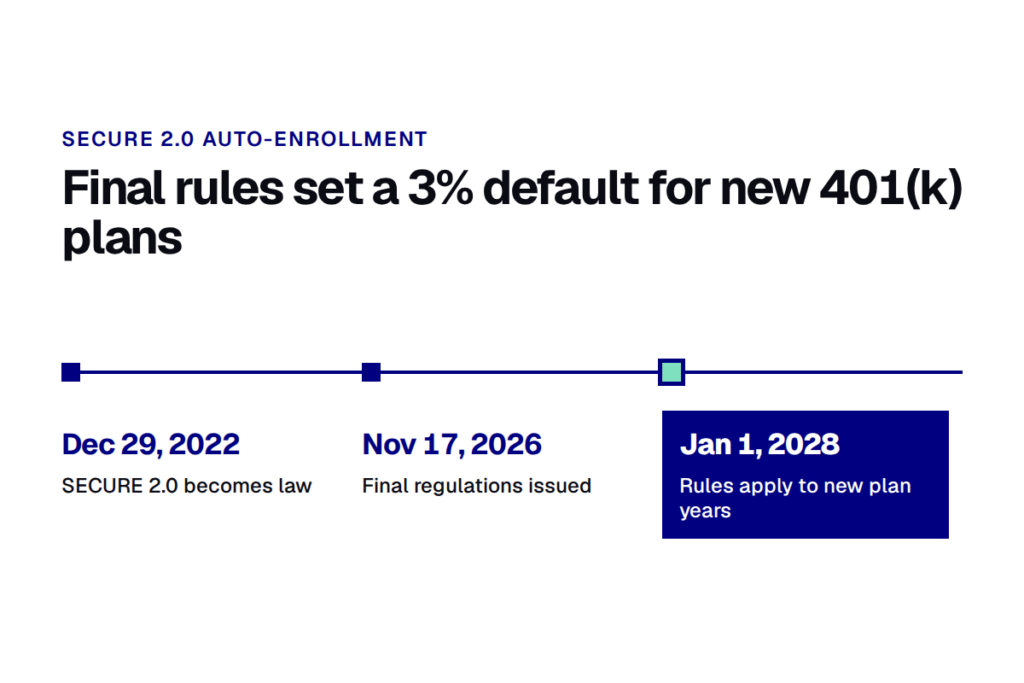
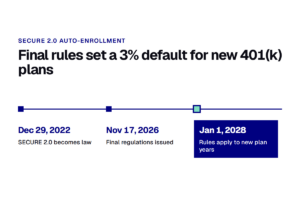
The Treasury Department and the Internal Revenue Service issued final regulations on November 17, 2026 requiring new 401(k) and 403(b) plans to enrol eligible staff at a default contribution of at least 3% of pay, for plan years starting after December 31, 2027.
The SECURE 2.0 automatic enrollment final rules matter to finance teams because they turn a statutory mandate from the December 2022 SECURE 2.0 Act into dated, testable plan design. Payroll set-up, plan documents, participant notices and employer match budgets all depend on them. Treasury estimates the expansion will raise retirement savings by an average of $4.2 billion a year over 2023 to 2032.
The regulations follow proposed rules published in the Federal Register on January 14, 2025. They are published as Federal Register document 2026-23530 and announced in IRS release IR-2026-141.
Accountio.The go-to weekly newsletter, straight to your inbox.Weekly newsletter, straight to your inbox.
Which plans the automatic enrollment rules cover
Under section 414A of the Internal Revenue Code, the mandate applies to 401(k) and 403(b) plans established after December 29, 2022, the day SECURE 2.0 became law. Plans that existed before that date are not caught by the requirement, which is why the SECURE 2.0 automatic enrollment final rules concentrate on new plans and on what happens when an old plan merges with a newer one.
The final regulations clarify the statutory exceptions for qualifying small and new businesses, governmental plans, church plans and SIMPLE 401(k) plans. By statute, a small business is one with 10 or fewer employees, and a new business is one that has existed for less than three years.
The 403(b) coverage extends the rule beyond the corporate sector. A 403(b) plan is the tax-sheltered annuity arrangement used by public schools, universities, hospitals and certain 501(c)(3) nonprofits, so finance leads at those organisations now face the same design rules as a private-sector 401(k) sponsor.
Contribution rates under the final rules
Covered plans must generally enrol eligible employees at a rate of at least 3%, and the statute caps the initial rate at 10%. After an initial participation period, the default rate must rise by at least one percentage point a year until it reaches at least 10%, subject to a 15% maximum.
Employees can opt out or choose a different rate. The SECURE 2.0 automatic enrollment final rules also give employers more flexibility over the timing and size of the automatic increases, within those statutory limits.
“A financially secure retirement is a cornerstone of the American Dream, and every worker deserves the opportunity to achieve it.”
Scott Bessent, Treasury Secretary
Bessent said the rules give employers “the clarity and flexibility to invest in their employees’ futures”. For a sponsor, the practical effect is on cost, because higher default deferral rates raise the amount of any employer match that flows through payroll each year.
What changed from the January 2025 proposal
The clearest change is the start date. The proposal would have applied to plan years beginning more than six months after final regulations were issued, and it told administrators to follow a reasonable, good-faith reading of the statute until then. The final rules instead apply generally to plan years starting after December 31, 2027, which gives sponsors a fixed date to plan against.
The final text also simplifies communications. Certain required notices may be combined, and annual notice requirements are reduced for eligible employees who are not participating, provided they receive annual reminders and any plan documents they are entitled to request. The regulations also explain how the automatic enrollment requirements apply after plan mergers.
IRS chief executive Frank Bisignano said the rules “reduce the administrative burden placed on taxpayers when making long-term financial decisions”. The agency presents the notice changes as part of that aim, and they are the part of the rule most likely to cut work for plan administrators.
What employers should do before the 2028 plan year
The first task is to establish when each plan was set up, because a plan created after December 29, 2022 is the case the rules were written for. A company that opened a 401(k) in 2023 and then bought a business with an older plan needs to read the merger provisions before it combines them.
The second is to test the small and new business exceptions against real headcount and dates. A firm with 10 employees today, or one that turns three years old during 2028, can move in or out of scope, so the exemption is not a one-off determination. Finance teams should record the evidence for the decision in an internal controls register, since plan sponsors answer for compliance failures.
Payroll and recordkeeping come next. Default deferrals, annual escalation dates and opt-out processing have to be configured in the payroll system and agreed with the plan recordkeeper. Providers such as ADP, which has agreed to embed payroll, HR and benefits in PNC business banking, already bundle payroll and benefits administration for small employers that will be asked to make these changes.
Finally, the budget needs updating. Auto-enrolment typically raises participation, and with a match formula, every additional participant and every one-point escalation adds to the employer cost. Treasurers and controllers should model the match at the 10% floor and at the 15% ceiling, not only at the 3% starting rate.
How the US rules compare with other markets
The US approach differs from the UK model, where pension auto-enrolment applies to nearly all employers by default and sets minimum contributions by law. The US mandate reaches only newer plans and exempts small and young businesses, and employers keep control over how they design the escalation schedule, within the 10% and 15% limits.
Multinational groups with US and UK payrolls will therefore run two different systems, with different eligibility tests, different contribution floors and different notice regimes. Finance leaders at those groups should map each jurisdiction’s rules before the next benefits budget cycle.
Plan years beginning after December 31, 2027 are the first to which the SECURE 2.0 automatic enrollment final rules generally apply, so calendar-year plans face their first compliance test on January 1, 2028.
Accountio.
The go-to weekly newsletter for accounting professionals. Trusted by 10,000+ industry leaders to deliver the tech trends and insights that matter most. Join them today.
Companies in this article
ADPPayrollView listing →