Written information security plan template for tax and accounting firms
Set out in one document how your firm protects client Social Security numbers, tax records and bank details, in the order the FTC Safeguards Rule lists its requirements. This written information security plan template is one Word plan, ready for your firm's name, people and systems.
US firmsGet this pack and 45 more for $69
You save $546 on buying them one by one
Buy the US library · $69Want every pack, for every region? Global library, 101 packs, $129
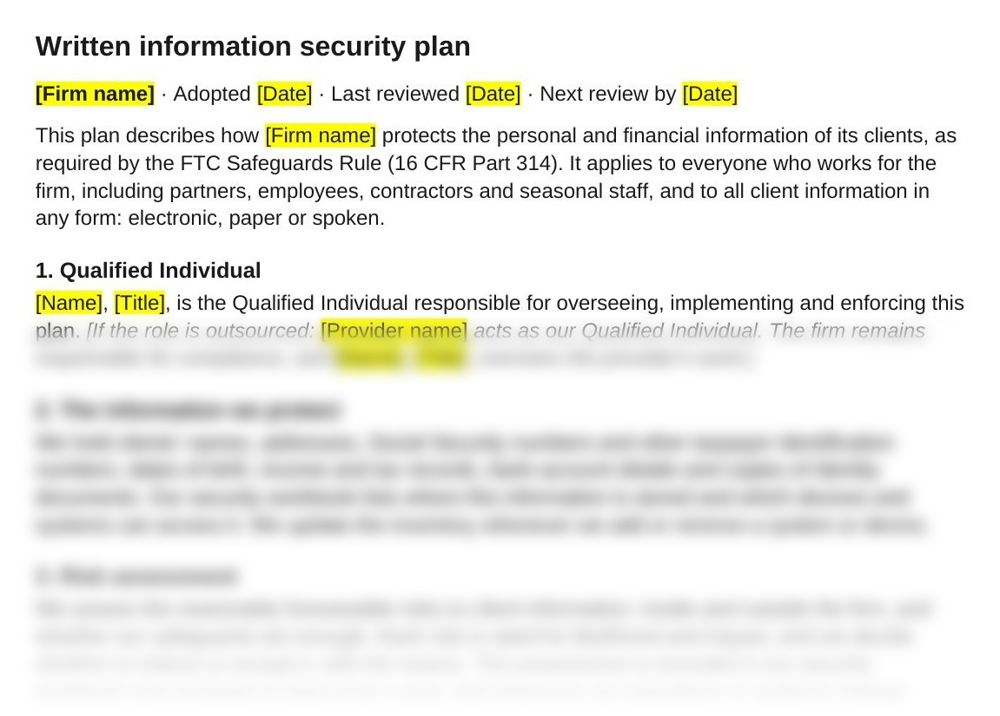
What the plan looks like
Who needs one
The FTC Safeguards Rule treats an accountant or other tax preparation service that completes income tax returns as a financial institution, and requires a written information security program. The IRS describes the written information security plan (WISP) as a requirement for tax and accounting professionals of every size, and Form W-12 asks preparers to confirm they know about it when they apply for or renew a PTIN. Use this one when:
- You prepare tax returns and have no written plan yet
- Your current plan doesn't cover multi-factor authentication, encryption or FTC breach notices
- You are renewing your PTIN and want the plan in place behind the Form W-12 answer
- Your cyber insurer or a client asks to see your security plan
How to use the written information security plan template
- Name your Qualified Individual. One person oversees the plan. If an outside provider does it, name the person at the firm who supervises them.
- List your information and systems. Write down where client data is stored and which devices and systems can reach it. The kit's security workbook has an inventory for this.
- Fill in your safeguards. Replace the yellow fields with your real settings: review frequency, password length, password manager, backup schedule and how you send documents to clients.
- Choose your testing option. Keep the continuous monitoring wording or the yearly penetration test and six-monthly scan wording, and delete the other.
- Approve, train and review. Sign the plan, walk staff through it, have each person sign the acknowledgment and review it at least once a year.
Questions
Is a WISP required by the IRS?
The requirement comes from the FTC Safeguards Rule, which applies to tax and accounting firms as financial institutions. The IRS points preparers to it in Publication 5708 and Publication 4557, and Form W-12 asks preparers to confirm they know paid preparers must create and keep a written information security plan.
What should a written information security plan include?
A Qualified Individual, a written risk assessment, safeguards such as access controls, encryption and multi-factor authentication, secure disposal, change management, monitoring or testing, staff training, service provider oversight, an incident response plan and a written report to the owners at least once a year.
Does a small tax practice need a WISP?
Yes. Every firm that prepares tax returns needs a written information security program. A firm holding information on fewer than 5,000 consumers is exempt from four parts only: the written risk assessment, penetration testing and scans, the written incident response plan and the yearly report. Everything else still applies.
Is a WISP required for a PTIN?
Form W-12, used to apply for or renew a PTIN, asks preparers to tick a box confirming they know paid tax return preparers are required by law to create and maintain a written information security plan.
How often should a WISP be reviewed?
At least once a year, and after any security incident or significant change to the firm's systems. The Safeguards Rule also requires the Qualified Individual to report in writing to the owners at least once a year.
Also in the WISP kit for tax and accounting firms
Who it's for
Small CPA, EA and tax preparer firms that need a written plan that matches how they really work.
Last checked
Checked against the FTC Safeguards Rule, IRS Publication 5708 and the Form W-12 instructions in November 2026.