Transfer pricing policy template for multinational groups
Write down how the companies in your group price goods, services, intangibles and loans between each other, and who keeps it all in order. This transfer pricing policy template is one Word document for the group, approved by the parent company board and reviewed every year.
Finance teamsGet this pack and 51 more for $79
Want every pack, for every region? Global library, 110 packs, $99
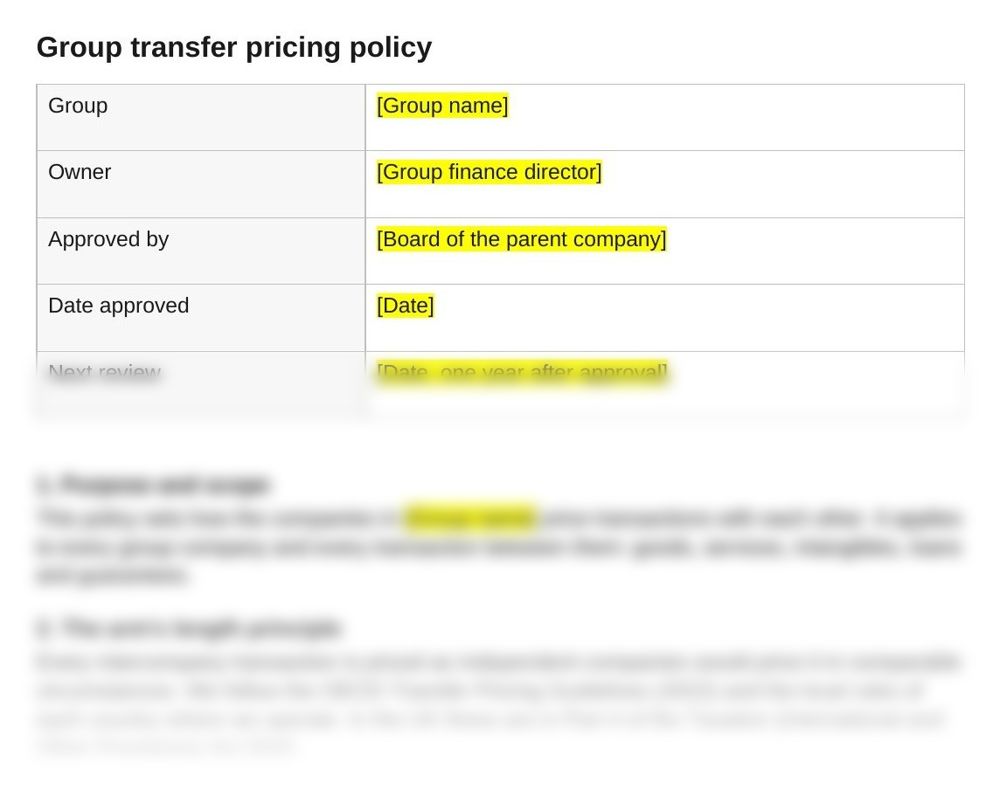
What the policy looks like
When you need a transfer pricing policy template
Every intercompany transaction has to be priced at arm's length, as independent companies would price it. A group policy sets one method and rate for each type of transaction, so entity finance teams charge the same way every month and the Local File describes what actually happened. Use the policy when:
- Your group has companies in more than one country that trade with each other
- Intercompany charges are set entity by entity and nobody has written down the method
- You are preparing a Master File and Local Files and need the pricing rules they describe
- The group is adding a new intercompany service, loan or royalty
- Year-end results keep landing outside the target range and you need a fixed adjustment process
How to use the transfer pricing policy template
- Fill in the group details. Group name, owner, approving board and the next review date.
- Set each pricing rule. Keep the transaction types your group has, delete the rest, and enter the margin, mark-up, royalty or interest rate from your benchmarking. Leave low value-adding services at 5%.
- Define the cost base. List the allocation keys you use, such as headcount, revenue or time spent, and the pass-through costs.
- Set dates and terms. Enter the year-end adjustment deadline, invoicing frequency, payment days, the interest rate on late balances and the benchmarking refresh cycle.
- Name the roles and approve it. Check the roles table matches your teams, then have the parent company board approve it and date it.
Questions
What should a transfer pricing policy include?
The arm's length principle, the method and rate for each type of intercompany transaction, the cost base, year-end adjustments, intercompany agreements, invoicing and settlement, documentation, roles and how new transactions are approved.
Which transfer pricing methods can a group use?
The OECD Guidelines recognise five: comparable uncontrolled price, resale price, cost plus, transactional net margin and transactional profit split. The policy picks the most appropriate one for each type of transaction.
What mark-up applies to low value-adding services?
Under the OECD simplified approach, 5% of the relevant costs, applied to every low value-adding service. It does not need a benchmarking study. Pass-through costs carry no mark-up.
When must UK transfer pricing documentation be ready?
For UK companies under the Transfer Pricing Records Regulations 2023, HMRC expects the Local File to be finalised by the filing date of the company's tax return, and the Master File reviewed by the return due date for the group's ultimate parent.
How quickly must the files reach HMRC?
HMRC generally treats 30 days after an information notice as a reasonable time. The policy keeps the files ready to send.
Also in the transfer pricing pack
Who it's for
Group finance and tax teams of multinational groups with UK entities, and the advisers who prepare their documentation.
Last checked
Checked against the 2022 OECD Transfer Pricing Guidelines, the Transfer Pricing Records Regulations 2023 and HMRC's International Manual in November 2026.