Fraud risk assessment template in Excel for the failure to prevent fraud offence
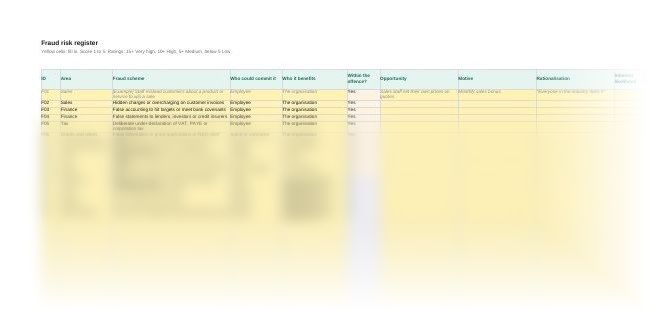
Work out whether the UK failure to prevent fraud offence applies to your group, score each fraud scheme before and after your controls, and show the board what is in place under each of the six principles. This fraud risk assessment template is one Excel workbook with a scope test, a fraud risks sheet of 100 rows with common schemes filled in, and a summary for the board.
Finance teamsGet this pack and 45 more for $69
You save $546 on buying them one by one
Buy the US library · $69Want every pack, for every region? Global library, 101 packs, $129
What the assessment looks like
Who needs a fraud risk assessment
A fraud risk assessment lists the ways fraud could happen in a business, how likely and how damaging each one is, and what stops it. Since 1 September 2025, a large organisation can commit the UK offence of failure to prevent fraud when an employee, agent, subsidiary or other person working for it commits fraud meant to benefit it. The defence is having reasonable fraud prevention procedures, and the Home Office guidance makes risk assessment one of its six principles. Use this one when:
- Your group meets two of the three large organisation tests and needs to show reasonable prevention procedures
- The board or audit committee has asked for a documented fraud risk assessment
- Sales targets, bonuses or bank covenants put pressure on staff to bend the numbers
- You use agents, contractors or subsidiaries that act for the business
How to use the fraud risk assessment template
- Run the scope test. Enter last year's employees, turnover and total assets for the whole group. The sheet says whether you are a large organisation on those figures.
- Go through the fraud schemes. Delete the ones that don't fit your business and add your own. For each, say who could commit it, who it benefits and why it could happen.
- Score each risk twice. Score likelihood and impact before your controls, describe the prevention procedures, then score again. Name an owner for every row.
- Answer the six principles. Mark each question In place, Partly or Not in place and record the evidence. Anything not fully in place needs an action, an owner and a date.
- Take the Summary to the board. Record who approved it and when. The next review date is set 12 months later, and you review sooner after a fraud or a big change.
Questions
What is a fraud risk assessment?
A documented review of how fraud could be committed against or on behalf of an organisation. It lists each fraud scheme, who could commit it, how likely and serious it is, and the controls that prevent it.
What is the failure to prevent fraud offence?
An offence created by the Economic Crime and Corporate Transparency Act 2023, in force from 1 September 2025. A large organisation is liable when an associated person, such as an employee, agent or subsidiary, commits a fraud offence intending to benefit it or its clients, unless it had reasonable fraud prevention procedures. It does not need to be shown that managers ordered or knew about the fraud.
Which organisations does the offence apply to?
Large organisations: those meeting two or more of these in the financial year before the fraud: more than 250 employees, more than £36 million turnover and more than £18 million balance sheet total. A parent's figures are added up across the whole group.
What are the six principles of fraud prevention?
Top level commitment, risk assessment, proportionate risk-based prevention procedures, due diligence, communication (including training), and monitoring and review. They come from the Home Office guidance on the offence.
How often should a fraud risk assessment be reviewed?
The Home Office guidance says the assessment should be documented and kept under regular review, typically every year or every two years, and sooner when something changes. A court can find that an out-of-date assessment was not fit for purpose.
What is the fraud triangle?
Three conditions that make fraud more likely: opportunity, such as weak controls; motive, such as a sales bonus; and rationalisation, such as "everyone does it". The workbook has a column for each one.
Also in the risk and internal audit pack
Who it's for
Finance directors, financial controllers, internal auditors and compliance leads in groups that meet, or are close to, the large organisation tests.
Last checked
Checked against the Economic Crime and Corporate Transparency Act 2023 and the Home Office guidance on failure to prevent fraud in November 2026.