Due diligence report template (Word) for buying a company
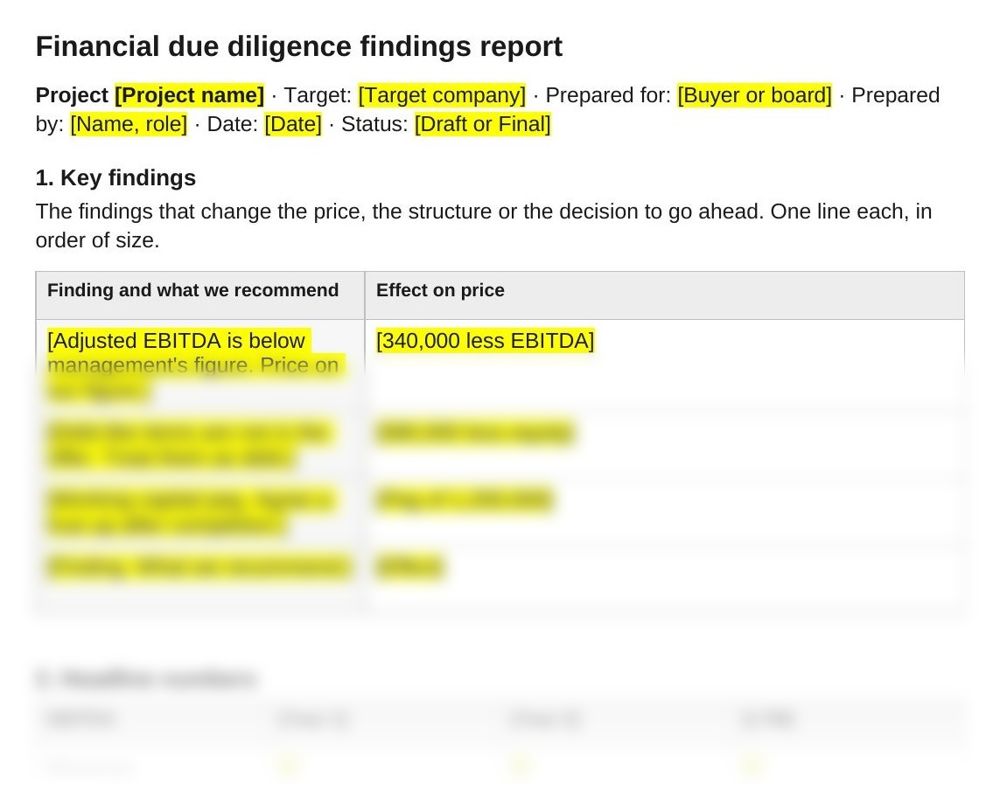
Tell the buyer what changes the price first, then show the evidence behind it, section by section, ending with what the purchase agreement must cover. This due diligence report template is one Word document in 13 sections with five appendices, set out for the financial findings on a company being bought.
Finance teamsGet this pack and 51 more for $79
Want every pack, for every region? Global library, 110 packs, $99
What the report looks like
When you need it
A financial due diligence report sets out what the buyer's team found in the target's accounts and what it means for the price and the deal terms. It is written once the requests are mostly answered and the adjustments are settled, before the purchase agreement is finalised. Use this one when:
- Your finance team is buying a company and reporting to its own board
- An adviser needs a clear structure for a findings report to a buyer
- The board needs findings ranked by their effect on price, not a long list
- A finance director selling a business wants to see the report a buyer will write
- You need to show the buyer's lawyers which points belong in the purchase agreement
How to use the due diligence report template
- Fill in the header. Project name, target, who the report is for, who wrote it, the date and whether it is a draft or final.
- Write section 1 last. Once the detail is done, list the findings that change the price or the decision, largest first.
- Bring the figures across. Take adjusted EBITDA, net debt, debt-like items and the peg from the quality of earnings workbook, so the report and the numbers match.
- Say what you could not see. Record open requests and any limits on access in section 3, and list the open requests in Appendix D.
- Hand section 13 to the lawyers. Tick each point for the purchase agreement as it is agreed.
Questions
What is a due diligence report?
A report from the buyer's team or advisers that sets out what they found when they checked a business before buying it. A financial due diligence report covers earnings, net debt, working capital, cash, tax and the forecast.
What should a due diligence report include?
Key findings with their effect on price, headline numbers, the scope and information used, a short description of the business, quality of earnings, revenue and costs, net debt and debt-like items, working capital, cash flow, tax, the forecast and points for the purchase agreement.
What is a financial due diligence report?
The part of due diligence that tests the target's financial information. Its main outputs are adjusted EBITDA, net debt and debt-like items, and a normal level of working capital, which together move the headline value to the equity price.
What is a vendor due diligence report?
A due diligence report the seller commissions before a sale and shares with bidders. The structure is much the same as a buyer's report, and a seller can use this outline to see what buyers will look at.
What is the difference between completion accounts and a locked box?
With completion accounts, the price is adjusted after completion for actual net debt and working capital against the peg. With a locked box, the price is fixed on an earlier balance sheet, and the seller agrees not to take value out of the business after that date.
Also in the m&A financial due diligence
Who it's for
Finance teams and advisers buying a company, and finance directors preparing a business for sale.
Last checked
Checked in November 2026.