Pay transparency policy template for EU employers
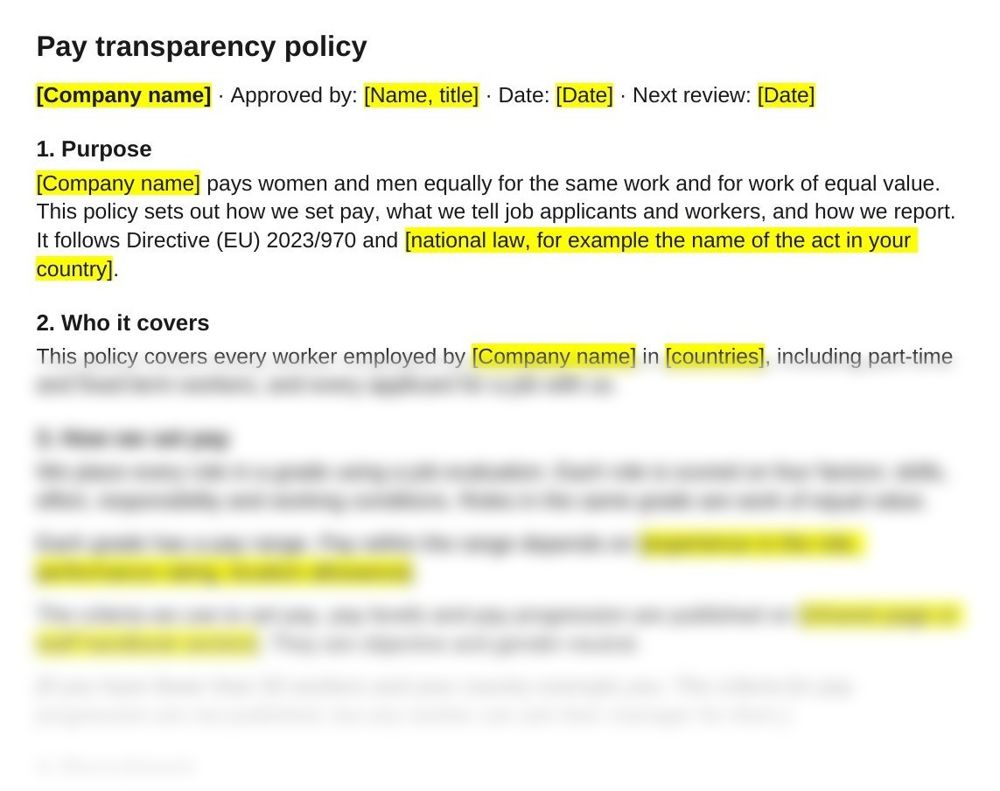
Set out in one document how your company sets pay, what job applicants and workers are told, how pay information requests are answered and how the gender pay gap is reported. This pay transparency policy template is a Word policy that follows Directive (EU) 2023/970, with gaps for your company, your countries and the national law.
EU firmsGet this pack and 109 more for $99
What the policy looks like
When you need a pay transparency policy template
Directive (EU) 2023/970 gives job applicants the right to know the pay range before the interview, gives workers the right to ask for pay information, and makes employers with 100 or more workers report on the gender pay gap. EU countries had until 7 June 2026 to bring it into national law, and the first reports for employers with 150 or more workers are due by 7 June 2027. Use the policy when:
- You employ people in an EU country and need written rules on pay ranges, requests and reporting
- Recruiters and hiring managers need one place that says what goes in an advert and what not to ask
- You expect pay information requests and want a set route and reply time
- Your first gender pay gap report is coming and you need to say who prepares and confirms it
- You advise EU clients on HR and payroll and want one policy to adapt for each of them
How to use the pay transparency policy template
- Fill in the company and the countries. Add the company name, the countries the policy covers and the name of the national law in each. The national transposition tracker in the pack lists them.
- Describe your pay structure. Name what decides pay within a range, such as experience or performance, and where staff can read the pay criteria. Use the small employer wording only if it applies.
- Set the request route. Add the HR contact, your reply time and the month you remind staff of their right to ask.
- Set the reporting details. Enter your headcount, how often you report, the first deadline and the national authority. Keep the publishing sentence only if you choose to publish.
- Name the people and approve it. Fill in the roles table and record keeping periods, then have it approved and dated, with a review date a year ahead.
Questions
What should a pay transparency policy include?
How pay is set and graded, the pay range in job adverts, the ban on asking about past pay, how workers request pay information, how the gender pay gap is reported, what happens when a gap is found, and who does what.
Do job adverts have to show the pay range?
Under the Directive, applicants have the right to the starting pay or its range, either in the published vacancy notice or before the job interview. Employers must not ask applicants about their pay history. The policy puts the range in every advert and gives it before the first interview where there is no advert.
How quickly must an employer answer a pay information request?
Within a reasonable period and no later than two months after the request. Workers can ask for their own pay level and the average pay levels, by sex, of workers doing the same work or work of equal value. Employers must remind all workers of this right every year.
Can a contract stop staff talking about their pay?
No. The Directive does not allow terms that stop workers from disclosing their pay for the purpose of equal pay. Employers can require that information received about other workers' pay is used only for exercising the right to equal pay.
What happens if the gap in a category is 5% or more?
If the average gap in any category of workers is at least 5%, the employer has not justified it on objective, gender-neutral criteria and has not corrected it within six months of the report, it carries out a joint pay assessment with workers' representatives.
Do small employers need a pay transparency policy?
The rights on pay in adverts and pay information requests apply to all employers. Countries can exempt employers with fewer than 50 workers from publishing pay progression criteria, and reporting starts at 100 workers. The policy has optional wording for the exemption.
Also in the EU pay transparency pack
Who it's for
HR and finance teams at companies with workers in the EU, and accounting firms that run payroll for them.
Last checked
Checked against Directive (EU) 2023/970 in November 2026.