Gender pay gap report template for EU employers
Work out every figure an EU employer has to report on pay between women and men from one list of workers: mean and median gaps, variable pay, quartile bands and the gap in each category of workers. This gender pay gap report template is one Excel workbook that follows the EU directive, not UK gender pay gap reporting.
EU firmsGet this pack and 109 more for $99
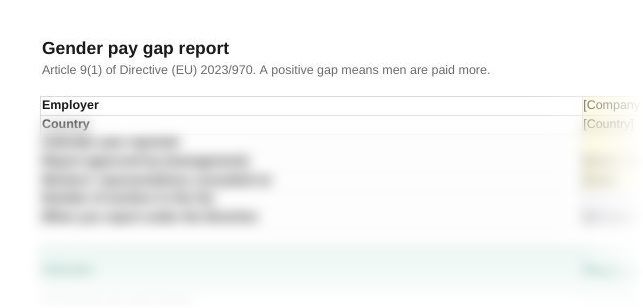
What the report looks like
Who needs a gender pay gap report template
Directive (EU) 2023/970 on pay transparency makes employers with 100 or more workers in an EU country report seven figures on the pay gap between female and male workers for the previous calendar year. Employers with 250 or more workers report by 7 June 2027 and every year after. Employers with 150 to 249 workers report by 7 June 2027 and every three years. Employers with 100 to 149 workers start by 7 June 2031. Use the workbook when:
- Your company employs 100 or more workers in an EU country
- Your first report is due by 7 June 2027 and you have not run the figures yet
- You run payroll for EU clients and will prepare their reports
- Management has to confirm the figures after consulting workers' representatives
- You want to see which categories of workers show a gap before you publish
How to use the gender pay gap report template
- Set up your categories of workers. Group people doing the same work or work of equal value. The job evaluation workbook in the pack gives you the grades.
- List every worker for the calendar year. Enter sex, category, gross basic pay, gross variable pay such as bonuses, commission and overtime, and paid hours. Delete the example rows first.
- Fill in the Report sheet. Company name, country, year, who approved it and the date workers' representatives were consulted. Figures (a) to (f) fill in by themselves.
- Type each category name once on the Categories sheet. Use the exact names from the Workers sheet. The gap for each category appears, with any gap of 5% or more flagged.
- Deal with every flagged category. Justify the gap with objective, gender-neutral criteria or fix it within six months. Then send the figures to the authority your country's law names.
Questions
What must a gender pay gap report include under the EU directive?
Seven figures: (a) the mean gender pay gap, (b) the mean gap in complementary or variable pay, (c) the median gap, (d) the median gap in variable pay, (e) the share of women and of men receiving variable pay, (f) the share of women and of men in each quartile pay band, and (g) the gap by category of workers, split into basic pay and variable pay.
How do you calculate the gender pay gap?
Take the average pay of male workers, subtract the average pay of female workers and divide by the average pay of male workers. The directive defines pay level as gross annual pay and the matching gross hourly pay, so the workbook shows both. A positive figure means men are paid more.
When is the first EU gender pay gap report due?
By 7 June 2027 for employers with 150 or more workers, covering the 2026 calendar year. Employers with 100 to 149 workers report first by 7 June 2031. Each country's law names the authority that receives the report.
What happens if a category gap is 5% or more?
If the gap is not justified by objective, gender-neutral criteria and is not fixed within six months of the report, the employer has to carry out a joint pay assessment with workers' representatives under Article 10.
Who sees the gender pay gap report?
Figures (a) to (g) go to the national authority that compiles and publishes them, and the employer can publish (a) to (f) on its website. The gap by category goes to all workers and their representatives, and to the labour inspectorate and equality body on request.
Is this the same as UK gender pay gap reporting?
No. UK reporting applies to employers with 250 or more employees on a snapshot date, usually 5 April. This workbook follows the EU directive, which starts at 100 workers, covers a calendar year and adds the gap by category of workers.
Also in the EU pay transparency pack
Who it's for
HR and finance teams at companies with workers in the EU, and accounting firms that run payroll for them.
Last checked
Checked against Directive (EU) 2023/970 in November 2026.