Business-wide risk assessment template for EU accounting firms
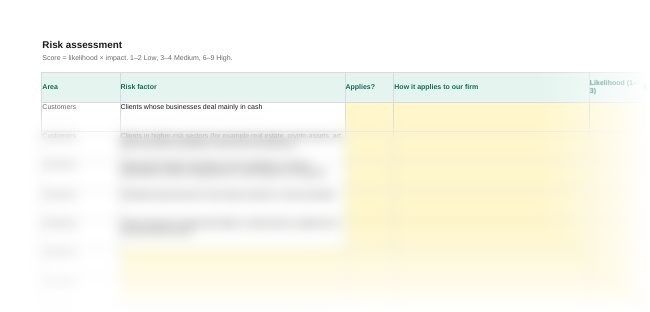
Write down the money laundering, terrorist financing and sanctions risks your firm faces, rate each one and record your controls, as Article 10 of the EU Anti-Money Laundering Regulation asks. This business-wide risk assessment template is one Excel workbook with a firm profile, over 20 risk factors already filled in and a sign-off sheet.
EU practicesGet this pack and 109 more for $99
What the risk assessment looks like
When you need a business-wide risk assessment
From 10 July 2027 the EU Anti-Money Laundering Regulation applies directly in every member state, and it lists auditors, external accountants and tax advisers as obliged entities. Article 10 asks each firm to identify and assess its money laundering and terrorist financing risks, and the risk of not applying or evading targeted financial sanctions. The assessment is written down, kept current and reviewed regularly. The compliance officer draws it up and the management body approves it. Use the workbook when:
- Your firm audits, keeps accounts or gives tax advice in an EU member state
- You are getting ready for 10 July 2027
- You plan a new service, delivery channel or technology, such as electronic identification
- Your supervisor asks to see your risk assessment
- Your clients or services have changed since the last assessment
How to use the business-wide risk assessment template
- Fill in the firm profile. Answer each question with numbers where you can. They are the evidence behind your ratings.
- Go through each risk factor. Say whether it applies, describe how it applies to your firm, and rate likelihood and impact from 1 to 3.
- Record controls and reasons. Note the controls you use and why you gave the rating. The Check column stays red until a row that applies is complete.
- Add your own risks. Each area has blank rows for risks specific to your firm.
- Conclude and approve. On Summary and sign-off, write the main risks and what you will change. The compliance officer draws it up, the management body approves it, and the next review date fills in a year later.
Questions
What is a business-wide risk assessment?
A written assessment of the money laundering and terrorist financing risks a firm is exposed to, and of the risk of not applying or evading targeted financial sanctions. Under the AML Regulation it takes into account the risk factors in Annexes I to III, the EU and national risk assessments, publications by the Commission, AMLA and international standard setters, information from your supervisor, and your client base.
Who draws up and approves it?
The compliance officer draws it up and the management body approves it. Where the firm also has a supervisory board, the assessment is shared with it.
How often should it be reviewed?
The Regulation asks for it to be kept current and reviewed regularly, including when events significantly change your risks. New services, delivery channels and technology are assessed before you launch them. The workbook sets the next review a year after approval.
Does every firm need a written one?
Supervisors may decide that individual documented assessments are not needed where the risks of the sector are clear and understood. That decision rests with the supervisor, not the firm.
When does the AML Regulation apply?
From 10 July 2027. Until then, firms follow their national anti-money laundering rules.
Also in the EU AML Regulation readiness pack
Who it's for
Accounting, audit and tax firms in EU member states getting ready for the AML Regulation.
Last checked
Checked against the EU Anti-Money Laundering Regulation in November 2026.