AMLR gap analysis template for accountants and auditors
Compare what your firm does under your national anti-money laundering rules with what the EU Anti-Money Laundering Regulation requires from 10 July 2027, article by article, and turn every gap into an action with an owner and a date. This AMLR gap analysis is one Excel workbook with nearly 40 requirements already filled in.
EU practicesGet this pack and 100 more for $129
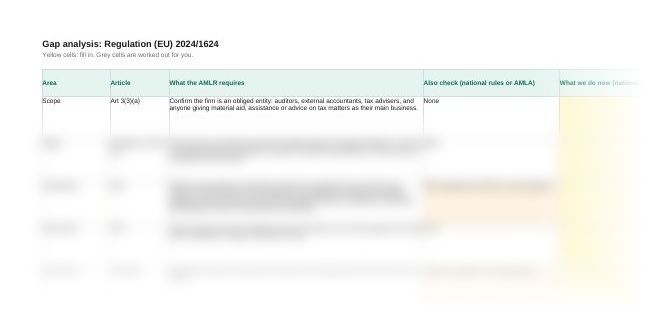
What the gap analysis looks like
When you need an AMLR gap analysis
The AML Regulation applies directly in every EU member state from 10 July 2027. It lists auditors, external accountants and tax advisers as obliged entities, along with anyone whose main business is giving material aid, assistance or advice on tax matters. It replaces most national anti-money laundering rules with one EU rulebook, while your supervisor stays national. Run the gap analysis when:
- Your firm audits, keeps accounts or gives tax advice in an EU member state
- You want a plan for the changes before 10 July 2027
- The partners need a list of actions with owners and dates
- Your firm also forms companies or provides a registered office
- Your supervisor asks how you are getting ready
How to use the AMLR gap analysis
- Describe what you do now. For each row, write how your firm meets the point under your current national rules.
- Mark the gap. Choose Yes, Partly or No in the Gap? column.
- Plan every gap. Enter the action, an owner and a due date for each Yes or Partly. Rows without them turn red.
- Check the Also check column. It shows where your national law, your supervisor or a pending AMLA standard still decides the detail.
- Track it to the end. Mark actions Done as they finish. The Summary sheet shows open actions and the days left until 10 July 2027.
Questions
When does the EU AML Regulation apply?
From 10 July 2027. Until 9 July 2027, firms keep following their current national anti-money laundering rules.
Does the AMLR apply to accountants?
Yes. Article 3 lists auditors, external accountants and tax advisers as obliged entities, as well as any person whose main business or professional activity is giving material aid, assistance or advice on tax matters.
What does the AMLR require of an accounting firm?
Written internal policies, procedures and controls, a business-wide risk assessment, a compliance manager from the management body and a compliance officer, staff training and integrity checks, customer due diligence, reporting of suspicions to the financial intelligence unit, and record keeping.
Who is the compliance manager under the AMLR?
A member of the management body who answers for compliance with the Regulation. The management body also appoints a compliance officer who runs the day-to-day controls and reports suspicious transactions. Where the firm's size and risks justify it, one person can hold both roles.
How long must AMLR records be kept?
Five years from the end of the business relationship or the date of the occasional transaction. Personal data is then deleted, unless other law requires a longer period.
Also in the EU AML Regulation readiness pack
Who it's for
Accounting, audit and tax firms in EU member states getting ready for 10 July 2027.
Last checked
Checked against the EU AML Regulation in November 2026.