Mileage log template (Excel) at HMRC approved rates
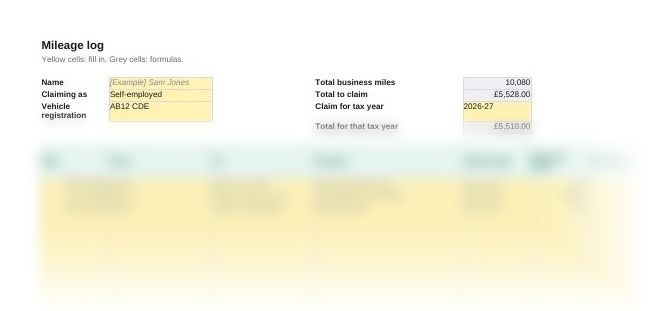
Log each business journey with its date, route and purpose, and see what can be claimed at HMRC's approved mileage rates, with the 10,000-mile limit applied for each tax year. This mileage log template is one Excel workbook for employees and the self-employed.
UK practices- In the pack
- Client bookkeeping pack
- Files
- 5, Word and Excel
Get the pack by email
What the log looks like
Who needs one
Anyone claiming business mileage needs a record of each journey. HMRC asks employees who claim tax relief on their own vehicle for a mileage log showing the reason for every journey and its start and end postcodes. Use this one for:
- Employees who use their own car for work and get less than the approved rate from their employer, or nothing
- Sole traders who claim their vehicle at the flat rate per mile instead of actual running costs
- Employers who pay mileage allowances and want every claim in the same shape
- Drivers who pass 10,000 business miles in a tax year, when the car and van rate drops to 25p
How to use the mileage log template
- Say who is claiming. Pick Employee or Self-employed. The checks and passenger payments follow from this.
- Log each journey on the day. Date, from, to, business purpose, vehicle type and business miles. Use postcodes for From and To if you are an employee claiming relief from HMRC.
- Add passengers if you are an employee. Enter the number of fellow employees carried on the work journey.
- Let the sheet work out the rate. It finds the tax year from the date, counts the miles so far and moves cars and vans to 25p after 10,000 miles.
- Pick the tax year to total. Enter it at the top, such as 2026-27, to see the claim for that year, then delete the [Example] rows.
Questions
What are HMRC's approved mileage rates for 2026-27?
Cars and vans: 55p a mile for the first 10,000 business miles in the tax year, then 25p. Motorcycles 24p and bicycles 20p. From 2011-12 to 2025-26 the car and van rate was 45p for the first 10,000 miles. Employees can also be paid 5p a passenger a mile for carrying colleagues.
What should a mileage log include for HMRC?
The date and mileage of each work journey and the mileage for each type of vehicle. For an employee's tax relief claim, HMRC asks for a log showing the reason for every journey and the start and end postcodes, with a separate log for each employment.
Can self-employed people use the mileage rates?
Yes, as simplified expenses: 55p a mile for the first 10,000 miles and 25p after for cars and goods vehicles (45p before 6 April 2026), and 24p for motorcycles. Once you use the flat rate for a vehicle, you keep using it while that vehicle is in the business, and you can't use it for a vehicle you have claimed capital allowances on. Train fares and parking can be claimed on top.
What if my employer pays less than 55p a mile?
You can claim tax relief on the difference. Add up your business miles at the approved rates and take away what your employer paid. You can claim for the current tax year and the four before it, through your Self Assessment return if you file one.
How long should I keep a mileage log?
If you are self-employed, keep it with your business records for at least five years after the 31 January submission deadline for the tax year.
Also in the client bookkeeping pack
Who it's for
Accountancy practices and bookkeepers with sole trader and employee clients who drive for work.
Last checked
Checked against HMRC's approved mileage rates for 2026-27 and the simplified expenses rules in November 2026.