Trustees' annual report template for charities
Write the report the trustees sign each year with every section the regulations ask for: who runs the charity, what it did for the public benefit, what it achieved, its reserves and its plans. This trustees' annual report template is one Word document, with the extra sections for larger tier 2 charities marked.
UK practicesGet this pack and 100 more for $129
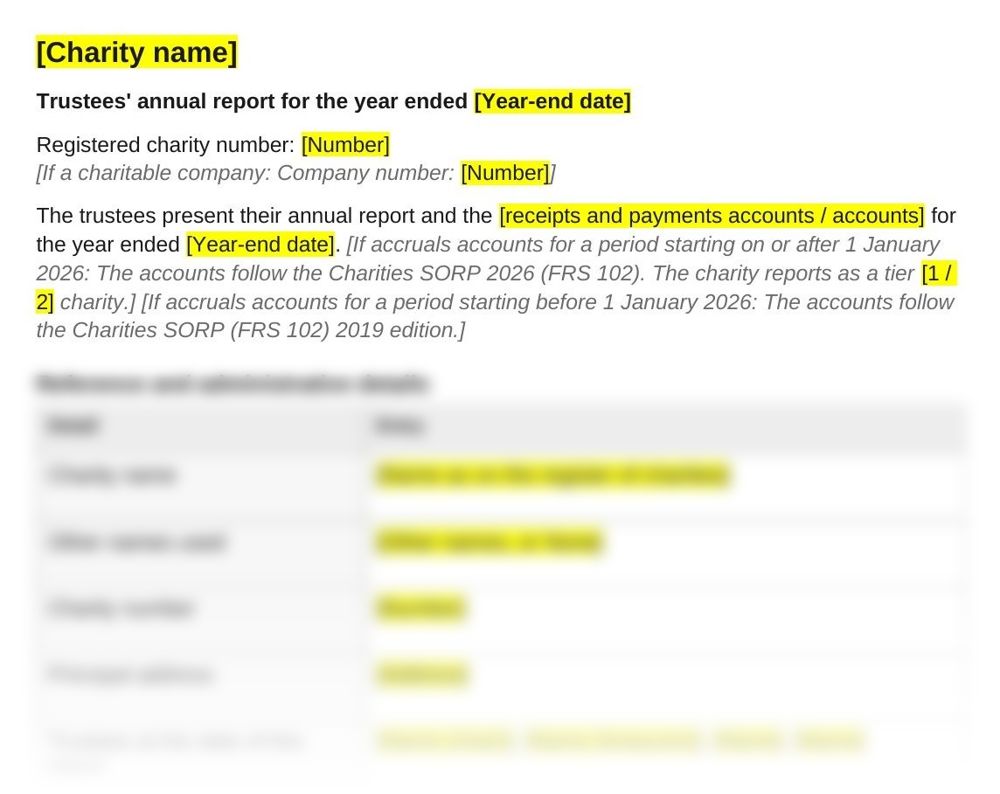
What the report looks like
Who needs one
Every registered charity in England and Wales must prepare a trustees' annual report for each financial year, whatever its income. Smaller charities give less detail. Charities with gross income over £25,000 send it to the Charity Commission with the accounts within 10 months of the year end, and a CIO sends it whatever its income. You need it when:
- You prepare the year-end accounts for a charity client and the trustees need a report to approve with them
- A charity's income passes £25,000, so the report and accounts now go to the Charity Commission
- A CIO is filing its first report
- A new treasurer or chair has to write the report for the first time
- Someone asks the charity for a copy of its latest report, which a registered charity must provide on request
How to use the trustees' annual report template
- Set the basis of the accounts. Pick receipts and payments or accruals in the opening paragraph and, for accruals accounts, the SORP edition and tier.
- Fill in the reference details. Use the name as it appears on the register of charities, list everyone who was a trustee during the year and add the examiner's details.
- Write the activities and achievements with the trustees. Use numbers, such as people helped or sessions run, and say what difference the work made.
- Take the figures from the accounts. Income, spending and year-end funds go in the financial review, with free reserves compared with the reserves policy.
- Delete what doesn't apply. Remove the tier 2 sections for a smaller charity, and any optional lines in grey italics that don't fit.
- Approve and sign before the examiner signs. The trustees approve the report and accounts and a trustee signs and dates the report. The independent examiner signs only after that.
Questions
What is a trustees' annual report?
The report the trustees prepare each financial year alongside the charity's accounts. It tells donors and others what the charity is set up to do, what it did in the year and how it raised and spent its money, and gives reference details such as its name, number, trustees and governing document.
What should be in a trustees' annual report?
For a charity that is not audited: a brief summary of its main activities for the public benefit and its main achievements, a statement on whether the trustees had regard to the Charity Commission's public benefit guidance, its reserves policy or a statement that it has none, the steps taken on any fund in deficit, and the reference and administrative details. These include its name and number, principal address, trustees, governing document, how trustees are appointed and a summary of its purposes.
Does every charity need a trustees' annual report?
Every registered charity does, whatever its income. Exempt and excepted charities are not required to prepare one. A charity with gross income of £25,000 or less sends its report to the Charity Commission only if the Commission asks for it, except a CIO, which always sends it.
Who signs the trustees' annual report?
One or more trustees authorised by the board sign and date it, usually the chair. The independent examiner must not sign their report until the trustees have approved and signed the annual report and the accounts.
When is the trustees' annual report due?
Within 10 months of the end of the financial year, for charities with gross income over £25,000 and for every CIO. It goes to the Charity Commission with the accounts and the examiner's or auditor's report.
Also in the charity accounts pack
Who it's for
Accountancy practices and independent examiners who prepare year-end papers for small charities, and charity treasurers and secretaries.
Last checked
Checked against the Charities Act 2011, the Charities (Accounts and Reports) Regulations 2008 and Charity Commission guidance in November 2026.