Independent examiners report template for charities
Report to the trustees on your examination of a charity's accounts in the wording the Charity Commission's directions expect, with your statement, any concerns and your signature block. This independent examiners report template is one Word document with three versions of the report.
UK practicesGet this pack and 100 more for $129
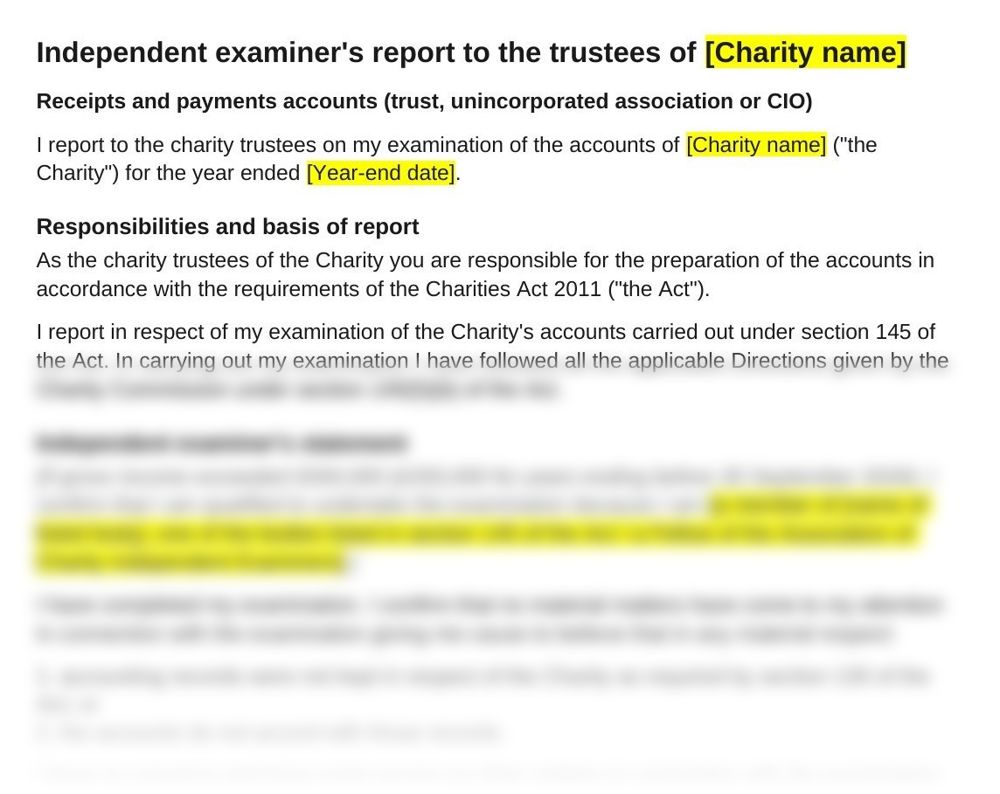
What the report looks like
When you need it
An independent examination is a limited check on a charity's accounts. The examiner confirms whether any material matters of concern have come to their attention, while an auditor gives an opinion on whether the accounts give a true and fair view. For financial years ending on or after 30 September 2026, a charity needs an examination or an audit once its gross income is over £40,000 (£25,000 for earlier years). Use the report when:
- You examine a trust, association or CIO that prepares receipts and payments accounts
- A charity that is not audited prepares accruals accounts
- A charitable company that doesn't need an audit chooses an examination instead
- A charity's income has passed £500,000 and the examiner must now be a member of a listed body or an ACIE Fellow
- The governing document asks for an examination even though income is below the threshold
How to use the independent examiners report template
- Pick the version. Receipts and payments, accruals for a trust, association or CIO, or charitable company. Delete the other two.
- Check you can act. You must be independent of the trustees, not a material donor and not the charity's bookkeeper, apart from the limited cases the Commission's guidance allows.
- Fill in the charity, the year end and your details. Keep the qualification paragraph only if the charity's income means it needs a qualified examiner.
- Keep or replace the statement. With no concerns, keep the standard paragraph. If you found a matter, say what it is, its effect and what the trustees have done.
- Sign after the trustees. Date and sign only once the trustees have approved and signed the annual report and the accounts.
Questions
What is an independent examiner's report?
The examiner's report to the trustees on the accounts. It gives the examiner's name and address, the charity, the financial year and any professional qualifications, says it is made under section 145 and the Commission's directions, and states whether anything suggests the records were not kept properly or the accounts don't agree with them. It is signed and dated.
Who can be an independent examiner for charity accounts?
An independent person the trustees reasonably believe has the ability and practical experience to carry out a competent examination. For financial years ending on or after 30 September 2026, if gross income is over £500,000 the examiner must also be a member of one of the bodies listed in the Charities Act or a Fellow of the Association of Charity Independent Examiners. The examiner can be a member or supporter of the charity, but not someone with a close personal relationship with a trustee, a material donor or its bookkeeper.
Does my charity need an independent examination?
For financial years ending on or after 30 September 2026: yes, once gross income is over £40,000, unless it has an audit. It needs an audit if income is over £1.5 million, or over £500,000 with assets over £5 million. Below £40,000, the governing document can still require one.
What is the difference between an independent examination and an audit?
An examination is a limited check. The examiner only confirms whether any material matters of concern have come to their attention. An auditor gives an opinion on whether the accounts give a true and fair view, plans work to find material fraud and follows auditing standards.
Who signs the independent examiner's report?
The examiner in person. The appointment is a personal one, so the named examiner carries out the examination and signs the report, even when they work for a firm.
Also in the charity accounts pack
Who it's for
Accountants and independent examiners who examine the accounts of small charities in England and Wales.
Last checked
Checked against the Charities Act 2011 as amended from 30 September 2026, the Charities (Accounts and Reports) Regulations 2008 and Charity Commission guidance CC32 in November 2026.