Variance commentary examples and template
Turn "revenue down" into a comment the board can act on: the amount, the cause, whether it reverses and what it does to the forecast. These variance commentary examples come from a Word guide for budget holders, with the rules and a checklist to run before the pack goes out.
Finance teamsGet this pack and 51 more for $79
Want every pack, for every region? Global library, 110 packs, $99
The variance commentary examples in the guide
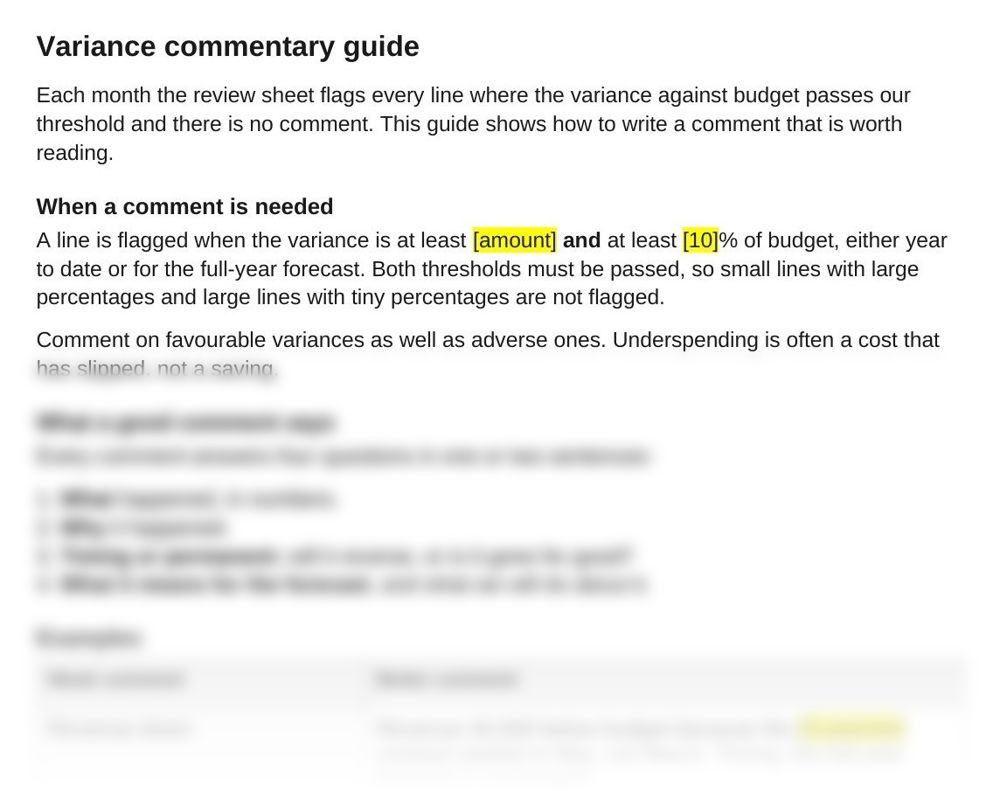
When you need it
Variance commentary is the short written explanation next to each line where actual results differ from budget or forecast. Finance teams ask budget holders for it every month, and boards read it before they read the numbers. Use the guide when:
- Budget holders send comments like "timing" or "higher than expected"
- You are training new budget holders before the first month of a new budget
- The board asks the same questions every month about the same lines
- Comments don't add up to the variances in the summary
How to use the variance commentary examples
- Set the two thresholds. Fill in the amount and the percentage. A line needs a comment only when it passes both, so tiny lines with big percentages are left out.
- Send the guide with the month's figures. Budget holders see the flagged lines in the workbook's review sheet and the examples in the guide.
- Answer the four questions. For example: "Marketing 18,000 under budget: the trade show moved from April to June. Spend comes back in June; no change to the full year."
- Change the forecast for permanent variances. In the same month the comment is written, not at the next reforecast.
- Run the checklist. Every flagged line has a comment, the comments add up, and anything that needs a decision goes to the named person directly.
Questions
What is variance commentary?
A short written explanation of why an actual result differs from budget or forecast. A good comment gives the amount, the cause, whether the difference will reverse, and what it means for the full-year forecast.
How do you write a good variance comment?
Answer four questions in one or two sentences: what happened in numbers, why it happened, whether it is timing or permanent, and what it means for the forecast. For example: "Salaries 25,000 under budget because two engineering roles are still vacant. Hires expected in July; saving for the year is 60,000."
What is the difference between a timing and a permanent variance?
A timing variance moves revenue or spend between months, so the full-year total and the forecast stay the same. A permanent variance changes the total for the year, so the forecast for the rest of the year changes in the same month.
Which variances need a comment?
Lines where the variance passes both a money threshold and a percentage threshold, such as 10% of budget. Comment on favourable variances as well as adverse ones, because an underspend is often a cost that has only slipped.
What is an example of a weak variance comment?
"Overspend on software" or "Timing". Neither gives an amount, a cause or the effect on the forecast. A better version: "Software 12,000 over budget: new sales software approved in February. Permanent: full-year forecast up 30,000."
How long should a variance comment be?
Under 40 words. If two things happened on one line, give the amount for each in the same comment.
Also in the budget and rolling forecast
Who it's for
Financial controllers, FP&A teams and finance directors who collect monthly commentary from budget holders.
Last checked
Checked in November 2026.