AI use policy template for accountants and finance teams
Tell everyone in your firm which AI tools they may use, what they may put into them and how they check what comes out. This AI use policy template is one Word document in eight short sections, with a table for your approved tools.
EU and UK- In the pack
- AI literacy and AI use pack
- Files
- 4, Word and Excel
Get the pack by email
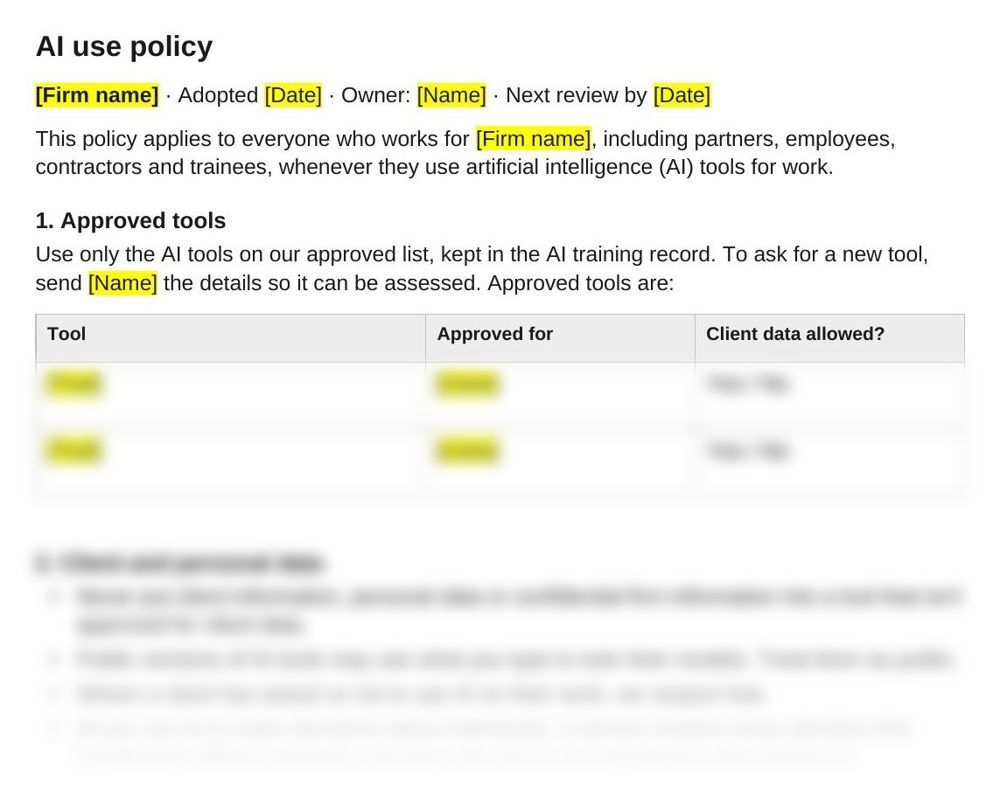
What the policy looks like
Who needs one
Article 4 of the EU AI Act has applied since 2 February 2025 to every organisation that uses AI systems at work, whatever its size. It requires measures to support the AI literacy of staff and others who use AI on the firm's behalf. In the UK, the professional bodies' guidance on AI in tax work describes an AI usage policy as one way to control how staff use these tools.
- Staff already use chat assistants or AI features in your accounting software
- Your firm has clients, offices or staff in the EU
- You give tax advice and want to follow the PCRT guidance on AI
- A client has asked how you use AI on their work
- You are about to approve a new AI tool
How to use the AI use policy template
- List the tools in use. Find out which AI tools people already use, approved or not.
- Fill in the approved tools table. For each tool, say what it may be used for and whether client data is allowed.
- Pick the optional lines. Keep the line on decisions about individuals and the engagement letter reference if they apply.
- Name the owner. Fill in who approves new tools and who staff report problems to.
- Approve it and train staff. A partner or director signs it off. Run the training and record who has done it.
Questions
Do accountants need an AI use policy?
The PCRT guidance on AI, issued by the seven tax professional bodies in January 2026, gives an AI usage policy as an example of how a firm can control the use of AI tools. In the EU, firms using AI must also take measures to support the AI literacy of their staff.
What should an AI use policy include?
Which tools are approved and for what, the rules on client and personal data, how output is checked, when AI use is disclosed, what records are kept, what is never allowed, training and how to report problems.
Does the EU AI Act apply to UK firms?
It applies to firms established in the EU, and to firms outside the EU where the output of the AI system is used in the EU. A UK practice with EU clients or offices should treat the AI literacy duty as applying.
What is the AI literacy requirement in the EU AI Act?
Article 4 requires providers and deployers of AI systems to take measures to support the AI literacy of their staff and others using AI on their behalf. Since the July 2026 amendment it does not require any specific level of literacy for each person.
Can accountants put client data into public AI tools?
The PCRT guidance says putting client data into publicly available AI tools is likely to breach client confidentiality unless the client has agreed. Any data that is used should be anonymised so the client cannot be identified.
Who answers for work produced with AI?
The adviser does. The PCRT guidance says members are accountable for any work they produce, whatever the use of AI, and output should be reviewed as if a less experienced junior colleague had prepared it.
Also in the AI literacy and AI use pack
Who it's for
Accounting practices and finance teams that want clear rules on AI tools without a long policy.
Last checked
Checked against the EU AI Act as amended in July 2026 and the PCRT guidance on AI in November 2026.