AI risk assessment template for each new AI tool
Check the risks of an AI tool before anyone at your firm uses it for work: what goes into it, where the data ends up, how secure it is, what mistakes it makes and whether it falls into a high-risk use. This AI risk assessment template is one Word document in five short sections, ending with a signed decision.
EU and UK- In the pack
- AI literacy and AI use pack
- Files
- 4, Word and Excel
Get the pack by email
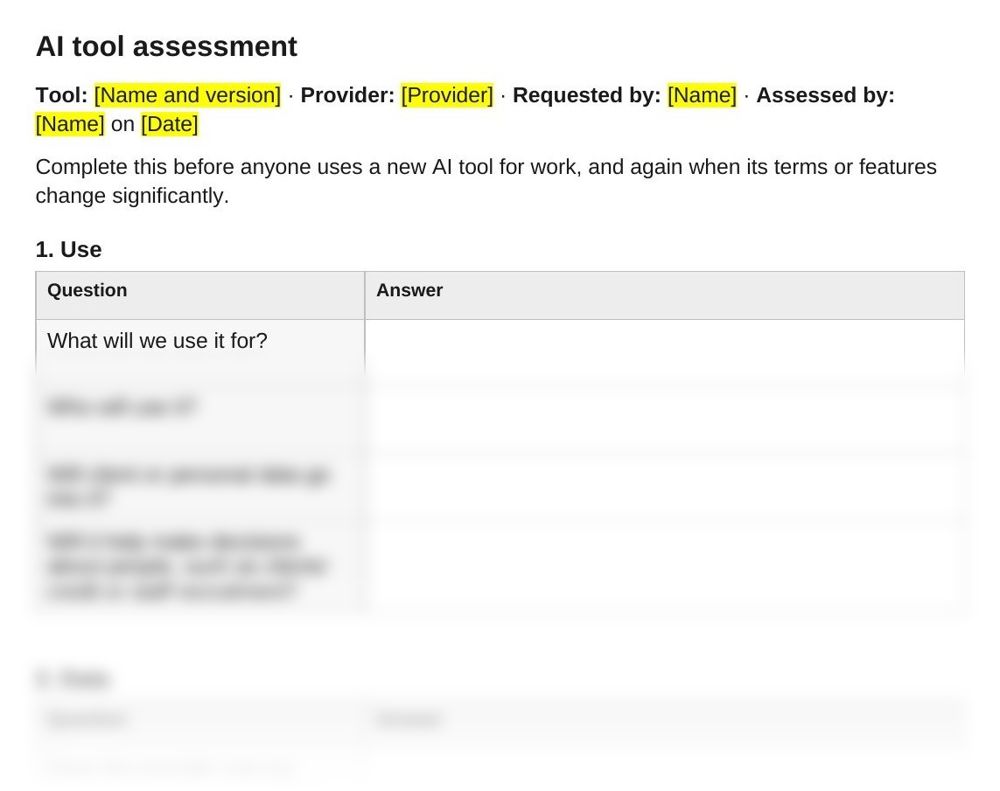
What the assessment looks like
When to use the AI risk assessment template
Complete one assessment for each AI tool before anyone uses it for work, and again when its terms or features change significantly. The questions follow the risks that matter most to an accounting practice or finance team: client confidentiality, personal data, wrong answers and uses the EU AI Act treats as high-risk. Use it when:
- A colleague asks to use a new chat assistant or AI feature
- Your accounting or payroll software switches on AI features
- A provider changes its terms on how it uses your data
- You are deciding whether client data can go into a tool
- A tool will help screen job applicants or assess a client's credit
How to use the AI risk assessment template
- Fill in the header. Name the tool, its version and provider, who asked for it and who is assessing it.
- Answer the use questions. Say what it is for, who will use it and whether client or personal data goes in.
- Check the provider's terms. Read the terms and data processing agreement to answer the data and security questions.
- Test it on real examples. Run it on work you have already checked and record the mistakes it makes.
- Record the decision. Approve it, approve it without client data, or refuse it. Add conditions, a review date and who signed it off, then add approved tools to your approved list.
Questions
What should an AI risk assessment include?
What the tool will be used for and by whom, what data goes in, whether the provider trains on your inputs, where data is stored and for how long, security controls, how the tool performed in testing, whether the use is high-risk, and a decision with conditions and a review date.
Which AI uses are high-risk under the EU AI Act?
Annex III lists uses such as AI for recruiting or selecting staff, for decisions on promotion or termination, for monitoring staff performance, and for assessing the creditworthiness of individuals or setting their credit score. AI used only to detect financial fraud is excluded from the credit scoring entry.
When do the EU AI Act high-risk rules apply?
Since the July 2026 amendment, the rules for high-risk uses listed in Annex III apply from 2 December 2027. The AI literacy duty in Article 4 has applied since 2 February 2025.
Do you need to assess every AI tool?
Complete one for each tool before anyone uses it for work, and again when its terms or features change significantly. Approved tools then go on the approved list in your AI use policy and in the AI training record.
What is the difference between this and an AI use policy?
The policy sets the rules for everyone: which tools are approved and what may go into them. The risk assessment is how a single tool gets onto the approved list.
Also in the AI literacy and AI use pack
Who it's for
Accounting practices and finance teams deciding which AI tools their staff may use.
Last checked
Checked against the EU AI Act as amended in July 2026 in November 2026.